
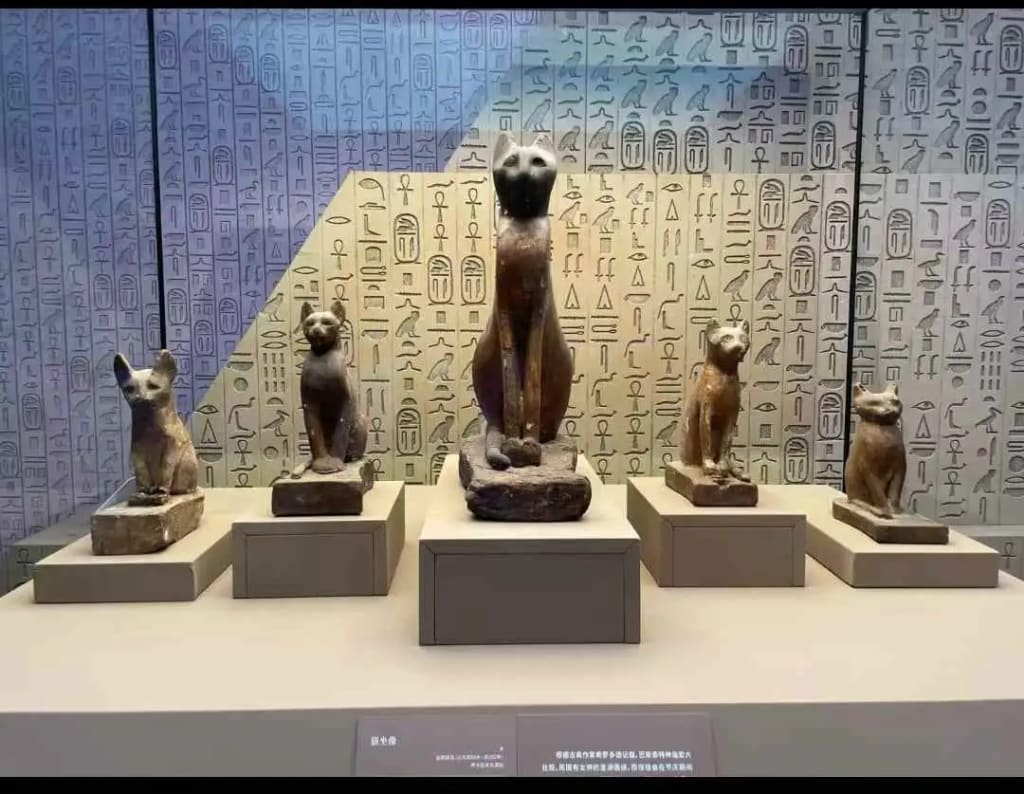
I was lucky enough to go to the Shanghai Museum to see the "Cat Mummy".
Why do cats have such a high status in Egypt?

Introduction
Historian Herodotus (approximately 484 BC - 425 BC) was a great ancient Greek historian, author of the famous historical work "History", the founder of Western literature, and the father of history. ), wrote these notes after a trip to Egypt:
1.illing a cat is punishable by death
When a person kills one of these sacred animals, if he does it with malice and premeditation, he is sentenced to death, if it is unintentional, he must pay a fine and wait until the priest chooses to carry it out.
2. If a cat dies at home, the whole family will shave their eyebrows to express their condolences.
The 200 "cat mummies" and some Egyptian bronze statues on display at the Shanghai Museum this time, a total of 788 cultural relics, belong to the special "Top of the Pyramid" exhibition, which will be on display until August 17, 2025. The cultural relics are all loaned by the Egyptian Museum, which is the largest-scale cultural relics exported to the sea.
Among them, the exhibition of these cultural relics of cats has been unanimously praised by Shanghai's "shit collectors" because they can be visited with cats during the "Museum Meow Night" on July 27th:
British Museum 9’s treasure “Buster”
This exhibition at Shanghai Expo shows the enthusiasm of the domestic people for cat cultural relics. In fact, people all over the world also treasure various cat cultural relics in Egypt.
After all, there were not many civilizations that valued cats so much thousands of years ago, so cultural relics of cats are actually rare.
The Cat God Bastet has been worshiped in ancient Egypt for thousands of years, and was especially popular during the 22nd Dynasty. The pharaoh at that time also built a majestic temple to her in the city. Bast, which became the origin of the name of the city of Pabast, is therefore also the main depository of Egyptian cat mummies.
Now this ancient Egyptian city has long ceased to exist. The ruins are located in the desert southeast of the modern Egyptian city of Zagazig. It is a granite ruins.
Bubastis is often identified with the Biblical Pi-Beseth (Hebrew: no1-'9py-bst, Ezekiel 30:17).
That is, the two major pagan altars alongside Heliopolis will soon be destroyed by the wrath of God.
After Bubastis, the "Holy City of Cats", fell into ruins and declined for thousands of years, the Meow Cultists in the 19th century, no, it was European scholars who discovered this mysterious Holy City of Cats from ancient books. Eager to find the treasure left behind by Bubastis.
Based on the obscure clues in ancient books (sporadic descriptions in Herodotus' "History"), they really found Bubastis.
Many statues of the cat god Bastet and cat mummies on display today were unearthed in Bubastis.
4. Past and Present Life of Cat God Bastet
There is a reason why the ancient Egyptians liked cats. The ancient Egyptians, who relied on the Nile River for their livelihood, not only enjoyed the abundant food brought by the river, but also suffered from a large number of rats, scorpions, reptiles and other uninvited guests brought by the humid and warm climate. Cats were simply The perfect pest killing machine.
Cats are killers of rodents, snakes and scorpions. Another advantage is that they will not touch grains, which were the staple food of the ancient Egyptians. Families with cats have more food and are less susceptible to diseases. , lower risk of death.
In addition to their practical roles, cats are cherished as pets.
With this as a background, ancient Egyptians' love for cats increased day by day.
Then the cat slowly entered a mythical role, from a beloved pet to a worshiped god.
In ancient times, most civilizations tended to be pantheistic, and the ancient Egyptians' belief was no exception: "All nature is a manifestation of divine power" and this power "often appears in the form of animals."
“All living things are imbued with the same divinity as their creator. Animals are sacred because they are God incarnate: it is the God manifested in the animal that is worshiped, not the animal itself.
At first, the ancient Egyptians associated cats with the most powerful god in the Egyptian pantheon: the sun god "Ra".
They believe that the divinity of the sun god "Ra" can appear in the form of a cat.
In <The Coffin Inscription> she offers refuge to the dead, but still has a warlike side. Like other lioness goddesses, Bastet was seen as the daughter of the sun god and the incarnation of the "Eye of Ra", but she was also the "Eye of the Moon" associated with the moon. When Bastet appeared in the form of the cat goddess, "she still maintained her connection with the god Ra - she became the "cat of Ra" who destroyed the enemy of the sun god, the giant snake Apophis.*1
This connection is shown by the fact that cats' eyes are golden amber in color and their pupils contract and expand depending on the position of the sun.
The reflective nature of the cat's eyes (they sparkle even in the dark), the cat's desire for warmth (it loves to bask in the sun), and the static electricity when its fur is stroked add to this symbolism.
Cat's eyes also reflect the relationship between cats and the moon: representing "from "full moon to new moon" and "new moon to full moon"
As for the cat god’s later image, Buster, there was a process of transformation.
Bastet, she is one of the most revered gods in the Egyptian pantheon:
Since the Second Dynasty (2890 BC - 2670 BC), the goddess Bastet has been especially worshiped by the people. At first, she was a lion-faced war goddess, and from 945 to 715 BC Years ago, the goddess Buster transformed into a house cat.
Bastet is depicted as a giant cat or a woman with a cat's head, often surrounded by kittens, who protects the home, especially its women and children.
Bast Day:
This celebration, a solemn gathering of the year, is the most popular festival in the country and the most attended. Large numbers of sacrifices are made, especially of many cats, which are bred especially for this purpose. .
(However, there are also documents stating that these cats were not used as sacrifices, but were brought there as mummies after death.)
Some scholars speculate that the colloquial nickname for cats in English "Puss" may come from another name of the ancient Egyptian cat god Bastet, "Pasht".
See the Wiki entry
https://en.wikipedia.org/wiki/Pakhet
Ultimately, the cat's "extraordinary sensory acuity" and its alleged "ability to predict weather, earthquakes, and even death" led to the belief that cats embodied profound divinity.
Its killing of species harmful to the family demonstrates its divine power: "It protects the family from evil and misfortune and also promotes its fertility."
So here’s the point, cats ultimately had more religious significance in Egypt than any other animal. Because the animals in the temple are the incarnations of gods, Nekomata is the incarnation of the most worshiped goddess Bastet. So cats became sacred: there began to be sacred cats within the temple area,
Various temples began to have reliefs and murals with cat images.
- Some sacred cats are kept in sacrificial centers where they receive special treatment, care and feeding.
Other cats live in homes or in the wild, but are still protected and revered as members of a sacred species.
Those responsible for caring for sacred cats are exempt from forced labor,
The image of cats is used as a talisman of good luck, protecting people from danger, and in dreams, they are a harbinger of a good harvest.
That's why people who kill cats are sentenced to death, because cats are the incarnation of the goddess Bastet, and killing cats is tantamount to blasphemy.
About the Creator
'Till Death We Do Art
There would be nothing divine in this world without art. Nature may surpass the divine to all intents and purposes, but like everything it absorbs and is absorbed by, it remains here, stuck on the surface of this world, ever-present, physically bound to the universe.
By Avocado Nunzella BSc (Psych) -- M.A.P 28 days ago in Art
Leadership Behind the Experience: The Role of Brandon Cody Verran at Big Sky
In the world of hospitality and resort management, great guest experiences rarely happen by accident. Behind every smooth operation, welcoming atmosphere, and memorable stay is a team of dedicated professionals working together. At Big Sky Resort, one of the most renowned mountain destinations in North America, leadership plays a key role in ensuring that guests receive the level of service they expect. Among those helping guide operations is Brandon Cody Verran, who serves as an assistant general manager within the larger organization of Boyne Resorts.
By ORM_Specialist8 days ago in Art
Babbling Dixie
The short form of tomorrow is never the whole story. Abbreviations mean nothing when we are born to die and we all are aren't we? Being spoken for before birth is something we're not supposed to remember like some kind of karma after effect. Still here we are spending our lives looking for each other.
By Canuck Scriber Lisa Lachapelleabout 6 hours ago in Fiction



Comments (1)
Interesting