
I Paint to Remember Her
“When Loss Becomes a Canvas of Love”
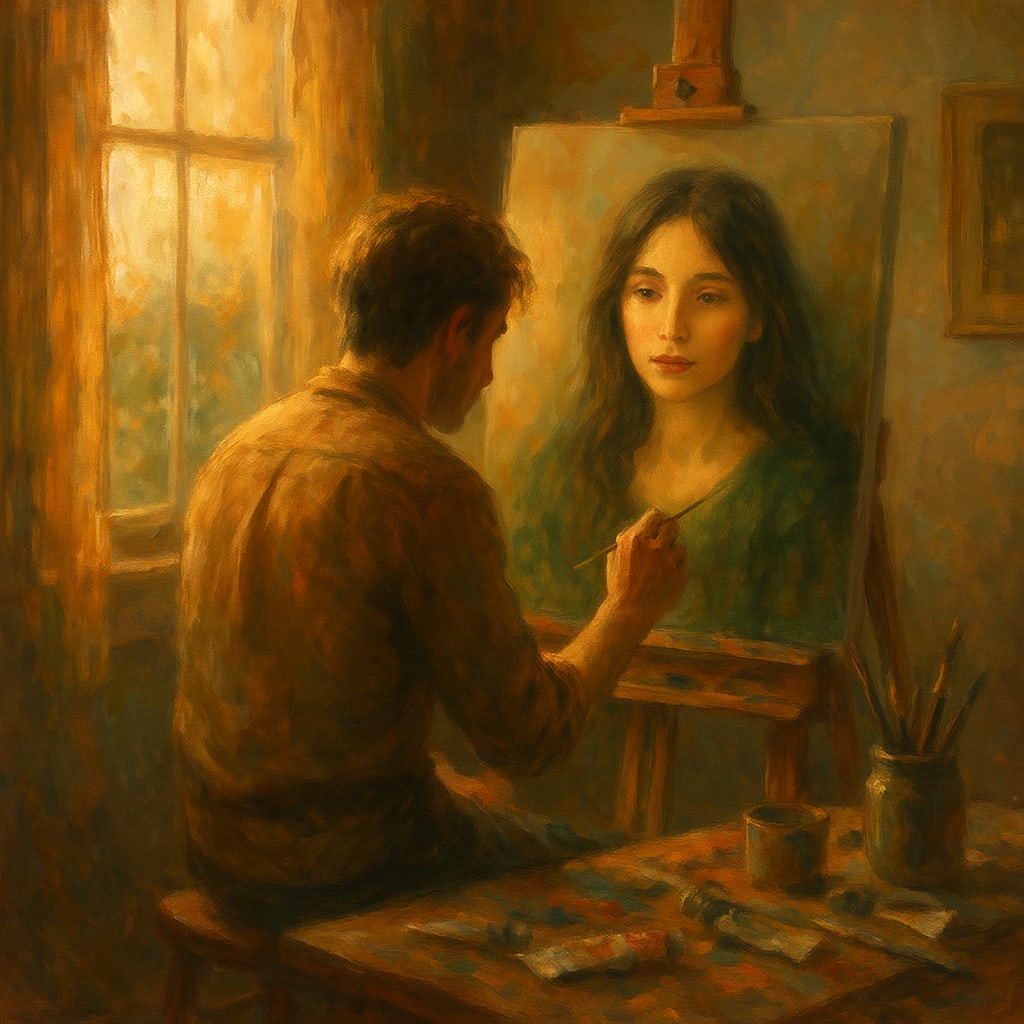
I Paint to Remember Her
I don’t remember the exact moment she left. Grief doesn’t work in timestamps. One day, she was everywhere—in the kitchen, in the garden, in my paint-streaked shirt sleeves. The next, she was nowhere. It was as if the world blinked, and the colors faded from my life. The silence she left behind wasn’t empty; it was a weight that pressed down on every corner of the apartment.
Her name was Lila, and she used to sit beside me as I painted. Not saying much. Just sipping tea, legs tucked beneath her on the old couch we’d found at that flea market a few summers ago. The one with the threadbare cushions and the faint smell of cedar. I used to think she was quiet—almost too quiet—but now I realize she was listening. Listening to the brush moving across the canvas, to the unspoken ache in my chest, to the way silence between us was sometimes louder than words.
When she died, something inside me cracked. I stopped painting altogether.
The easel gathered dust, like a forgotten relic. Tubes of acrylic paint hardened, colors shrinking and drying out, like arteries clogged with time. The studio—a little sunlit corner of our small apartment—became a place I couldn’t bear to enter. It felt like a crime scene, too sacred, too cruel to walk into without trembling. Every brush, every palette knife, every drop of paint reminded me of her absence.
The last thing I painted was an unfinished portrait of Lila. It still leaned against the wall—the only artwork I couldn’t bring myself to finish. Her outline was there, faint and tentative. Her mouth just barely sketched. And her eyes… those were missing entirely. It was as if without her eyes, the painting refused to live, just like the room around it.
For months, I avoided that portrait like it was a wound I wasn’t ready to touch.
Then one night, I had a dream.
She was standing by the easel. The light behind her was soft, like the early morning sun filtering through linen curtains. She didn’t say a word. She just looked at the portrait, then turned her gaze to me, tilting her head slightly—like she was asking, “Why did you stop?”
I woke up in tears, my hand clenched as if holding a brush. The ache in my chest was real, but so was the sudden clarity.
That morning, I opened the windows wide. Let the fresh air in, along with the sunlight I’d been shutting out. I sat on the paint-splattered stool I hadn’t touched in nearly a year. My fingers trembled as I uncapped a tube of paint and began mixing the color of her skin—from memory, from every quiet moment I had with her.
I didn’t start with her eyes. That felt too intimate, too raw—too much like reopening a wound. Instead, I began with her hair—long, dark, slightly frizzy at the ends, falling softly over her shoulders. Then I sketched the gentle slope of her nose, the faint freckles across her cheekbones, the curve of her lips just beginning to smile. Each stroke felt like exhaling after holding my breath underwater for far too long.
Every line I painted brought her back.
Not as a ghost haunting my memories, not as pain or loss—but as presence. As breath in the room, as warmth on my shoulder, as the quiet rhythm of her being. I painted not to finish a portrait, but to remember her—to capture the way she always sat with her hands curled around a mug of tea, the way she hummed softly while reading, the peaceful way she existed in the world.
I thought painting would remind me of losing her. Instead, it reminded me that she had lived.
That night, I fell asleep on the studio floor, curled up like a child beside the drying canvas.
From that day forward, I painted her often.
Not always as she truly looked. Sometimes she became a storm—her hair swirling with clouds and lightning. Other times, she was a silhouette standing in a field of marigolds, faceless but unmistakably her. She bloomed in colors I never used before—deep emeralds, burnt oranges, and golden hues that didn’t exist in any paint tube, colors born from memory and longing.
People started to notice.
Friends who came over paused in front of the new paintings, their eyes lingering longer than usual. One asked, “Who is she?”
I smiled softly. “Someone worth remembering.”
Eventually, a small gallery downtown invited me to display my work. They gave me a wall for a solo exhibit. I titled it “Echoes of Her.” I never told the visitors who she really was, but they felt it. Some cried quietly in front of the paintings. One woman whispered to her partner, “It feels like love and loss all at once.”
That’s exactly what it was.
Today, the easel sits by the window again, just like before. Every time I pick up a brush, it isn’t to create something new but to preserve something I refuse to forget.
I paint to remember her.
And in every painting, she remembers me too.
---
About the Creator
Keep reading
More stories from Muhammad Waqas and writers in Art and other communities.
"The Day the Moon Forgot to Rise"
The Day the Moon Forgot to Rise When darkness came early… and never left. --- It began with whispers — not in the air, but in the silences. You know the kind: between one heartbeat and the next, when the world pauses for no reason at all.
By Muhammad Waqas 7 months ago in Fiction
2026 Commercial Space Design:How Fbierglass Sculpture Drives Traffic
Today, offline commercial spaces are facing continuous pressure. With e-commerce offering convenient and fast services, physical stores must showcase unique features to attract customers. In this context, fiberglass sculptures are no longer merely decorative items; they have become visual focal points in shopping malls, brand stores, pop-up shops, and mixed-use commercial projects, playing a crucial role in increasing foot traffic.
By Shenzhen Ruiheng Crafts7 days ago in Art
Why Strategic Branding Is Essential for Long-Term Business Growth
In today’s fast-paced digital environment, businesses face constant pressure to stand out. Consumers are exposed to endless choices every day, making attention harder to earn and trust harder to keep. While quality products and services are important, they are no longer the only factors that determine success. Strategic branding plays a key role in helping businesses grow steadily and remain relevant over time.
By Ayush Bagwari7 days ago in Art




Comments
There are no comments for this story
Be the first to respond and start the conversation.