
Hiding on Canvas
Paintings in which artists have depicted themselves
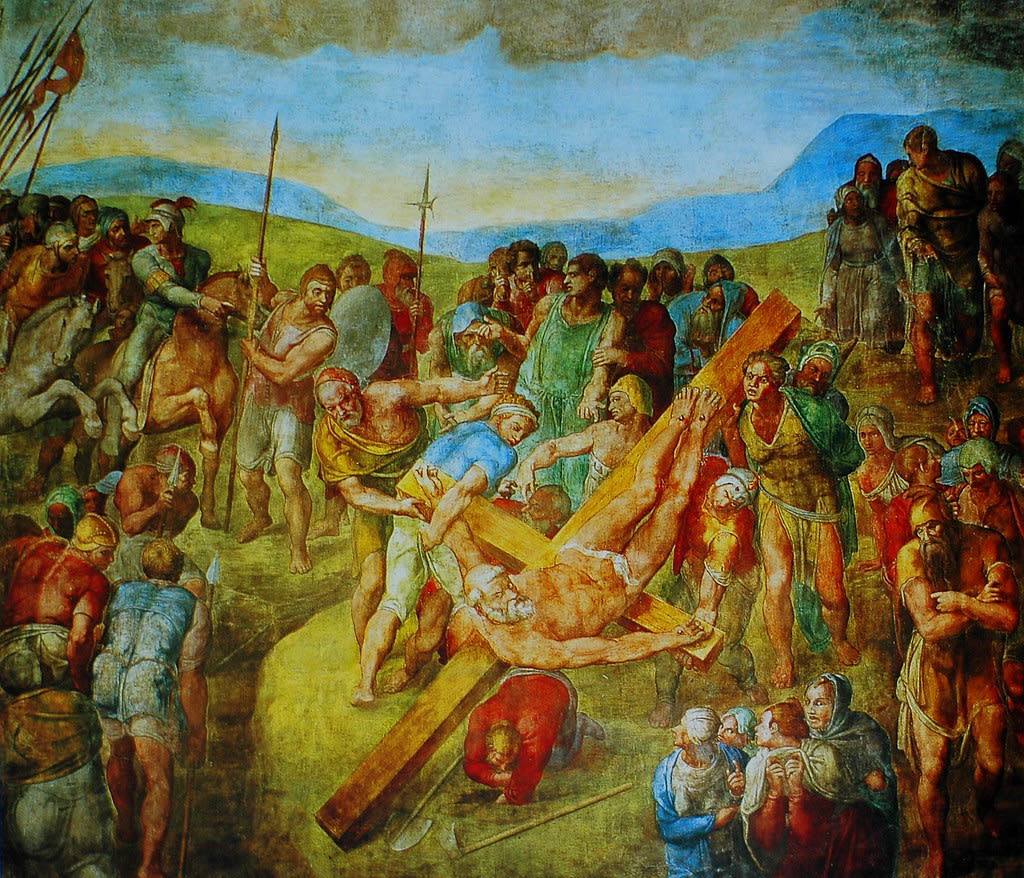
Crucifixion of St. Peter Michelangelo
Italian artist Michelangelo depicted himself in his final painting. The self-portrait was discovered when the painting was being restored in the Pauline Chapel in the Vatican. The artist has depicted himself as a figure in a blue turban riding a horse in the top left of the artwork. It was confirmed when his image was compared to portraits of the artist done by other painters.
The Last Judgment Michelangelo

Italian artist Michelangelo created the artwork The Last Judgment from 1536 to 1541 on the wall over the altar in the Sistine Chapel. The painter depicts his image in the face of the skin held by St, Bartholomew, just below and to the right of Jesus. In Christianity, the last judgment refers to the second coming of Christ and the final judgment of God over everyone in the world.
Michelangelo also wrote poetry and in 1835 he wrote a poem titled “The Silkworm”
“Oh, would that I might die, for her to find
Raiment in my outworn mortality!
That, changing like the snake, I might be free
To cast the slough wherein I dwell confined!”
He might have seen himself transformed into something better after death,
The School of Athens Raphael

Italian artist Raphael created the fresco The School of Athens from 1509 to 1511. It is on display in one of the “Raphael Rooms” at the Vatican. The painting depicts the most famous classical philosophers and thinkers among them Plato, Aristotle, Pythagoras, Euclid, Zoroaster, Ptolemy, and Diogenes. Raphael has depicted himself wearing a dark beret on the far right under the arch looking out toward the viewer of the artwork.
Adoration of the Magi Sandro Botticelli

Italian artist Sandro Botticelli created the Adoration of the Magi in 1475. The painting shows the wise men visiting the baby Jesus and his parents. During the Renaissance in Italy, the members of important Florence families were often portrayed as the Magi. The trio in the artwork is in the guise of the Medicis family – Cosimo, kneeling at Jesus’ feet, Piero, kneeling in a red robe, and Giovanni, kneeling in a white robe. The artist depicted himself standing at the far right in a brown robe, one of the only two in the painting that looks straight at the viewer.
David with the Head of Goliath Caravaggio

Italian artist Caravaggio painted this artwork between 1605 to 1610. There is some disagreement with the depiction of the painter himself. He could be Goliath or both figures with David representing his younger self and Goliath his older. Another suggestion is that David was the depiction of Caravaggio’s young assistant.
Still Life with Flowers, Gilt Goblets, Coins, and Shells Clare Peeters

Flemish still-life artist Clare Peeters has created six self-portraits in one painting.

Peeters can be seen holding her brushes and palette and can be seen in the decorative circles on the goblet in the back, and to the right.
The Arnolfini Portrait Jan Van Eyck

Flemish artist Jan Van Eyck created this painting in 1434. It includes the identities of the couple and their marital status. The woman is either pregnant or bunching up her dress and the identities of the two figures are reflected in the mirror in the middle of the painting.

One of the two people in the mirror might be Van Eyck since the writing in Latin showing above the mirror on the wall translates into English as “Jan Van Eyck was here”.
Las Meninas Diego Velazquez

Spanish artist Diego Velazquez created this artwork in 1656 and it translates to “ladies in waiting”. It depicts Infanta Margaret Theresa, the only daughter of King Philip IV of Spain, and his wife, Mariana, surrounded by her attendants. The painter served as the court painter of the King and depicted himself at the left painting on an easel.
About the Creator
Rasma Raisters
My passions are writing and creating poetry. I write for several sites online and have four themed blogs on Wordpress. Please follow me on Twitter.
Keep reading
More stories from Rasma Raisters and writers in Art and other communities.
Battles on Canvas
The Death of Major Pierson 1783 John Singleton Copley English artist John Singleton Copley depicted the incident that occurred in January 1781 when American-allied French soldiers invaded Jersey. They were driven out by British forces led by Major Francis Pierson. Even though the British forces were successful in their defense of Jersey the battle resulted in the death of Major Pierson. In the painting women and children are seen fleeing to safety outside of the city.
By Rasma Raistersabout a year ago in Art
Arnold Clark Photography… The Pinnacle in High School Senior Portraits
Arnold Clark Photography sits on 24th Street in Omaha Nebraska, its front windows glowing softly long after most shops have gone dark. From the outside, it looks timeless with clean lines and framed portraits that hint at decades of stories. Inside, it is anything but stuck in the past.
By ArnoldClark Photographya day ago in Art
Why John LoPinto Values Intentional Travel Over Speed and Volume
In a world that celebrates movement and accumulation, travel has increasingly become about speed and volume. More destinations, tighter itineraries, and constant motion are often seen as markers of experience. John LoPinto takes a different approach. He values intentional travel over rapid consumption, believing that depth of experience matters far more than distance covered. For him, travel is most meaningful when it creates understanding, not just memories.
By John LoPintoabout 18 hours ago in Art




Comments
There are no comments for this story
Be the first to respond and start the conversation.