
Flawed and Beautiful: Lessons from Kintsugi
How the Art of Mending with Gold Helped Me Embrace My Scars and See Strength in Brokenness
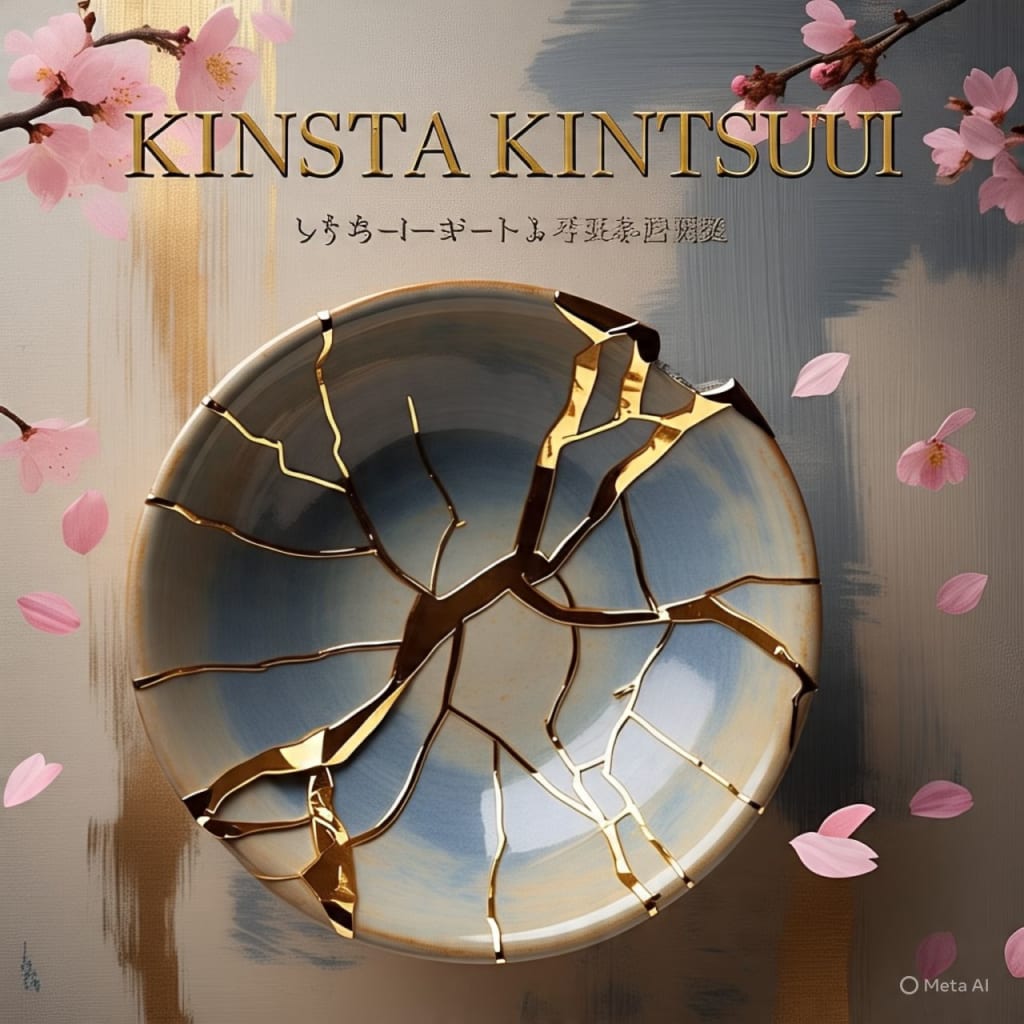
Flawed and Beautiful: Lessons from Kintsugi
I never imagined that a broken bowl could change how I saw myself.
It started on a rainy afternoon in Kyoto. I was visiting Japan on a much-needed break — the kind of trip you take when life has worn you down to the edges. I had spent the last few years trying to hold everything together: my career, my relationships, my sense of self. But no matter how much I tried, something always slipped through the cracks. I came to Japan hoping for peace, but also running from a version of myself I didn’t know how to fix.
Wandering through a narrow alley of artisan shops, I stumbled into a quiet studio filled with shelves of ceramic pieces. Some were flawless, gleaming with polished perfection. But the ones that caught my eye were different — cracked, shattered once, but now delicately repaired with glowing veins of gold. These weren’t accidents covered up. They were transformed. They were… celebrated.
A small sign explained the art of Kintsugi — a Japanese technique of mending broken pottery with lacquer mixed with powdered gold. Rather than hiding the damage, it illuminated it. It was as if the cracks told a story of survival, of healing, of resilience.
The shop owner must have noticed my fascination. An older woman with gentle eyes and silver hair, she approached me quietly.
"Broken things are not always meant to be discarded," she said. "Sometimes, they are meant to become something more."
I nodded politely, unsure how to respond. But something in her words stuck with me.
That night, back in my small guesthouse room, I stared at my reflection in the mirror. I traced the lines under my eyes, the weight of stress on my face. My life, too, had cracked. A failed relationship. A lost job. A version of myself I could no longer recognize. I had tried to glue it all back together in secret, pretending nothing had ever happened. But maybe that was the mistake.
A few days later, I returned to the studio. The owner welcomed me and offered to teach me the basics of Kintsugi. I agreed, unsure of what I was hoping to find in the process.
The bowl I chose was not especially beautiful — plain and gray, with a jagged break down the center. She handed it to me with a smile.
“Now we make it whole again.”
The process was slow and deliberate. First, we cleaned the edges. Then we applied the adhesive, mixing it with gold powder, and carefully rejoined the fragments. I held my breath as I aligned the pieces, afraid of ruining it further. But with each step, I felt a strange calm begin to settle.
When the bowl was finally whole, golden seams traced its once-broken form. It looked nothing like the perfect bowls I’d admired before — but it had a beauty all its own. A beauty that came from its history, from its healing.
That night, I cried. Not out of sadness, but release. For the first time in years, I allowed myself to see my own cracks — and not hate them.
I began to reflect on everything I had tried to hide. The heartbreak that left me feeling unlovable. The career setback that made me question my worth. The depression that shadowed my days, which I pretended wasn’t there. These were the broken pieces I carried inside — pieces I tried to conceal because I thought they made me weak.
But what if, like the bowl, these scars were not signs of failure, but proof of resilience?
Kintsugi didn’t erase the damage. It honored it.
I returned home from Japan changed — not in the dramatic, cinematic way people expect from travel — but gently, deeply. I began to speak more openly about my struggles. I sought therapy, not as a sign of defeat, but as an act of rebuilding. I reconnected with friends I had pushed away during my lowest points. And I started creating again — journaling, painting, even learning ceramics myself.
One day, I took out the Kintsugi bowl from my suitcase. I placed it on my shelf, not just as decoration, but as a reminder: wholeness does not mean perfection. It means embracing your story — every broken, mended, and golden part of it.
Over time, I began to feel less ashamed of my past. Instead of hiding my vulnerabilities, I shared them. To my surprise, people didn’t turn away. They leaned in. They saw themselves in my cracks. We are all, in some way, trying to heal.
Years later, a friend going through her own difficult time came to visit. As we talked over tea, her eyes fell on the golden-veined bowl.
“It’s beautiful,” she said.
“It wasn’t always,” I replied. “But it became something better.”
She looked at me, eyes softening. “Like you.”
I smiled, not out of pride, but peace.
Because I finally understood: I didn’t need to be flawless to be whole. I only needed to be real — broken, mended, and beautiful.
About the Creator
Keep reading
More stories from Muhammad Ansar and writers in Art and other communities.
Everyday Grace
Everyday Grace Finding joy and meaning in life's simplest moments The alarm buzzed softly at 6:30 a.m., and Amina reached out from under her quilt to silence it. She didn’t mind early mornings — not anymore. There was something sacred in the silence before the world fully woke. It was in these quiet moments that Amina had learned to see life more clearly.
By Muhammad Ansar10 months ago in Art
'Till Death We Do Art
There would be nothing divine in this world without art. Nature may surpass the divine to all intents and purposes, but like everything it absorbs and is absorbed by, it remains here, stuck on the surface of this world, ever-present, physically bound to the universe.
By Avocado Nunzella BSc (Psych) -- M.A.P 12 days ago in Art



Comments (1)
Nice