
Fingerboarding vs Skateboarding: A World of Similarities and Differences
Exploring the origins, tricks, culture, and creativity that connect two unique board sports

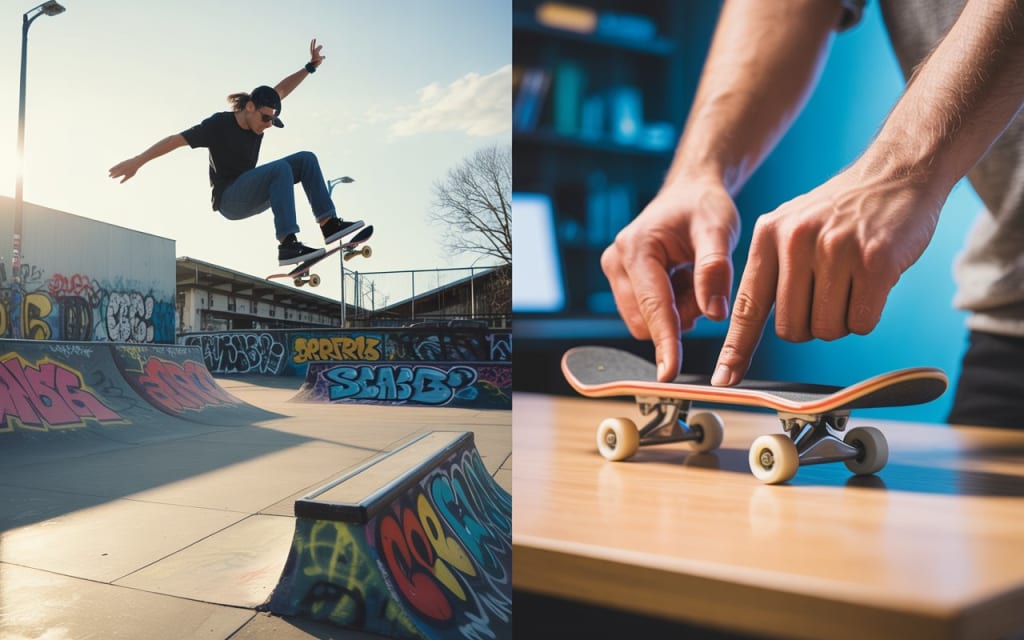
When most folks hear the term skateboarding, they envision massive ramps, rail grinding, and street ollies. However, when they hear fingerboarding, they generally stop, cock their head, and say, "Wait… what's that?"
Fundamentally, fingerboarding is skateboarding's little cousin—a smaller version of the sport you manipulate with your fingers rather than your feet. It began as a niche hobby, but fingerboarding has evolved into a worldwide community with competitions, bespoke equipment, and a culture of their own. But how close do these two worlds share similarities, and how far apart are they? Let's explore the intriguing overlap between skateboarding and fingerboarding.
1. Both Sports' Origins
Skateboarding became popular in the 1950s and 60s when surfers were seeking some way to "surf on land." It wasn't just a hobby—it became an art form, a culture, and then eventually a competitive sport with international recognition. Now, it's even an Olympic sport.
Fingerboarding, in contrast, has a far more frivolous background. Skateboarders would occasionally cut miniature boards from cardboard or wood to carry as keychains in the late 1970s. The fad caught on gradually until the 1990s when Tech Deck made plastic fingerboards available with authentic graphics of pro skater brands. A toy became a skill sport and developed its own underground culture.
So whereas skateboarding was born from a combination of surfing culture and athletic ingenuity, fingerboarding was born out of fun and shrinking down—but both are equal in terms of the spirit of expression and innovation.
2. Tricks and Skills
This is where the convergence becomes interesting. If you see a skateboarder catch a kickflip and then observe a fingerboarder doing the same trick on a table top, you'll find that the movements are deceptively similar.
Skateboarding tricks rely on footwork, balance, and body coordination.
Fingerboarding tricks rely on finger precision, timing, and hand-eye coordination.
Both worlds share the same trick vocabulary: ollies, kickflips, heelflips, grinds, slides, manuals, and even vert tricks. The main difference is scale—you’re flipping a 32mm deck with your fingers instead of a 32-inch deck with your feet.
Curiously enough, most skateboarders employ fingerboarding as a means of brainstorming new tricks or rehearsing motions when they're not on the board. It is similar to sketching out ideas before creating a masterpiece.
3. Culture and Community
Skateboarding culture is massive—music, streetwear, art, and film are all connected to it. The culture survives on individuality and experimentation. From street locations to skateparks, skateboarders come together to test one another, edit scenarios, and produce something original.
Fingerboarding captures this attitude but in a niche environment. There are fingerboard parks (small ramps, rails, and ledges), competitions, and even global competitions. YouTube, Instagram, and TikTok online groups post edits that are as creative and as raw as skateboarding footage.
One large similarity? DIY attitude. Like skateboarders create DIY ramps from discarded wood, fingerboarders tend to create their own small-scale parks from cardboard, plaster, or wood. Both communities live off creativity, enthusiasm, and the notion of creating something from nothing.
4. Accessibility
Accessibility is one of the largest differences between skateboarding and fingerboarding.
Skateboarding takes up space, equipment, and usually a skatepark or street location. There is also risk of injury, as well as a requirement for protective equipment.
Fingerboarding can take place anywhere—a desk, a coffee table, or a park bench. It's mobile, cheap, and safe.
This makes fingerboarding appealing to individuals who appreciate skateboarding but either lack the time, space, or nerve to enter into the full-size activity. It's also an excellent introduction for children, with a taste of the culture before actually getting on a board.
5. Professional Scene
There are professional athletes, sponsorships, contests such as the X Games, and now the Olympics. Jobs can be established on ability, creativity, and reach.
Fingerboarding might not be as popular, but it has a professional following. Brands create quality wooden decks, precision trucks, and urethane wheels—skateboard equipment on a smaller scale. Events such as Fast Fingers in Germany or online competitions bring fingerboard enthusiasts together, and some are even sponsored brands.
Though the limelight isn't as intense as skateboarding, the enthusiasm is just as genuine.
6. Creativity and Expression
Creativity is the essence of both fingerboarding and skateboarding. Neither sport is confined to established rules or set plays such as conventional sports. Rather, they invite experimentation.
A skater may spot a staircase and envision a new line. A fingerboarder may spot the edge of a notebook as an ideal ledge on which to perform a grind. Both perceive the world in a different manner—not as immobile objects, but as possibilities for tricks and creativity.
That mentality—turning day-to-day areas into playgrounds—is what unites both groups most.
Final Thoughts
Thus, fingerboarding vs skateboarding: are they separate? Yes. But are they also profoundly intertwined? Most certainly.
Skateboarding is a high-adrenaline, full-body experience that has defined generations. Fingerboarding is its miniature version—recreational, imaginative, and communal. Both take skill, practice, and creativity. Both provide a sense of community. And both demonstrate that with your feet or with your fingers, a board can be more than wood and wheels—it can be an instrument of expression.
At the end of the day, it doesn’t matter if you’re landing a kickflip on a handrail or on your kitchen table. What matters is the feeling—the creativity, the flow, and the joy of mastering something new. And in that sense, skateboarding and fingerboarding are more alike than different.
About the Creator
XFlippro
XFlippro is an advance product brand that launches professional graphic fingerboards, fingerboard decks, fingerboard trucks, fingerboard ramps, fingerboard wheels, and more to develop your skills.
'Till Death We Do Art
There would be nothing divine in this world without art. Nature may surpass the divine to all intents and purposes, but like everything it absorbs and is absorbed by, it remains here, stuck on the surface of this world, ever-present, physically bound to the universe.
By Avocado Nunzella BSc (Psych) -- M.A.P 26 days ago in Art
Apell and the Role of Precision Components in Aerospace Systems
Introduction Modern aircraft represent some of the most sophisticated engineering systems ever developed. Behind the visible technologies such as engines, avionics, and aerostructures lies a network of specialized components that ensure smooth and reliable operation. These components are often produced by dedicated industrial manufacturers who focus on precision engineering and strict quality standards.
By Beckett Dowhan3 days ago in Art
Why Didn't Anyone Tell Us
Men, move along. This is not for you. This is for the women. I was forty-five when I began menopause. It is pretty young for that to be going on in a woman’s life, but I had undiagnosed PCOS, my entire life. Thank you to all the gynecologists I had seen my entire life. That in itself should encourage women to keep seeking second opinions, especially when you are not getting correct answers or any at all.
By Alexandra Grant4 days ago in Humans



Comments
There are no comments for this story
Be the first to respond and start the conversation.