
Famous Dada Artwork
Artwork created during the Dadaism period


Dadaism was an avant garde artistic cultural movement that was prompted by the European societal climate after WW I. This movement rejected modern capitalism, bourgeoirs culture, and wartime politics that aligned with other far-left radical groups. Non-traditional art materials was used along with satire and nonsensical content. Dada was meant to be a word with no meaning.
Fountain 1917 Marcel Duchamp
French artist Marcel Duchamp was one of the most prolific artists of Dadaism. He created infamous painting, collages, and sculptures. He was also associated with Cubism, Futurism, and early conceptual art.
This artwork is one of the most iconic artworks of the 20th century. It is one of the earliest examples of "lowbrow" ot "ready-made" sculptures.
L.H.O.O.Q. 1919 Marcel DuChamp

French artist Marcel Duchamp created another "redy-made" sculpture that was created from an inexpensive postcard of the Mona Lisa by italian artist Leonardo da Vinci. the artist drew a waxed mustache and goatee. It features satiric elements.
Construction for Nobel Ladies 1919 Kurt Schwitters
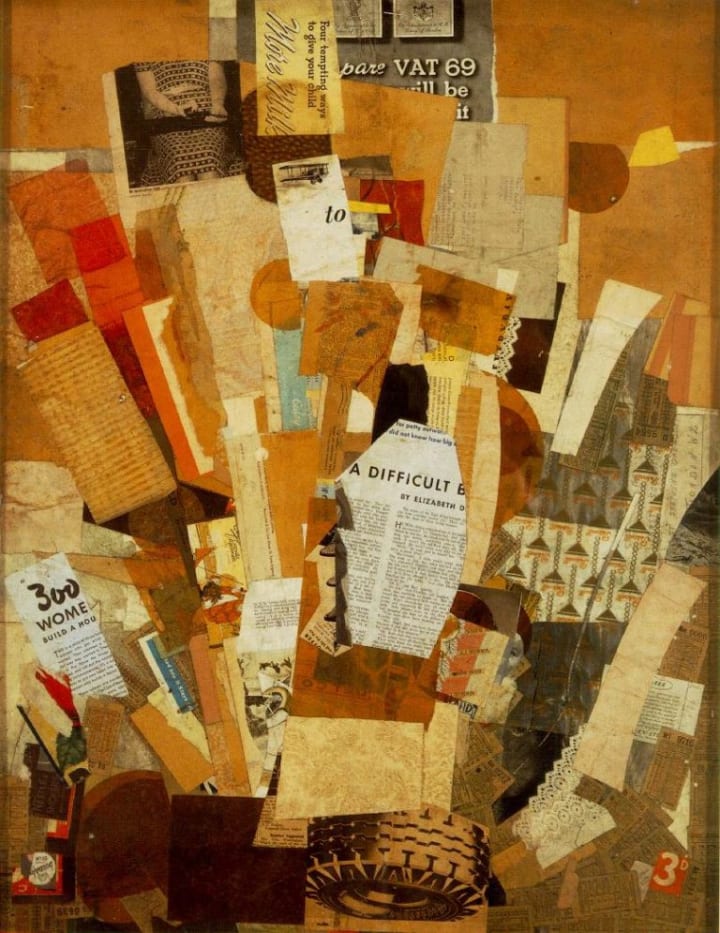
German artist Kurt Schwitters experimented with different mediums among them painting, sculpture, graphic design, installation art, and poetry. Besides Dadaism he was associated with Surrealism, Cubism, and Constructivism.
This artwork is an example of the artist's use of abstraction in collage and sculpture. It reflects the "found object" style of sculpture. The piece wass created with broken and disjointed materials among them a funnel, a metal toy train, and broken wheels. The artwork also includes a horizontal portrait of a noble lady giving it the title.
The Art Critic (1919-20) Raoul Hausmann

Austrian artist Raoul Hausmann was a prominent artist and leader of the Dada movement in Berlin, Germany. He focused mostly on photographic collage and poetry.
This artwork is a photo collage created with magazine and newspaper photos and includes drawn elements. It is considered to be "lowbrow" as it uses materials and iconography seen in popular culture.
The Mechanical Head 1920 Raoul Hausmann

Austrian artist Raoul Hausman created this artwork in 1920 and it became his most famous artwork. The art piece was crested from a hairdresser's wig dummy, a ruler, a pocket watch, a wallet, and pieces from a camera among other items. The artwork is considered to be a commentry on how humanity interacts with objects and the surrounding world. You can see the face is devoid of expression with objects attached to it.
Cut with Kitchen Knife Dada Through the Last Weimar Beer-Belly Epoch of Germany (1919-20) Hannah Hoch

German artist Hannah Hoch was a member of the Dadism movement. He was a pioneer of the photomontage or photo collage technique. She used image from popular media.
This artwork represents the juxtaposition between Dadaism and mainstream culture during this time. The members of dominant political groups such as the Weimar government and the army are put together in one part of the photo collage. The other side features communists, artists, and other radicals. The artist also included a small map displaying European countries that allowed women to vote.
Shirt Front and Fork 1922 Jean Arp

German-French artist, sculptor, and poet Jean Arp was also known as Hans Arp. He was a founding member of the Dadaist movement. His artwork is known to explore the unconscious - the elements of satire and the abstraction of organic forms.
This artwork is part of a series of painted wooden relief sculptures. The fork is easily identifiable but the shirt front resembles some other things.
Optophone I 1922 Francis Picabia

French artist and poet Francis Picabia was associated not only with Dadism but also with Impressionism, Cubism, and Pontillism. His most famous artworks were created with color blocks, geometric shapes, and abstractions.
This artwork is an example of the artist's "machinist" artworks. It was inspired by the early 20th century industrial equipment. The artwork simulates the effects of an optophone, a device using sonification for scan texts and images to help the blind identify letters on a page. The center of the piece shows a classical-style seated nude woman.
Dances at the Spring Francis Picabia

French artist and poet Francis Picabia created this early abstraction with flat angle forms to evoke the motion of dancing women. This remains a pivotal example of early Cubist and Dadaist experimentation.
Ubu Emperator 1923 Max Ernst

German artist, sculptor, graphic artist, and poet Max Ernst was an early member of the Dadaism and Surrealism movements.
This artwork represents his stylistic shift between Dadaism and Surrealism. It depicts a spinning anthropomorphic top with incongruent features. It portrays the father Ubu, a symbol of authority and greed seen in a series of plays by Alfred Jerry.
About the Creator
Rasma Raisters
My passions are writing and creating poetry. I write for several sites online and have four themed blogs on Wordpress. Please follow me on Twitter.
Keep reading
More stories from Rasma Raisters and writers in Art and other communities.
Famous Abstract Paintings
Beginning with the earliest Abstract artist who created artwork that spanned many mediums and techniques. There was nothing traditional about Abstract art it provided boundless freedom. Here are some of the most popular artwork created by some of the biggest names in art.
By Rasma Raisters11 months ago in Art
“What If It Happens?”
Monday, 11 April 2022 Ishrat Jahan One of our friends, Mr. Farooq, is a middle-aged man, yet he has still not been able to free himself from his deeply suspicious and fearful nature. These days, I happened to have some free time, so I thought it would be a good idea to meet him and try to untangle the puzzle of his constant worries. By coincidence, he himself arrived at my humble home, jolting along in a rickshaw.
By Sudais Zakwan3 days ago in Art
Introduction to Organic Solutions
In the realm of fitness, the role of nutrition cannot be overstated, and organic supplements are increasingly recognised as essential components of a well-rounded training regime. Unlike their synthetic counterparts, organic supplements are derived from natural sources, ensuring that fitness trainers can provide their clients with products that are free from harmful additives and chemicals. This not only promotes better health but also supports the body’s natural processes, thereby enhancing overall performance and recovery.
By Organic Products 8 days ago in Art


Comments
There are no comments for this story
Be the first to respond and start the conversation.