
Fake Faces from AI: Expert Guide to Spotting Deepfakes
Learn how to identify AI-generated fake faces using proven detection techniques. A must-read guide for staying safe online in the age of AI face swap tools.
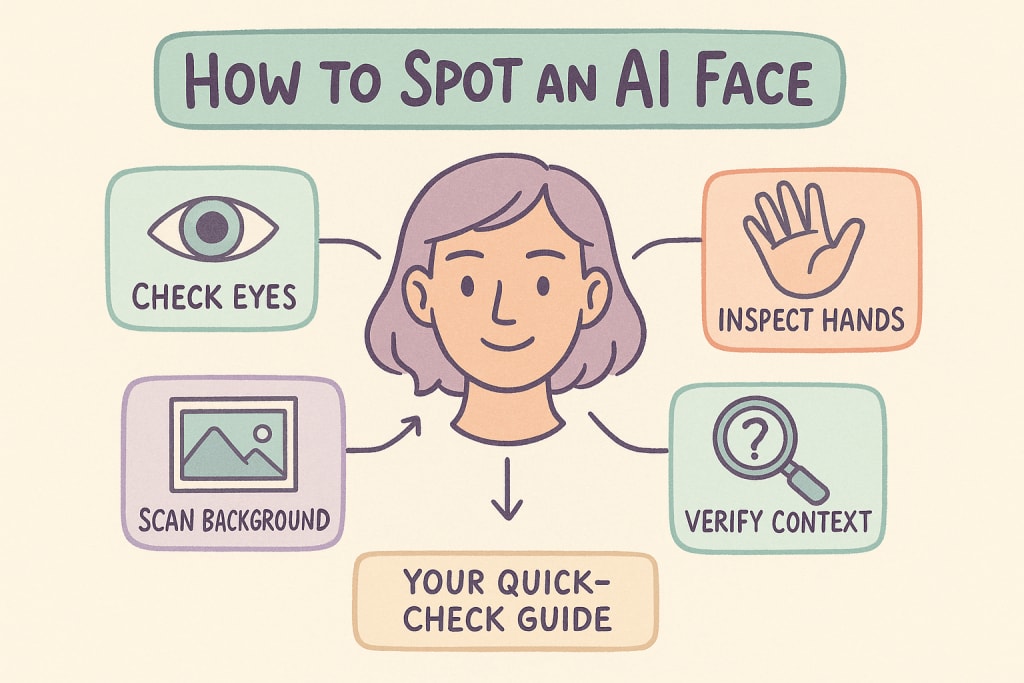
AI Face Swap Detection: How to Spot Fake Faces in 2025
In the age of viral deepfakes and AI face swap tools, one critical question echoes louder than ever: how can you tell if a face is fake? With realistic AI-generated people flooding social media, dating apps, news, and even ID systems, it's becoming increasingly difficult to distinguish real from artificial.
Whether you're a digital content creator, educator, security analyst, journalist, or simply someone who wants to stay informed, this guide unpacks everything you need to know about identifying AI-generated faces—from tell-tale signs to advanced forensic techniques.
We’ll answer questions like:
How to tell if a face is AI-generated?
Can you detect AI face swaps?
Are there free tools to spot fake images?
Let’s dive deep into the science, psychology, and technology behind spotting fake faces in an AI world.
What Are AI Face Swaps and Why Should You Care?
AI face swap technology uses deep learning (typically GANs—Generative Adversarial Networks) to blend or synthesize faces. Tools like FaceSwap, Zao, and more recently, deep-swap have democratized face manipulation.
Why It Matters
Misinformation: Deepfakes can impersonate public figures.
Fraud: Fake IDs and phishing scams are harder to detect.
Consent Violation: Faces are used without permission.
Trust Erosion: Media credibility suffers.
How to Tell If a Face Is AI-Generated
Answering the PAA: How to tell if a face is AI-generated?
There are visual and forensic indicators. Most AI-generated faces—even from state-of-the-art tools—exhibit subtle inconsistencies.
Visual Cues to Watch For
Asymmetrical Eyeglasses or Earrings: AI struggles with symmetry.
Blurred Backgrounds: Often inconsistent with depth of field.
Strange Hairlines or Teeth: Especially around edges.
Odd Lighting or Shadows: Light sources might be mismatched.
Unnatural Eye Glares: Catchlights may not align.
Facial Proportions: Look for mismatched ears or jawlines.
Pro Tip: Flip the image horizontally. Inconsistencies often become more obvious.
AI Artifacts
These are pixel-level errors like:
Glitches around accessories
Ghost-like outlines
Repetitive textures (especially in clothes or backgrounds)
Is There a Way to Detect AI-Generated Images Programmatically?
Answering the PAA: Is there a way to detect AI-generated images?
Yes. Several tools and platforms use machine learning to analyze and flag fake content.
Detection Tools & Methods
Deepware Scanner: Scans videos for deepfakes.
Microsoft Video Authenticator: Assigns authenticity scores.
Forensic Tools: Like FotoForensics (ELA - Error Level Analysis).
Reverse Image Search: Fake faces won't return results.
Example: Run a suspected image through TinEye or Google Reverse Image Search. No matches? That’s a red flag.
Can You Tell AI-Generated People from Real Ones?
Answering the PAA: Can you tell AI-generated people from real ones?
Yes, but it requires critical observation and pattern recognition.
Compare Against Real Human Patterns
Emotions: AI often misses micro-expressions.
Consistency: AI faces can appear too perfect.
Context: Real people have real-life photos, friends, histories.
Use Multi-Factor Authentication
Ask for a short video.
Verify social media presence.
Look at EXIF data (if available).
How to Identify Fake AI Faces on Social Media and Dating Apps
Answering the PAA: How to identify fake AI?
This is where practical tips help.
Behavioral Clues
Too Attractive or Perfect: Unrealistically polished.
Inconsistent Image Quality: Resolution jumps.
Generic Bio Info: No specifics about life, location, job.
Fast Rapport Building: Scammers using AI are trained to engage quickly.
Watch for patterns. Scammers use scripts with AI-generated photos.
Human vs. AI Face: Side-by-Side Comparison
Feature Human Face AI-Generated Face
Eyes Natural glare, symmetry Uneven catchlights
Hair Organic flow Repetitive patterns
Background Logical depth/focus Blurred or nonsensical
Accessories Aligned & real Glitched or floating
Image History Exists on web Unique, no matches
Future-Proofing: What AI Will Get Better At—and How to Keep Up
What’s Improving Fast
Better symmetry recognition
More natural lighting
AI-generated image metadata spoofing
What Will Remain Harder
Emotionally accurate micro-expressions
Truly consistent background details
Contextual presence (e.g., multiple-life photos)
Expert Prediction
“By 2026, most casual users won’t detect fakes without help. Detection tools must evolve faster than generation tools.” — Hypothetical AI Ethics Researcher
What You Can Do: Tips for Staying Safe
Actionable Best Practices
Don’t trust profile pics alone.
Cross-verify using video or voice.
Use detection tools on suspicious images.
Educate friends and coworkers.
Organizational Safety
Implement facial verification standards.
Train staff on identifying fake profiles.
Use automated scanning tools for onboarding.
Conclusion: Stay Sharp in the Age of Synthetic Faces
AI-generated faces are here to stay—and they’re getting better every day. But so is your ability to spot them.
The more you know about AI face swap tools and how they work, the more empowered you are to spot the signs. Whether for personal safety, professional accuracy, or platform integrity, staying informed is the best first line of defense.
Call to Action
Want to explore AI face generation for creative, ethical use? Discover what’s possible—and what to watch for—with AI face swap tools at deep-swap.
About the Creator
Keep reading
More stories from Zenobios Tomiko and writers in Art and other communities.
The Rise of AI Face Swap: Changing Photography Forever
How AI Face Swap Will Transform the Way We Share Photos in the Future The way we share photos is on the brink of a seismic shift, and the catalyst is AI face swap technology. What once seemed like science fiction—seamlessly swapping one face for another in images or videos—is now a reality available at the click of a button. As tools like deep-swap become more accessible, intuitive, and realistic, we're entering an era where the lines between authentic memories and synthetic creations blur.
By Zenobios Tomiko9 months ago in Art
'Till Death We Do Art
There would be nothing divine in this world without art. Nature may surpass the divine to all intents and purposes, but like everything it absorbs and is absorbed by, it remains here, stuck on the surface of this world, ever-present, physically bound to the universe.
By Avocado Nunzella BSc (Psych) -- M.A.P 22 days ago in Art
When Stone Meets Style
The first time I held a piece of raw gold still nestled in quartz, it did not shimmer politely. It caught the light in uneven flashes, like a secret smile from inside the stone. My fingers traced its rough ridges, and I realised that perfection can feel far more alive when it refuses to be polished smooth.
By CurlsAndCommas7 days ago in Art




Comments