

A Deconstruction of Form and Feeling: Exploring "Ext-Ent"
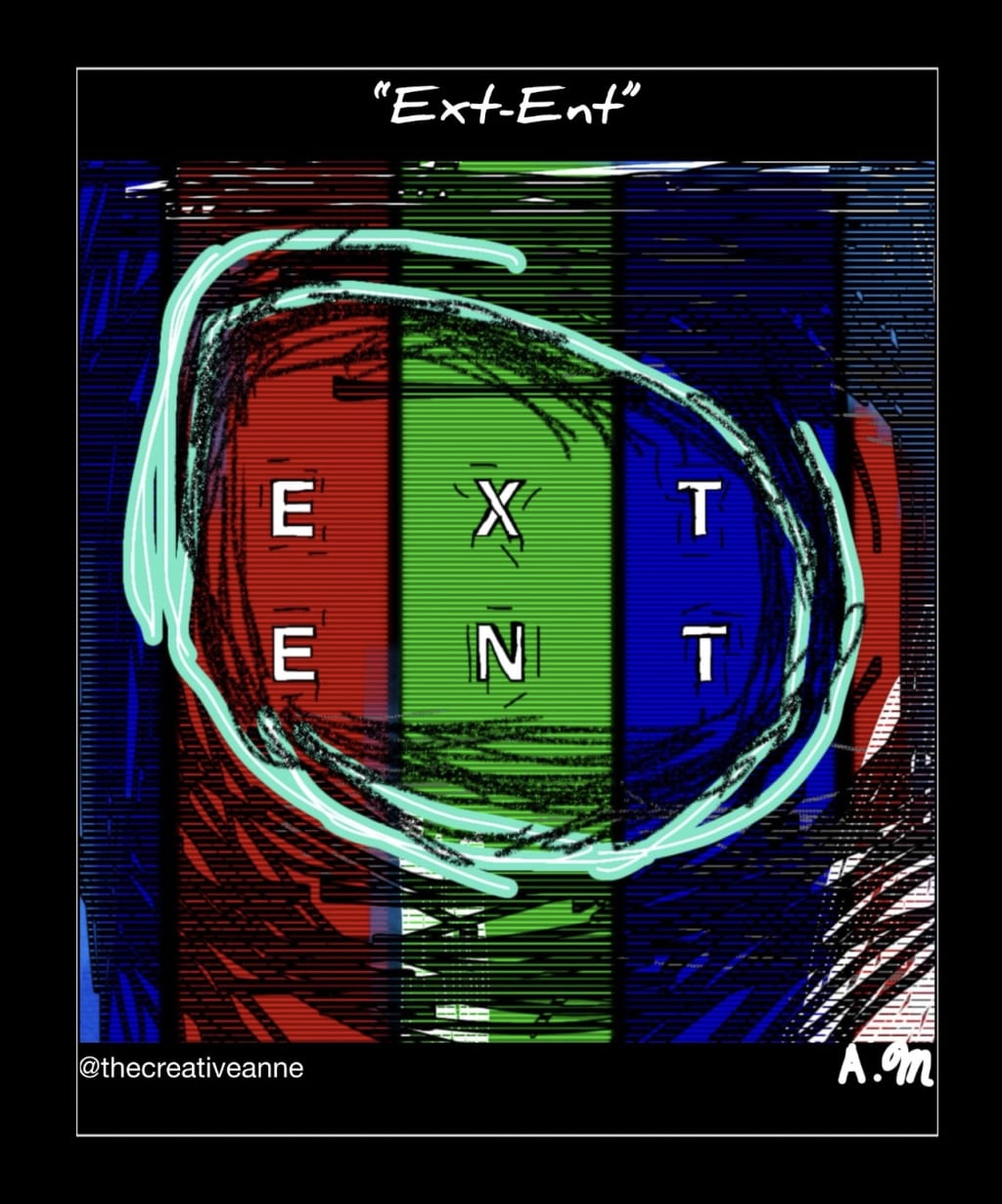
The canvas, a digital tapestry woven from light and code, presents "Ext-Ent" not merely as an image, but as an experience. This work, a recent foray into the intersection of digital media and traditional artistic principles, serves as a meditation on the concept of extent—a word split, dissected, and reconfigured to explore the boundaries of perception, emotion, and existence itself.
The Conceptual Framework: Deconstructing a Word
At its core, "Ext-Ent" is a visual exploration of a single word. The title, deliberately fragmented, is the key to unlocking the piece's meaning. By splitting "extent" into "EXT" and "ENT," the artwork creates a duality. "EXT" represents the external world—the physical, tangible reality we navigate. "ENT," in contrast, delves into the internal—the realm of thought, emotion, and consciousness. This division isn't just linguistic; it's a foundational philosophical question about the relationship between what is "out there" and what is "in here." The entire composition is a meditation on this central tension, inviting the viewer to consider the boundaries of their own existence and perception.
The letters “E,” “X,” “T,” “E,” “N,” and “T” are stenciled in a stark white typeface, each letter residing in its own designated color field. The deliberate separation of the word "extent" into "EXT" and "ENT" is the conceptual core of the piece.
A Study in Color and Texture
The visual language of the piece is built upon a striking use of color and texture. Three vertical fields—a deep red, a vibrant green, and a cool blue—form the central triptych. The red on the left, home to "EXT," pulsates with the energy of external reality. It’s a color of passion and vitality, but also of danger. The blue on the right, housing "ENT," provides a serene counterpoint, suggesting introspection, calm, and even melancholy. The central green field acts as a liminal space, a bridge between the two extremes.
The central green field, housing the letters “X” and “N,” acts as the fulcrum, the point of balance and tension. Green, a color of growth and nature, but also of envy and illness, is a powerful choice for this liminal space. The "X" and "N" are not just letters; they are a bridge. The "X" could represent the unknown, the variable, the crossroads. The "N" could signify "and," linking the two sides, or a negation, a void between them. This central section is where the external and internal worlds meet, collide, and sometimes dissolve into one another. It’s the space where our perceptions of the world are filtered through our internal state, and where our internal state is shaped by our external experiences.
Beyond the color fields, the artwork employs a "glitch art" aesthetic. The horizontal and vertical lines that run through the colors are intentional distortions, creating a sense of digital static and fragmentation. This texture is not an error but a conscious artistic choice that speaks to our modern, screen-mediated reality. It suggests that our experiences, whether external or internal, are often filtered through imperfect data streams, adding a layer of complexity to the piece.
The Human Touch: Unifying Elements
While the core of the piece is clean and digitally rendered, a crucial element unifies the entire composition: a hand-drawn circle. This thick, expressive line, rendered in a bright, gestural turquoise, encircles the entire structure. Unlike the precise, static lines of the background, this circle is raw and imperfect, a clear sign of the artist's hand. It is a deliberate subversion of the digital perfection, a reminder that despite the technological medium, the artwork is born from a raw, human impulse. This circular motif, a universal symbol of wholeness and unity, suggests that the chaos and duality within the piece are ultimately contained and connected.
Conclusion: Bridging the Divide
“Ext-Ent" is a powerful synthesis of concept and form. It uses the digital medium to explore timeless questions about the self and its relationship to the world. By deconstructing a word and using visual elements like color, texture, and a unifying circular motif, the piece invites viewers to contemplate the extent of their own reality. It is a work that finds beauty in the tension between internal and external, between the human and the digital, and ultimately suggests that these seemingly disparate elements are inextricably linked, contained within the boundary of our own consciousness.
The piece invites the viewer to look beyond the surface, to consider the extent of their own reality, and to find the human touch within the machine. It is a testament to the idea that even in a fragmented world, there is a fundamental unity, and that the search for meaning, like the artist's hand, continues to move in a never-ending circle.
About the Creator
Slgtlyscatt3red
Slightly scattered. Just a woman with autism and ADHD that loves to write poetry, create art, and sing.
Keep reading
More stories from Slgtlyscatt3red and writers in Art and other communities.
Love Is Folly 2016
Love Is Folly 2016: Peter Ayolov Between Cinema, Education and Memory In 2016, at the International Film Festival Love Is Folly in Varna, Dr Peter Ayolov—lecturer in screenwriting at Sofia University St. Kliment Ohridski and author of the book Медийният сценарий (2026)—was invited to serve as a member of the festival jury. His participation marked not only a professional recognition of his work in media and narrative theory, but also placed him at the intersection of Bulgarian cinematic history and contemporary film education.
By Peter Ayolov7 days ago in Art


Comments
There are no comments for this story
Be the first to respond and start the conversation.