
Exploring Female Pleasure in Jean-Honoré Fragonard's "The Swing"
Understanding that female pleasure is all about choice.

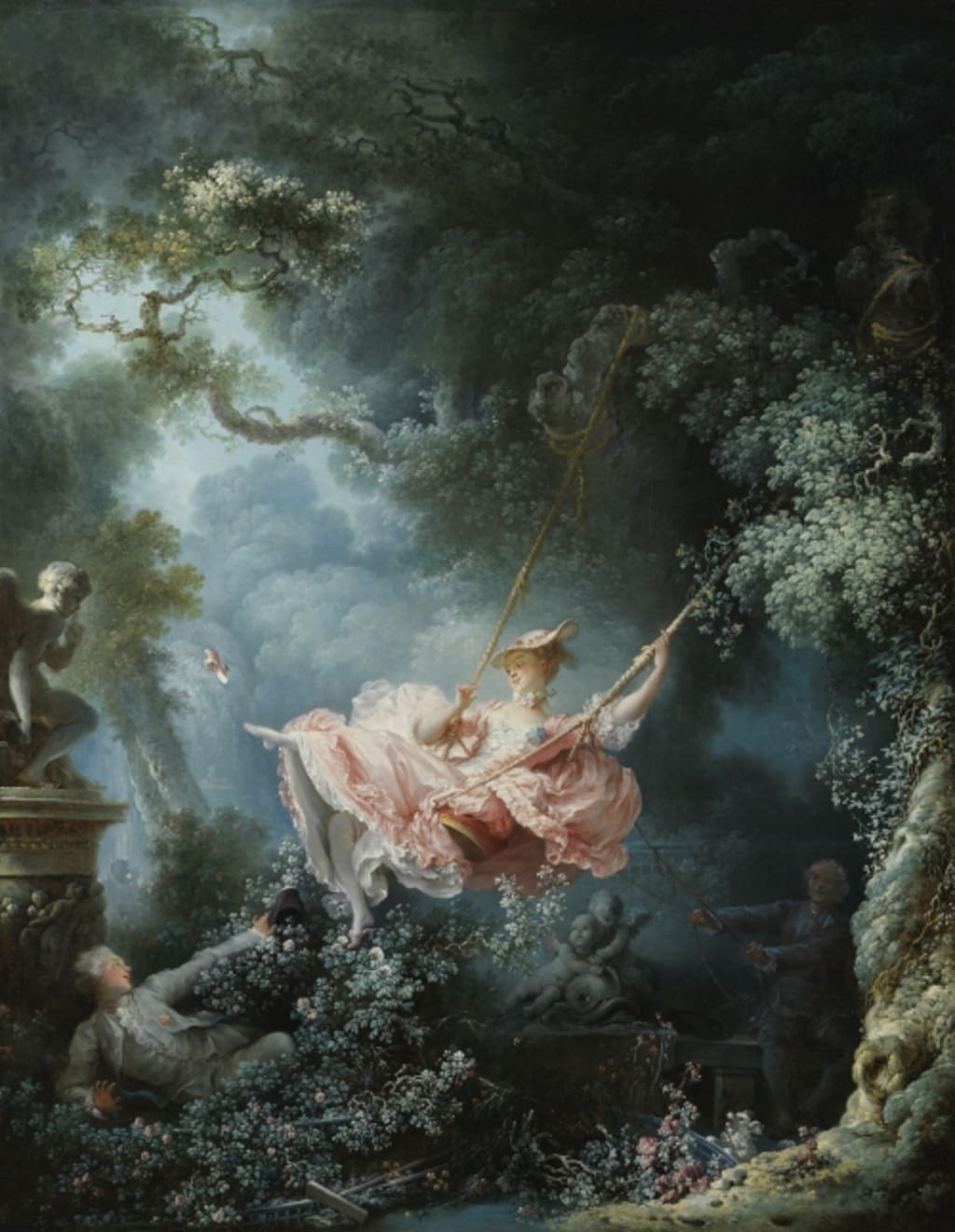
Female pleasure is often not accurately defined or explicitly portrayed as artists and writers are often more familiar with portraying female displeasure. There seem to be more representations of sad, angry and hurt women in art, stories and movies than those who are happy, content or even excited. But what do women need in order to be happy?
I define female pleasure as having choices and being allowed to change your mind, and this is encapsulated in the painting "The Swing".
"The Swing", painted by Jean-Honoré Fragonard in 1767, was commissioned by Baron Louis-Guillaume Baillet de Saint-Julien, who wanted a picture of his mistress on a swing being pushed by a bishop whilst he looked at her longingly. Featuring the bishop in the painting was too scandalous, so Fragonard instead painted an old man who represented the mistress's husband.
The woman at the centre of the painting is caught between two men who represent different ideas swinging back and forth. The older man seems to represent stability, whilst the younger represents fun and excitement. The woman's shoe flying off symbolises freeing herself from expectations and societal norms, as it is often expected that women should accept their lot in life. The foliage, flowers and trees are growing freely, much like the woman's excitement and joy without anyone to clip them. I believe she looks content because she has the choice of either man and what they represent; she can choose stability or she can choose spontaneity. She can also change her mind and swing in the other direction.
Portrayals of women as having choices are rare; the only example I can think of is Samantha Jones from Sex and the City, who did not seem to be boxed in by society's expectations. A woman's agency is often underestimated when it comes to making choices, especially when making romantic choices. There is a long history in many cultures of arranged marriages and matchmaking that took away a woman's ability to choose their life partner and barred them from being able to date casually. When women do choose, they have to then stick with that choice and are deterred from changing their minds for fear of blowing up their entire lives. An example of this is when working women choose to become mothers; the time they have to take off work can blow up their career progression.
I believe we need more portrayals of women as excited and joyful because I am tired of seeing women portrayed as martyrs, nagging wives or having their reputations ruined after they have decided to put their needs first.
There is this idea of women being "complicated", and I don't believe we are that complicated. I just think we want to have as many options as possible and to be able to change our minds without destroying everything we have built. How wonderful would it be to choose
I wish I could be Samantha one day and Charlotte the next and maybe not as cynical as Miranda some days. I would hate to be Carrie, as I can't imagine any man having a hold on me as Big did. Carrie could have benefited from choosing to put her energy and time elsewhere. For example, engaging in volunteer work, travelling or exploring new hobbies.
What I love about paintings in the Rococo era is that women were represented as autonomous in love and leisure and can choose who to love and how they want to have fun. They also showed women as having interests outside of domestic duty with playful personalities. They displayed revelling in merrymaking without punishment or judgement. "The Swing" is a classic example of a Rococo painting. It was painted by a man for another man but seems to echo what women truly want, which is choice.
About the Creator
Aashna Woodin
A true critic of pop culture.
Keep reading
More stories from Aashna Woodin and writers in Art and other communities.
Exploring Moodiness in Vincent Van Gogh's Sunflowers
Vincent Van Gogh was a Dutch painter who found fame a century after his death caused by a self-inflicted gunshot wound. He led a troubled life as a struggling artist who suffered from mental health issues and spent some time in an asylum after an altercation with fellow artist, Paul Gauguin, which resulted in his ear being mutilated. He was prone to mood swings, outbursts and often isolated himself from others as outlined by his letter to his brother, Theo. His artworks were not appreciated in his time and he only managed to sell one painting before his death. His paintings now hang in world renowned museums such as the Metropolitan Museum of Art and his works have sold for millions of dollars.
By Aashna Woodin6 months ago in Psyche
Male Tattoo Artist Roles in Contemporary Tattoo Culture
Walking into a studio today feels very different from the old days of loud music and tough talk. Modern tattoo shops can be calm, warm and welcoming, and the person guiding you through the whole process is often a male tattoo artist who takes his job very seriously.
By Tools of Trade Studios3 days ago in Art


Comments
There are no comments for this story
Be the first to respond and start the conversation.