
Exploring Andy Warhol: The Artist’s Life Through His Food and Art
From Cornflakes to Campbell’s Soup: A Deep Dive into Warhol’s Daily Life and Iconic Works


There is an Andy Warhol that you likely know. He created repeated images of Marilyn Monroe, Campbell’s soup, Brillo boxes, cow wallpaper, celebrity portraits, and dollar signs. Many writings exist about Warhol, including biographies and a detailed account of his daily life from the mid-1970s until his death in 1987. Warhol surrounded himself with people who gave competing reports about their time with him. He also provided many memorable sayings that are still referenced today.
Today, we'll explore Warhol's life through the food he portrayed and the food he actually ate. We will discuss the person behind the enigma—the producer, consumer, and product all in one. This might be difficult to capture, but it is enjoyable to attempt.
Let's start with breakfast. For Warhol, breakfast often meant cornflakes. We have photographic evidence of him enjoying them, sometimes with his mother, Julia. Julia lived with Warhol in New York from 1952 to 1970. In the late 1970s, photographer Bobby Grossman captured Warhol eating cornflakes.
Cornflakes were not only a significant part of his diet. They were also featured in his art. Warhol incorporated cornflakes boxes into his famous 1964 show at the Stable Gallery in New York. This exhibition also included sculptures of Brillo boxes, Heinz tomato ketchup, and Campbell's tomato juice. Visitors could only navigate through the space via narrow pathways, as the room was filled with these works. The boxes were wooden, bought from a carpenter and painted by Warhol and Gerard Malanga, his assistant at the time.
Warhol’s creations in this space were among the first made in what would be known as the Factory. The Factory was characterized by assembly line processes and had previously been a hat factory. Warhol’s works highlight the peculiarity of industrially produced food that became dominant in the American diet after World War II.
Next, we will discuss a popular dish from a restaurant where Warhol spent a lot of time in the 1950s. Serendipity 3 opened in 1954 and was Warhol's unofficial headquarters. The best-known item on their menu is frozen hot chocolate. To make it, chop 3 ounces of any chocolate and melt it in a double boiler. Add two teaspoons of hot chocolate mix and one and a half tablespoons of sugar, stirring until blended. Then, add half a cup of milk and let it cool.
While the mixture cools, we can look at Warhol’s work during the time he enjoyed these drinks. In the 1950s, he achieved considerable success as an illustrator for magazines like Vogue and Harper's Bazaar. He created illustrations for advertisements and displays, often collaborating with his mother, Julia, who contributed the cursive script in his works.
Warhol would trace images from photographs using tracing paper. He then would attach the tracing paper to drawing paper and use an ink pen to ink the drawing section by section. This method often left jittery lines and smudges. An old classmate once noted that Warhol discovered this technique at a restaurant, where he blotted a sketch with a napkin. This approach fit the automation he embraced later in his career, allowing him to delegate parts of his process.
Now let’s turn back to the chocolate mixture. Pour it into a blender with one additional cup of milk and three cups of ice. Blend until smooth, and then pour it into goblets. Top with whipped cream and chocolate shavings.
By the early 1960s, Warhol shifted his focus. He started creating paintings of comic strips and advertisements—objects he understood well. In 1962, he made two large paintings of Coca-Cola bottles. One had a drippy, expressionistic style while the other had clean edges. Friends preferred the hard-edged one, so he used it.
Warhol was drawn to Coca-Cola for a reason. He noted that in America, the rich and the poor buy the same things. You could watch TV and see Coca-Cola, knowing that many famous people drank it, too.
Another staple of Warhol’s work is Campbell's tomato soup. After painting Coca-Cola bottles, he sought new subject matter. He asked friends for suggestions, and one suggested a common thing like a Campbell's soup can. Warhol began making his first series of soup can paintings, using black-and-white photographs as a guide.
Warhol painted nearly 50 soup can paintings in a short period. He eventually chose silk screening as the best method to replicate the soup cans. His soup can paintings featured in the 1962 exhibition, "The New Realists," which helped define pop art. By 1964, his soup can paintings became iconic. He sold them for $1,500 each.
To make Campbell's soup, mix one can of water with the concentrate, heat it, and it's ready to eat.
About the Creator
Ahmed mohsin
As a passionate history enthusiast, I weave captivating tales inspired by real events, with a love for movies, dramas, manga, and anime, where every story carries the echoes of history with the excitement of the fictional worlds I adore.
Keep reading
More stories from Ahmed mohsin and writers in Art and other communities.
The history of art in Byzantium/Istanbul P.1
Did you know Istanbul was once called Byzantium, and later, Constantinople?” Ali asked, looking over the bustling city. “It’s incredible how this place has been the capital of three mighty empires—Roman, Byzantine, and Ottoman.”
By Ahmed mohsin12 months ago in Art
Why Nietzsche Belongs in 2026
As the world moves toward 2026, it does not feel like a calm progression into the future—it feels like a collision. Rapid technological acceleration, cultural fragmentation, economic uncertainty, and a deep crisis of meaning define the modern condition. Traditional authorities are distrusted, ideologies compete aggressively, and individuals feel both empowered and exhausted by choice. In such a landscape, Friedrich Nietzsche’s philosophy emerges not as a comfortable guide, but as a necessary one. Unsettling, demanding, and brutally honest, Nietzsche may offer the most fitting philosophical framework for the year ahead.
By Fred Bradford7 days ago in Art
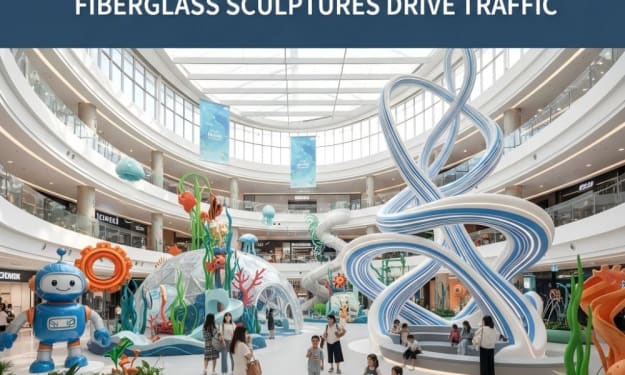
2026 Commercial Space Design:How Fbierglass Sculpture Drives Traffic
Today, offline commercial spaces are facing continuous pressure. With e-commerce offering convenient and fast services, physical stores must showcase unique features to attract customers. In this context, fiberglass sculptures are no longer merely decorative items; they have become visual focal points in shopping malls, brand stores, pop-up shops, and mixed-use commercial projects, playing a crucial role in increasing foot traffic.
By Shenzhen Ruiheng Crafts3 days ago in Art



Comments
There are no comments for this story
Be the first to respond and start the conversation.