
Expert of Ancient Painting and Precision
The Life and Times of Ancient Greece's Greatest Painter

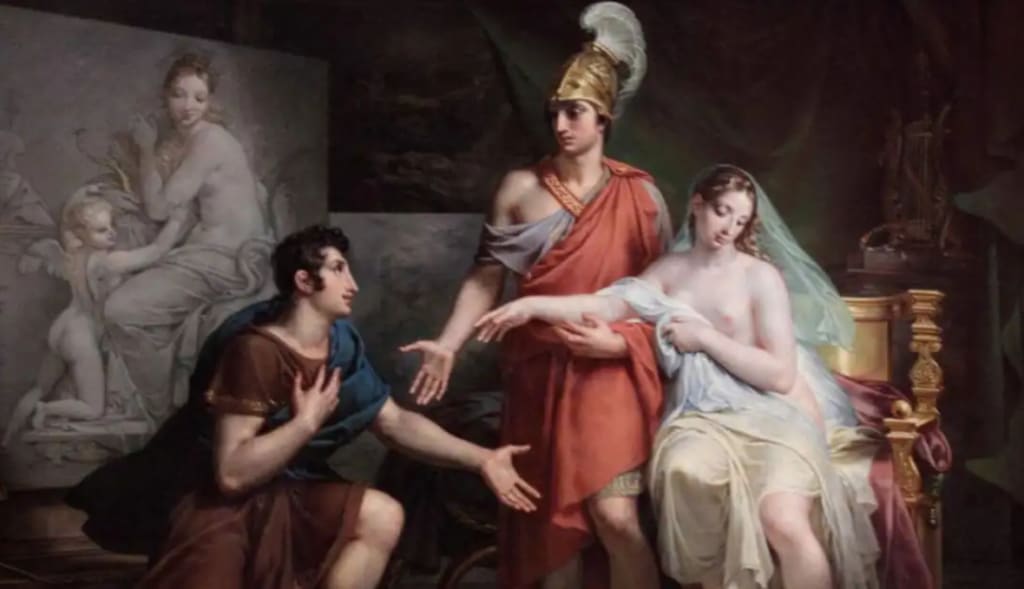
The name Apelles has reverberated throughout the history of art, and he is considered by many to be the greatest painter of antiquity. He has no surviving works, yet the stories of his skill and offerings to the art of painting never cease to inspire artists and scholars alike.
Apelles has been immortalized from ancient Greek texts to Renaissance ideals, resulting in an indelible mark on the art world.
The Fame of Apelles
The ancient Roman writer Pliny the Elder wrote in Natural History one of the more profound praises of Apelles, preserving that. But it was Apelles who was greater than any other painters, whether preceding or succeeding.
He contributed more to painting, single-handed, than all the others together, This is one of the highest accolades of admiration Apelles was accorded both in his time and all centuries after.
Apelles, whose life extended from ca. 380 to 370 bce, was probably born in the Greek city of Colophon on the western coast of Asia Minor. His professional career began in Ephesus and he refined his skills under the great artist Pamphilus in Sicyon.
There Apelles learned the basic principles of scientific painting, emphasizing geometry, proportion, and the laws of perspective, His training at such a revered school would prepare him perfectly for the cultured craftsmanship that set him apart from other artists.

A Patronage with Kings
Apelles's career took a turn for the better when he became the official court painter for King Philip II of Macedonia, and later and perhaps more famously,his son, Alexander the Great.
He spent more than three decades painting the royal family, the portrait of Alexander being one of his most popular.
He also recorded images of war, providing a visual account of the majesty of Alexander's conquests. Not only did his connection to such influential patrons enhance his reputation, but it also enabled him to experiment artistically, mixing realism with stylistic experimentation.
After Alexander's death in 323 BCE, Apelles worked under the patronage of the Hellenistic kings, including King Antigonus I and King Ptolemy I Soter.
Despite all of the upheavals in the politics of the ancient world, Apelles's fame remained untarnished, and his oeuvre would go on to influence painters throughout the Mediterranean.

Innovative Media Practices
Among Apelles's most enduring legacies are the technical contributions he made to painting. His experimentation with light and shadow contrasted his work with paintings that came before him, a precursor to what would be called chiaroscuro.
In his portrait of Alexander the Great, that great master Apelles augmented his brilliance by darkening the background as he lightened the subjects chest and face, producing a stunning contrast that heightened the subject's features.
His palette was remarkably small, consisting mainly of white, black, red and yellow, a group known as tetrachromia. But he also used light blue, evidence that he was expanding his palette of expression.
While this might seem like a limiting palette, Apelles produced an unprecedented level of realism in his painting. A secret to his success was the creation of a special black varnish known as ''attramentum''.
This material, which Apelles guarded as a closely held secret, preserved his paintings and mellowed the tinctures, giving them an exceptional brilliance and durability.

Science is about Precision and Perfectionism
The Pompeiian Tacitus records of him an ''apipein'' who surpassed all others in technique, of ''Charis'' who made it part of his paintings. This is how he stuck to the idea that beauty in art can only be achieved by supposedly true mathematical proportions and geometrical principles.
Apelles also knew the dangers of perfectionism, though. It speaks to his philosophy of knowing at which point to leave the painting alone in order to find its balance without over-mass ac thing the work.His famous saying ''other painters are better than me in everything, but always their paintings are worse'' seems to refer exactly to the idea we wrote in the previous line.
One of the most fascinating stories of Apelles typifies his commitment to accuracy and perfection. And even his competition submission to draw a horse, he asked for live horse to be brought to the venue so he could draw them from life. ''To the applause of my horses, such a perfect picture,''attributed to Apelles himself, was the last thing you would hear when he left the studio.
About the Creator
Keep reading
More stories from Rohitha Lanka and writers in Art and other communities.
Catherine: The Unshakable Heart of the Monarchy
The House of Windsor is facing a subtle but undeniable shift. Tension runs high, and the once-clear lines of loyalty and influence are now blurred. At the center of it all stands Catherine, Princess of Wales—a figure who has long been admired for her grace, calm, and unwavering dignity. But recent events have brought a storm to the palace doors, one that threatens to test the very foundation of royal stability. For years, Catherine served as the quiet anchor of the monarchy. She carried her role with elegance, weathering constant scrutiny from the public and press alike. Then came a serious health challenge, a period of uncertainty and silence that left many wondering if she would step back permanently. But she did not. Instead, she returned stronger, her poise and presence commanding renewed attention and respect. Public admiration for her soared, culminating in headlines that celebrated her as more than a royal figure—they crowned her a symbol of strength. This rising public affection, however, has created ripples behind palace walls. Reports suggest that King Charles feels overshadowed, and Queen Camilla may be aligning with palace traditionalists in response to Catherine’s prominence. What was once a harmonious center of royal life now shows signs of friction. Influences are shifting, whispers and press narratives become tools of subtle power struggles, and Catherine, the stabilizing force, is suddenly cast as a threat. This isn’t about Catherine versus Meghan Markle, though the comparison is inevitable. Meghan, once seen as the disruptor, now observes the palace from outside. Her era of controversy shaped her influence, but today’s narrative highlights endurance over disruption. Catherine doesn’t need confrontation to command attention—her consistency, humility, and resilience naturally draw public support. This quiet power is precisely what unsettles those who rely on control and manipulation. Catherine’s return demonstrates a fundamental truth: legacy outlasts noise. She embodies a rare combination of grace under pressure, emotional intelligence, and unshakable composure. Her strength is evident not in headlines or controversy but in her ability to maintain dignity amid chaos. People don’t just admire her; they trust her. They feel her presence, and in her, they see continuity, reliability, and hope for the monarchy’s future. The palace may attempt to manage narratives, deploy commentators, or subtly influence the media, but they cannot manufacture the connection Catherine shares with the public. Her influence is organic. It is the result of years of consistent, visible dedication, and it resonates far beyond the confines of Buckingham Palace. While power struggles may unfold within, the world watches, and the audience has already chosen a champion. Meanwhile, Meghan’s story, once loud and all-encompassing, fades into the background. Her brand of influence—rooted in challenge and controversy—cannot compete with Catherine’s enduring presence. The public craves stability, someone who embodies calm, resilience, and authenticity. Catherine provides that in abundance, and the contrast is unmistakable. Enduring legacy outshines transient disruption. Ultimately, Catherine’s rise is not a threat to the monarchy—it is its lifeline. She is the bridge between tradition and relevance, connecting generations with quiet confidence. The very qualities that some may perceive as challenging palace control—her popularity, her grace, her resilience—are precisely what sustain public trust. This isn’t a story of rivalry; it’s a lesson in the power of character, the influence of consistency, and the enduring appeal of authenticity. History has a way of remembering who strengthens institutions and who allows petty conflicts to erode them. Catherine stands as a testament to steadfast leadership, quiet courage, and the enduring bond between a royal and her people. Those who underestimate her do so at their peril, for her strength is both visible and deeply felt. The narrative is clear: Catherine isn’t merely surviving; she is thriving. She faces pressure, criticism, and palace politics with unflinching dignity, reinforcing her role as an indispensable figure in the monarchy’s future. Her story reminds the world that true influence is built on resilience, authenticity, and the unwavering commitment to serve, rather than to command attention. As the palace navigates shifting alliances and personal insecurities, the public stands with Catherine. Her legacy, already forming, will outlast the temporary noise of gossip and speculation. She is the embodiment of stability, grace, and leadership—a woman whose presence strengthens the monarchy and whose endurance inspires the world. The House of Windsor may grapple with internal tension, but Catherine has already secured her place in the hearts of those she serves. In a world of fleeting attention and manufactured drama, Catherine proves that true influence is quiet, steady, and lasting. She faces life’s storms not with theatrics, but with poise and resilience, leaving a legacy that no palace intrigue can diminish. The world watches, admiration grows, and history quietly notes who stood firm, who served with dignity, and who became a true icon of endurance. Image Creation Format for This Story: Subject: Catherine, Princess of Wales, standing gracefully in a sunlit palace courtyard, with subtle shadows representing tension behind palace doors. Mood: Elegant, dignified, serene, yet powerful—contrast of calm versus tension. Style: Realistic digital painting, slightly cinematic, focus on light and expression.
By Behind the Curtain6 days ago in Art
The Uncopiable Human Wit to Write
We all have been in that spot at least once in our schooldays where we have been wringing our brains off to curate written articles of some sort until our soul-less friends were born. At just four years old, our beloved soul-less, metallic, digital assistant who is always by our side when we turn on our computers and smart phones, will be doing much more than curating written content for us all, if you know what I mean.
By Sound Savvy2 days ago in Art



Comments
There are no comments for this story
Be the first to respond and start the conversation.