
Early Buddhist Capitals of Ashoka’s Pillars
Originally written for Art of Asia at ASU

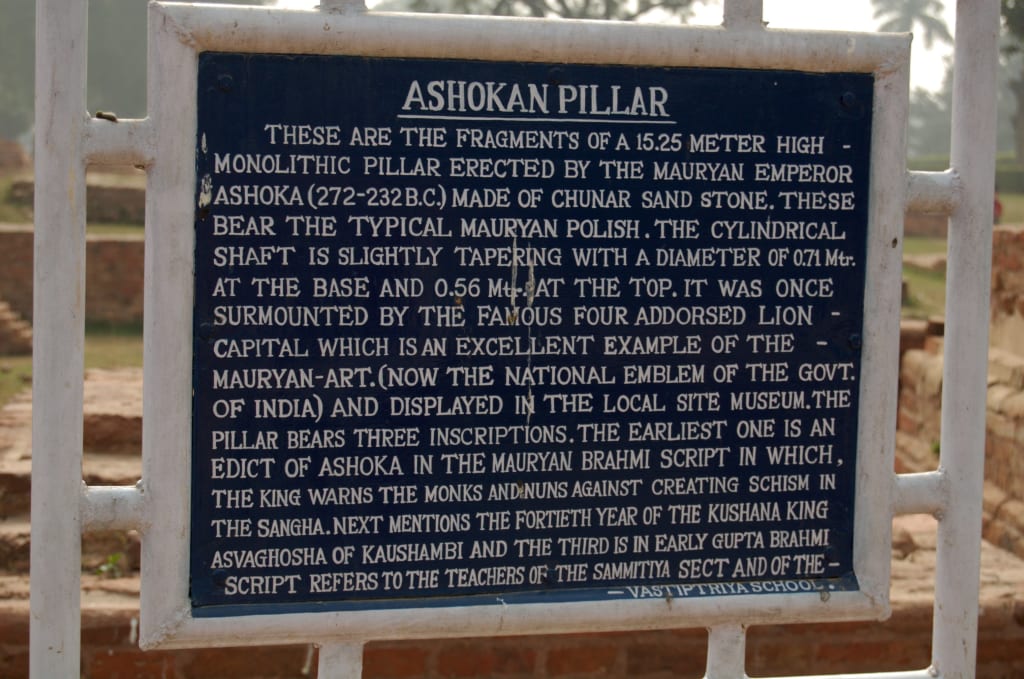
The Asoka Pillars are notable for a variety of reasons, not the least of which is them having been built by Asoka as a way of marking the area of his reign, so to speak. The monolithic statues were inscribed with Ashoka’s edcits, and reflected the Vedic concept of axis mundi, the pivot of the universe.
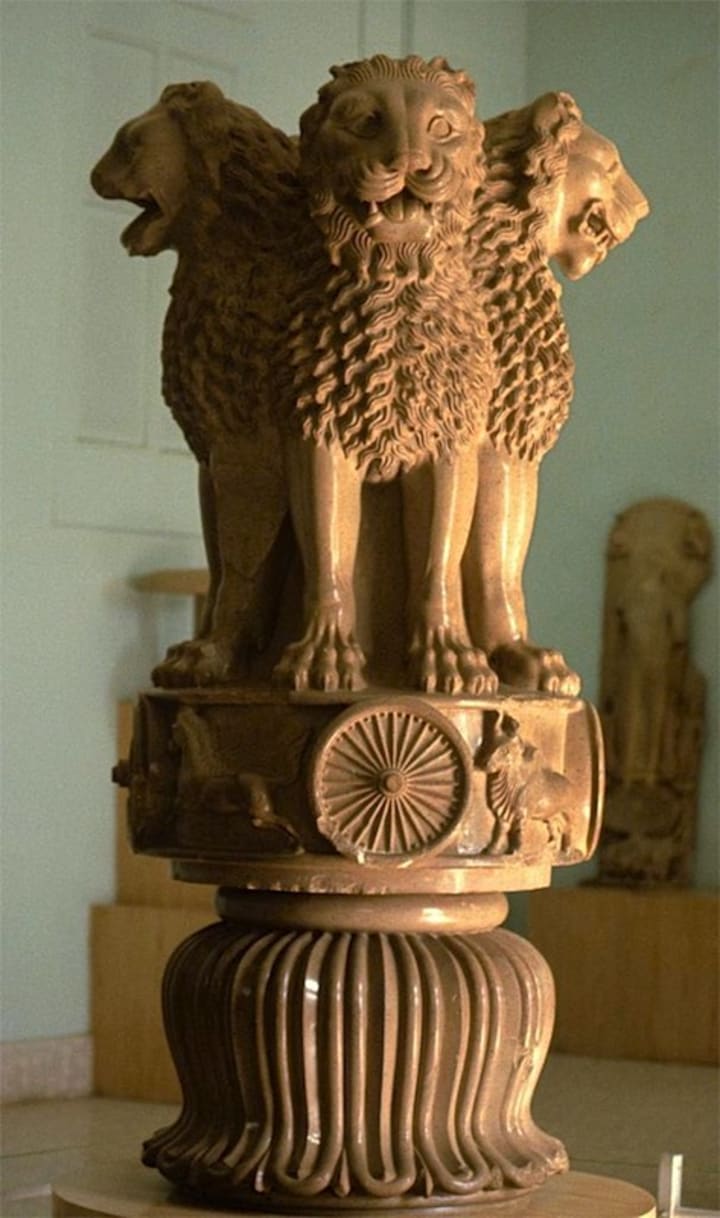
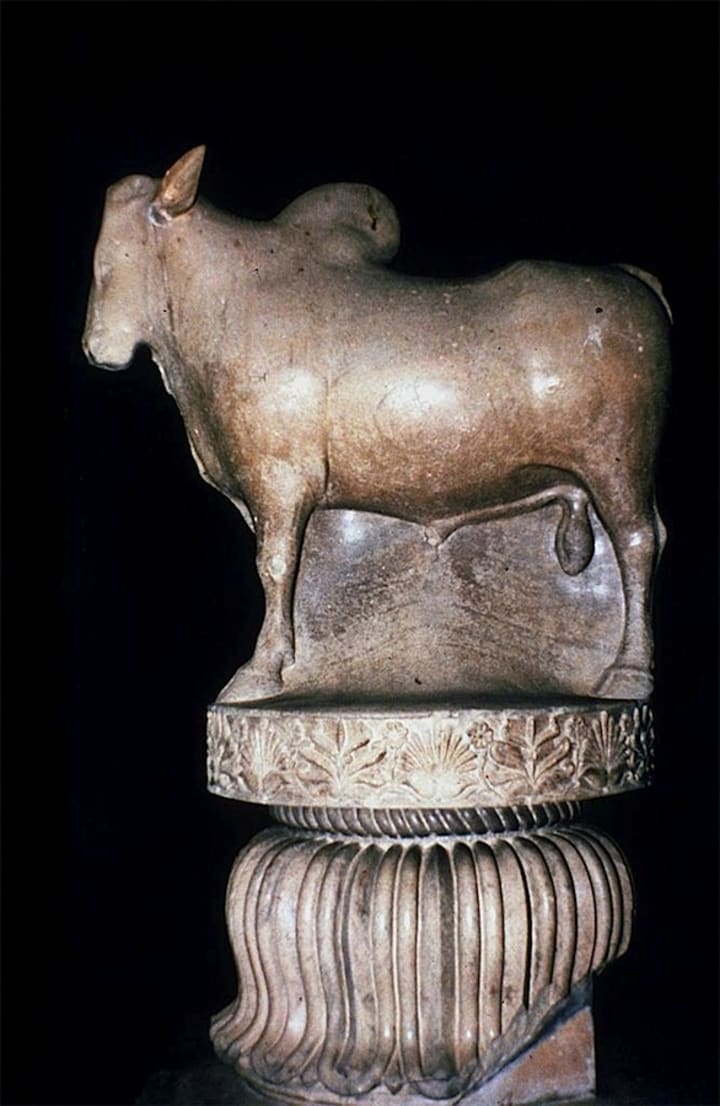
The pillars were set up at many stupa sites after Ashoka converted to Buddhism after the violent invasion of Orissa, and associate the moral teachings of Buddha with Ashoka’s word of law. Few of these pillars remain today, and fewer still of their capital’s remain intact, the two of the most notable that have survived are the Bull Capital of Rampurva, and the Lion capital of Sarnath.
These two capitals are from opposing sides of the land area that was under Ashoka’s rule, but the similarities between them are still pronounced.
The capitals were both built around the 3rd century BCE, and are carved by sandstone. But despite the similarities in their origin and construction, it’s the differences between them where we see the full richness of the iconography of the era.
The bull would be recognized as the mount of Shiva in Hinduism. And the bull capital has a palmetto motif in the bas relief of its abacus that is reminiscent of Hellenistic influence. The bull itself is of a much more realistic and simple style than that of other sculpture of the period, and is more similar to that of steatite seals. Although scholars still debate whether or not the bull capital was commissioned by Ashoka for his edicts, they largely agree that the Lion capital definitely was.
The use of the lion as a symbol at all is likely made to symbolize the Buddha, as the Sakya clan that he was born to used a lion as their seal, and lions themselves were commonly seen as being symbolic for royalty. The lion capital was once divided into 4 sections, though only 3 now remain. At the top was once a wheel meant to represent the Buddha’s rule of dharma. The wheel rested on the heads of 4 lions, heavily stylized where the bull was natural. Like the bull, the lions rest atop an abacus, which does contain a bull in its design. The relief sculpture contains said bull, a lion, a horse, and a wheel between them. Much of these images hold great significance in Vedic tradition. At the bottom of the figure, an inverted lotus bud, which symbolized purity in Buddhist traditions.
It is through the capitals that we see the blending of various traditions in the rich culture that was the Maurya dynasty of North Eastern India. Even in art meant to symbolize the Buddha, we still see homage to Hinduism, and the Greek influence that was brought to the area by Alexander the Great. The Mauryan court fell in less than 150 years, buts its legacy of a leadership that wanted unity in an exceptionally diverse culture lives on in its art.
Bibliography
Neave, Dorinda, Lara C W Blanchard, Marika Sardar, and Miranda Bruce-Mitford. Asian Art.
Boston: Pearson, 2015.
Qu, Shen. “Section 3: Early Buddhist Art.” Asu.edu, 2025. https://canvas.asu.edu/courses/218834/pages/section-3-early-buddhist-art? module_item_id=16081164.
About the Creator
Alex Brown
Mostly politically slanted and very clearly influenced by Youtube video essayists
Keep reading
More stories from Alex Brown and writers in Art and other communities.
Evolution of Chinese Landscape Paintings
The two paintings in question are in dialogue with each other. Or, it may be more accurate to say that the first is answering a question that had been posed by the second. These two were written approximately three-hundred years apart from each other and under different circumstances. And yet both are not only emblematic of Chinese Landscape paintings, they equally demonstrate its evolution.
By Alex Brown10 months ago in Art
'Till Death We Do Art
There would be nothing divine in this world without art. Nature may surpass the divine to all intents and purposes, but like everything it absorbs and is absorbed by, it remains here, stuck on the surface of this world, ever-present, physically bound to the universe.
By Avocado Nunzella BSc (Psych) -- M.A.P 26 days ago in Art
Why Didn't Anyone Tell Us
Men, move along. This is not for you. This is for the women. I was forty-five when I began menopause. It is pretty young for that to be going on in a woman’s life, but I had undiagnosed PCOS, my entire life. Thank you to all the gynecologists I had seen my entire life. That in itself should encourage women to keep seeking second opinions, especially when you are not getting correct answers or any at all.
By Alexandra Grant5 days ago in Humans



Comments
There are no comments for this story
Be the first to respond and start the conversation.