
Designing for Idiots
A Lesson from Indonesia’s Literacy Problem


In the digital age, where design thinking prioritizes user-centered solutions, a persistent issue in Indonesia exemplifies the gap between intent and user behavior.
Viral posts on X (formerly Twitter) highlight an unsettling trend: the outright misinterpretation or ignorance of clear signage and design prompts. Although humorous at first glance, these instances reveal more profound truths about literacy, cultural norms, and the challenges of effective design communication.
The Cases
Misused Clothing Donation Bins
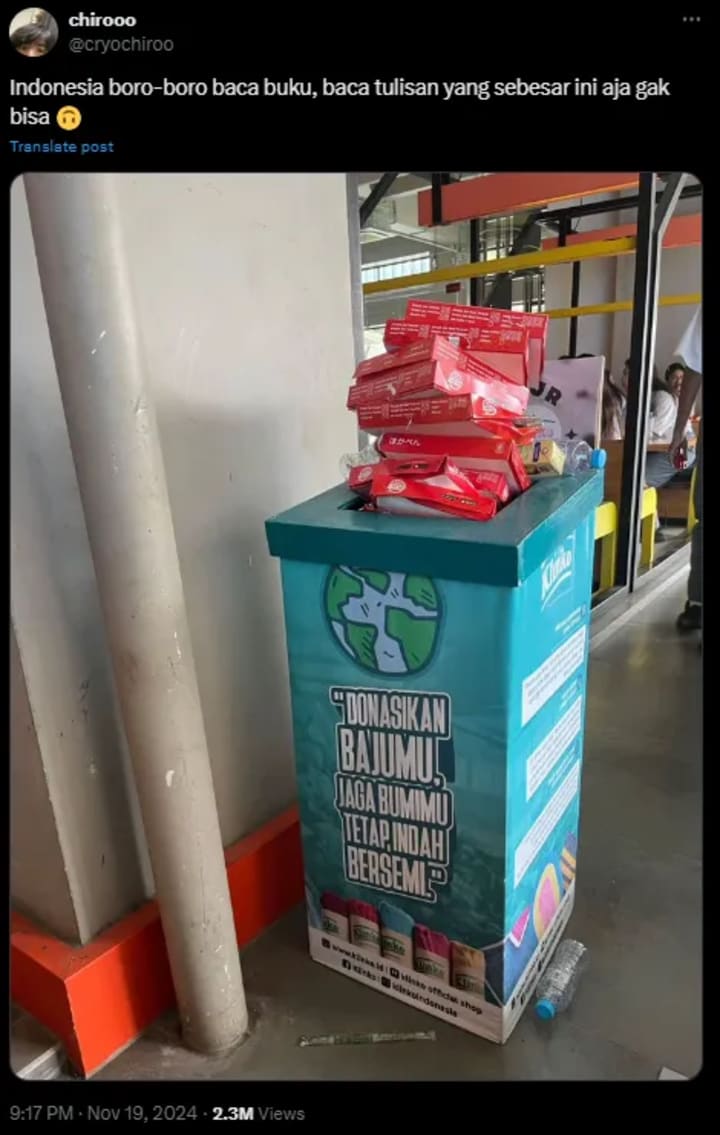
A post by X user @cryochiroo showcased a clothing donation bin outside a convenience store. Bold letters across all its sides read: “Donasikan bajumu, jaga bumimu tetap indah bersemi” (“Donate your clothes, keep the earth blooming beautifully”). Despite this explicit messaging, users stuffed the bin with trash, turning a goodwill gesture into an environmental nuisance.
Parks with No Rules?
Another example shared by @RiceSlab_Yyy depicted a park with prominent signs urging visitors not to step or sit on the grass. Large, bold, and centrally located signs can’t be missed. Yet, visitors flouted the rules entirely. Parents encouraged children to play on the grass, and adults lounged as if the signs were non-existent.

Footwear Faux Pas
X user @natanialfega added another layer to the narrative. A rug adorned with bold text urging people to “Please use your footwear” became a resting place for discarded shoes and sandals. The irony couldn’t be starker.

Medical Trash, Misplaced
Perhaps the most jarring example came from @_ikhsanrizky, who shared an image of a hospital medical trash bin. The bin had neon green instructions stating, “Use the pedal to open the lid.” Instead of following the design’s guidance, visitors placed non-medical trash on the closed bin, interpreting the instruction as a prohibition against opening it entirely.

The Challenge of Communicating Through Design
While Indonesia boasts a high introductory literacy rate, functional illiteracy — the inability to understand and apply written instructions — remains a significant challenge. According to a study by the World Bank, an estimated 55% of Indonesian adults struggle with functional literacy. While most individuals can read, many cannot process or act on complex information effectively.
This disconnect is not just a matter of education but also cultural and contextual factors:
- Educational Gaps: Many Indonesians have access to basic education but need more exposure to problem-solving or critical thinking skills. These deficits hinder their ability to interpret instructions in new or unfamiliar contexts.
- Cultural Norms: Indonesia’s communal culture prioritizes informal practices over formal rules. For instance, parks are seen as public spaces for relaxation and play, making restricting activities like sitting on the grass counterintuitive.
- Cognitive Shortcuts: Users often rely on heuristics — mental shortcuts — to make decisions quickly. These shortcuts can lead to misinterpreting signage or instructions, requiring deliberate thought.
Lessons for Designers
Beyond addressing immediate design challenges, designers have a broader opportunity to contribute to improving functional literacy. By creating educational campaigns, interactive tools, and accessible resources, the design community can play a pivotal role in bridging the literacy gap.
Educational Campaigns
Designers can collaborate with educators and policymakers to create engaging materials that promote literacy. Interactive visuals, gamified learning modules, and culturally resonant content can make literacy education more accessible and practical.
Community Engagement
Design solutions should be co-created with communities to ensure cultural relevance and user buy-in. Designers can create tools that resonate with local norms and preferences by involving users in the design process.
Advocacy and Awareness
Public campaigns that highlight the importance of functional literacy can drive awareness and funding for literacy programs. Designers can use their skills to craft compelling narratives that inspire action.
Beyond the Blame Game
Design failures observed in the clothing donation bin, hospital trash container, and park signage are not just reflections of user neglect. They underscore the critical need for thoughtful, research-driven design processes. By understanding user behavior, cognitive tendencies, and cultural norms, we can shift from blaming the user to creating solutions that resonate with their realities.

Redesign Solution: The Case of the Clothing Donation Bin
Behavioral insights from X user @anaktunggal1008 provide a compelling framework for improving the donation bin’s design. They suggest that visual and physical cues can clarify intended actions when users struggle with minimal reading comprehension.
Proposed Redesign Strategies
Enhanced Visual Communication
- Prominent Iconography: Place universally recognizable symbols, such as clothing items or a person inserting clothes, prominently on the bin to complement the text.
- Color Psychology: Adopt color codes that signal purpose. For example, green could symbolize eco-friendly initiatives, reinforced with precise contrasts.
Strategic Text Placement
Instead of confining instructions to the front, position key messages on all visible sides of the bin. This ensures users approaching from any angle understand the intended purpose.
Use concise, action-oriented phrases like “DONATE CLOTHES HERE” in the local language and font hierarchy to prioritize clarity.
Physical Redesign
- Trash-Resistant Openings: Integrate slotted or flapped entry points that accommodate folded clothes but reject trash-sized items.
- Interactive Features: Add motion-sensor-activated voice prompts in Bahasa Indonesia that greet users with reminders like, “Place only clean clothes inside, not trash.”
Benchmarking Global Best Practices
Study donation bins from countries with high functional literacy rates. Many include pictorial instructions, multilingual labels, or innovative mechanisms to encourage correct usage.
Insights for Broader Applications
The redesign principles for the clothing bin can extend to other contexts, reinforcing a user-first mindset in design:
Interactive Park Signage
Replace “Do Not Sit on the Grass” signs with visual markers designating specific areas for sitting, picnicking, or children’s play.
Introduce colored tiles, stepping stones, or rope dividers to subtly guide behavior without confrontation.
Hospital Trash Bins
Eliminate ambiguity by combining explicit textual instructions with automatic mechanisms. For instance, a hands-free lid opener could activate when users approach, reducing confusion about pedal usage.
Reinforce proper usage through visual aids on the bin, such as a chart with “Do’s and Don’ts” in both text and pictures.
Designing for Empathy and Action
These redesign approaches illustrate that effective design goes beyond mere instruction. It anticipates behavioral patterns and removes barriers to compliance. By aligning form with function and integrating behavioral insights, we can mitigate misuse while fostering positive user experiences.
Some of My Thoughts
Empathy must form the foundation of effective design. While it’s easy to criticize users for misusing products or services, the real challenge lies in addressing the gaps between user behavior and design intent. Solutions inspired by behavioral research include integrating visual cues, simplifying instructions, and benchmarking global best practices. A designer’s job is to demonstrate how designs can accommodate diverse user needs, especially in low-literacy contexts. This moves us beyond blaming users to fostering shared responsibility for creating accessible, intuitive systems.
Moreover, good design is about collaboration. Designers should involve users in the creative process, using their insights to refine and iterate solutions. By embedding empathy into every stage — from research to execution, designers can craft experiences that empower individuals rather than alienate them. Effective design doesn’t just solve problems; it creates environments where people feel understood, valued, and capable of making the right choices.
The responsibility lies not in designing for people but in creating with them.
About the Creator
Gading Widyatamaka
Jakarta-based graphic designer with over 5 years of freelance work on Upwork and Fiverr. Managing 100s logo design, branding, and web-dev projects.
Keep reading
More stories from Gading Widyatamaka and writers in Art and other communities.
'Till Death We Do Art
There would be nothing divine in this world without art. Nature may surpass the divine to all intents and purposes, but like everything it absorbs and is absorbed by, it remains here, stuck on the surface of this world, ever-present, physically bound to the universe.
By Avocado Nunzella BSc (Psych) -- M.A.P 18 days ago in Art
Echoes in the Silence
In the distant future, on a planet known as Elara, there was a small village named Felsia. This village was surrounded by vast forests and towering mountains. The people of Felsia lived simple lives, but they had one unique feature—every villager possessed the ability to hear echoes of the past. When someone spoke, their words would create echoes that floated in the air like whispers, allowing others to hear stories long gone.
By Hamad Afridi 6 days ago in Art
"Scream 7" (2026): Running out of Fresh Screams
This is the seventh time we’ve had a Ghostface crisis. Scream 7 is the latest edition of the Scream franchise. Sydney Prescott and her family are under attack by another anonymous killer dressed in a Ghostface costume. While having issues with her daughter, Tatum, they run from the bloody murders, trying to determine who is behind it all.
By Marielle Sabbag6 days ago in Horror




Comments (1)
Pretty true! Great work! Good job’!