
Cried Clay
A sculptor haunted by loss discovers that even clay can carry love and memory

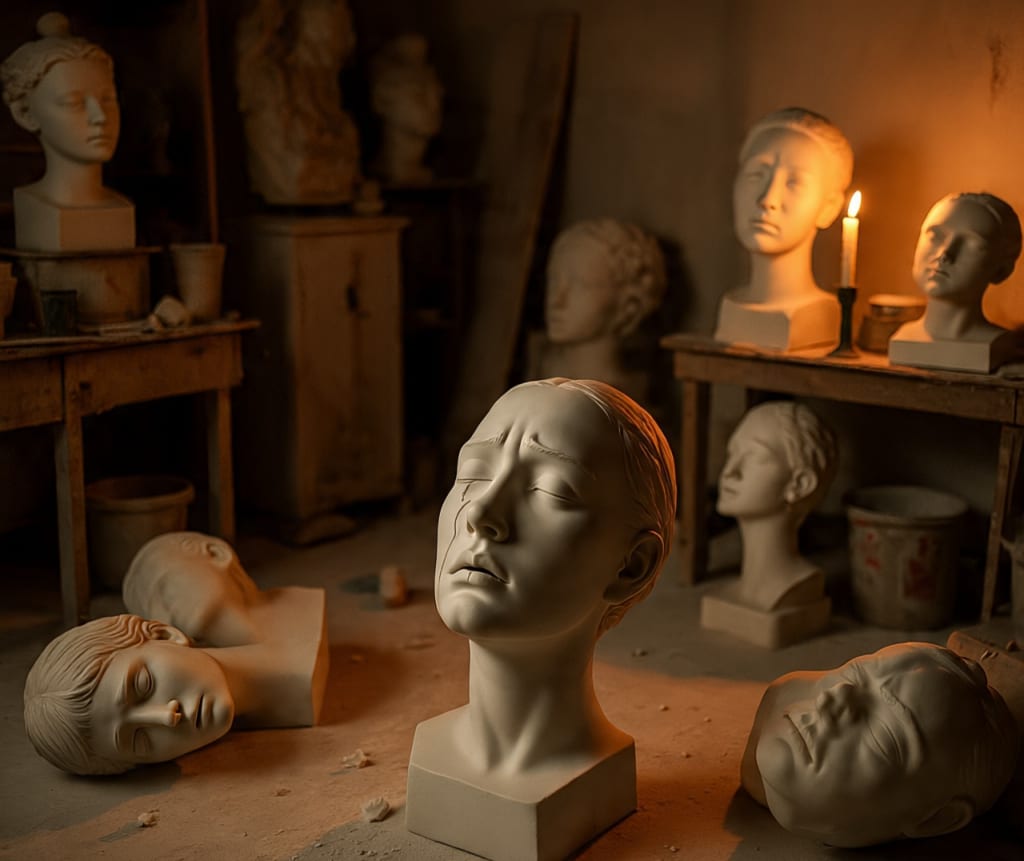
In a quiet village in southern France, there lived a sculptor named Adrien Marchand. His hands were known across the region for turning lifeless clay into faces that seemed almost ready to breathe. He never married, never had children, and rarely spoke. He lived for his art — and for the one memory that haunted him every day.
Long ago, Adrien had been engaged to a woman named Claire. She had been a painter, full of laughter and light. They had planned to open an art studio together, a small space by the river where her colors and his sculptures would live side by side. But life, as it often does, turned differently. Claire fell ill one winter, and within weeks, she was gone.
After her death, Adrien stopped sculpting for nearly two years. His hands, once so sure, trembled whenever they touched the clay. He avoided people, living quietly in his stone cottage at the edge of the village. But grief is a strange companion. It doesn’t stay silent forever. One night, unable to sleep, Adrien sat by his wheel again.
He began shaping the clay, not thinking, not planning. His hands moved on their own, as though guided by a memory buried deep inside him. Slowly, a face emerged — soft, delicate, unmistakably hers. Claire. Her eyes closed, her lips curved into a faint smile.
When he finished, he stared at it for hours. For the first time in years, he spoke aloud. “I tried to forget,” he whispered. “But you never left.”
That night, as rain fell softly on the roof, Adrien dreamed of her. She was standing in a field of sunflowers, laughing the way she used to. But when he reached out, she turned to clay and crumbled in his hands. He woke up crying, his heart aching with the strange feeling that she had been close, too close.
The next morning, when he entered his studio, he froze. The sculpture’s face was wet — not damp from the rain, but streaked, as though tears had rolled down its cheeks.
He touched it. The clay was cool, the tears real. For a long moment, Adrien stood there, unsure if grief had finally broken him. Then, slowly, he smiled. “So even you remember,” he said softly.
Days turned into weeks. Adrien continued to sculpt, and every piece he made seemed to hold something human inside it — a pulse, a breath, a trace of sorrow. People from nearby towns came to see his work. They said his statues looked alive, that they carried emotion no one could explain. One woman swore she saw her late husband’s eyes glisten in a bust Adrien had made.
But Adrien never sold the first sculpture. He kept it on a table near the window, where the morning light touched its face. Sometimes, he would sit across from it, speaking as if to an old friend. “I know,” he would say. “I’m trying.”
One evening, a young apprentice named Luc came to learn from him. Luc was curious and full of questions. He often caught Adrien staring at the sculpture for hours. “Who is she?” Luc finally asked one day.
Adrien smiled faintly. “Someone who taught me that clay can cry, and hearts can heal.”
Luc never understood what he meant, not fully. But he noticed something strange — whenever Adrien worked with deep feeling, the clay seemed to soften differently, as though listening to him.
Years passed. Adrien grew older, his hands slower, but his art more tender. One spring morning, Luc came to the studio and found Adrien sitting quietly at his wheel, eyes closed, a gentle smile on his face. He had passed away in his chair, the sculpture of Claire beside him.
When they prepared his things, Luc noticed something new. The sculpture’s eyes — once closed — were slightly open, as if watching over him. And on the table lay a single line written in Adrien’s uneven handwriting.
“Art does not end when the artist does. Love shapes what the hands cannot.”
The villagers still tell his story. They say that on rainy nights, if you walk past the old studio, you can hear the faint sound of a chisel and the whisper of clay being molded. Some say it’s the wind. Others believe Adrien still works beside her — the clay that once cried now smiling in the moonlight.
About the Creator
LUNA EDITH
Writer, storyteller, and lifelong learner. I share thoughts on life, creativity, and everything in between. Here to connect, inspire, and grow — one story at a time.
Keep reading
More stories from LUNA EDITH and writers in Art and other communities.
Art That Breathed
In a quiet street in Florence, Italy, where every corner smelled of paint and coffee, there stood a small art studio with cracked windows and ivy creeping up its walls. Inside, a man named Luca spent his days surrounded by canvases that never sold and colors that refused to fade.
By LUNA EDITH5 months ago in Art
Things to do in Casablanca:
Casablanca is one of lovely destinations around Morocco. Casablanca is considered the largest city in Morocco. It's famously known for its historic attractions, cultural sites and natural landscapes. Additionally, the city is well- known for its clean beaches offering visitors a lifetime experience. This blog cover the top things to do in Casablanca:
By Othmane Anaamabout 6 hours ago in Art


Comments
There are no comments for this story
Be the first to respond and start the conversation.