
Creative Briefs: The Best Way to Track Design Projects If You’re Short on Time
How to Provide “Just Enough” Info For Your Projects


Designers often assume their audience already has context, leading to awkward silences when presenting ideas. Whether it’s a blank stare after you share user research or executives interrupting with basic questions, you’ve likely experienced the consequences of missing context.
Providing context is crucial — but finding the right balance is a challenge. Give too much, and you lose engagement; too little, and your audience won’t grasp your point.
So, how do you strike the perfect balance? The answer often lies in a Creative Brief.

That’s why taking a step back and giving more context is often a critical part of most presentations.
However, it often turns into a Goldilocks problem.
The most common mistake, especially in job interviews, is to provide too much context. But too little context doesn’t help you, either.
What’s the exact right amount of context to present your ideas? It often takes the form of a Creative Brief.
Creative Briefs: A Designer’s Secret Template
In The Design Method: A Philosophy and Process for Functional Visual Communication, Eric Karjaluto highlights how creative briefs are often one of the most versatile and powerful ways to provide context.
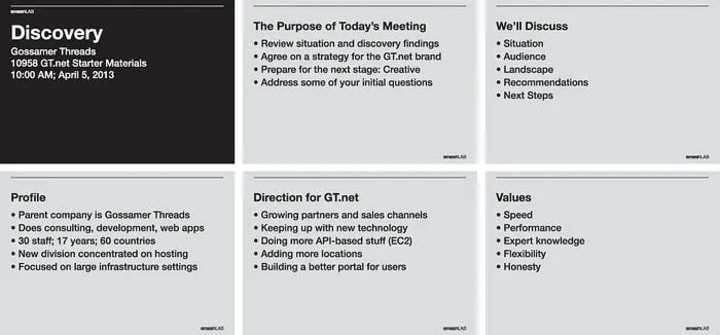
A well-crafted creative brief is versatile and valuable in several key situations:
- Onboarding new team members
- Communicating the value of design decisions
- Providing context to executive stakeholders
- Keeping track of design iterations for a portfolio
- Identifying the problem your project solves
Summarizing essential questions that led to the project’s initiation, a creative brief helps stakeholders stay aligned despite the complexities of large-scale projects.
With multiple iterations, shifting priorities, and last-minute executive directives (like “Let’s integrate AI!”), teams can lose sight of the project’s original intent.
A creative brief serves as a grounding document, keeping everyone on the same page.
Beyond internal alignment, creative briefs are also critical for design portfolios. The same high-level overview that helps stakeholders understand a project is what recruiters and interviewers need to assess your work’s impact.
So, what are the elements of a creative brief, and what do you need to express?
Provide Business Context, Not Just Design Details
The #1 mistake designers make, which leads to portfolios that don’t have much impact, is that you need to ask about the business context.
“Because the business told me to!” is not a strong rationale for design decisions. Instead, designers should ask the right questions to understand the underlying business needs.

For example, a junior designer working on an interface for nuclear engineers once told me, “The problem with the interface is that it’s outdated.” While that might be true, businesses don’t invest in redesigns without good reason.
The real motivations likely include:
- Usability issues: Errors or inefficiencies due to an outdated interface impact productivity and revenue.
- Steep learning curves: New users require extensive training, slowing down onboarding and increasing support costs.
- Brand perception: An outdated design may create a negative perception of the product, affecting sales.
By understanding how businesses define success and what they care about, you can help define how the business context fits into the creative brief with a single question:
How will the business measure this project’s success or failure?
This question helps connect the design process to tangible business outcomes, making your work more impactful.
Instead of saying, “I redesigned an old interface,” you can say, “I redesigned an old interface to improve user onboarding and reduce errors.”
After that, you need to focus on change.
Why Change? Establishing the MVP
The next thing you must do is highlight the need for change. Most businesses adhere to the principle: “If it ain’t broke, don’t fix it.”
If a Minimum Viable Product (MVP) is working well and isn’t costing money, there’s little incentive to change.
So, your creative brief should address:
- What’s wrong with the current design?
- What user behaviors need to change?
Design, from a business perspective, is about behavior change. If you’re redesigning an old UI for nuclear engineers, consider what behaviors the current design promotes. Perhaps new users:
- File excessive support tickets due to confusion
- Require six months of supervision to learn the system
- Make frequent errors that require corrections
Framing problems in these terms demonstrates the value of design. If you’re struggling to pinpoint the user behavior shift, ask:
What specific user behaviors do we need to encourage or eliminate?
After all, design, from a business perspective, is about changing user behavior.
Highlighting the problems like this, in plain terms, helps show the value of design. By clarifying why the current solution doesn’t work, you also clarify the problem you’re attempting to solve.
After that, we can begin brainstorming our current solution (which will change with each iteration).
Using “How Might We” to Frame the Problem
“How Might We” (HMW) is a powerful tool — but only when used correctly. Instead of vague questions like, “How might we design a table for easy sorting and filtering?” focus on behavior change.

For instance, if nuclear engineers need six months of training to use the interface, your HMW statements might be:
- “How might we simplify onboarding so users don’t feel overwhelmed?”
- “How might we reduce the number of complex decisions new users must make?”
- “How might we prevent users from choosing advanced options that could cause errors?”
By defining the large-scale context and the current design problems, “How Might We” becomes a valuable tool for discussing the current design approach for fixing these problems.
This not only helps us understand the scope of behavior change that we hope our design has, but it also helps us understand and establish why it matters.
Establishing “Why” Matters More Than Ever
Today, businesses expect designers to do more than present polished visuals. In a results-driven environment, companies need clear justifications for every dollar spent. That means explaining why your design matters in plain language.
Rather than documenting every detail of your process, a creative brief provides a structured, high-level summary that can be referenced across multiple contexts. It serves as a:
- Project tracker to maintain alignment across iterations
- Presentation tool for explaining design decisions
- Portfolio aid to communicate project impact to recruiters
That’s why the creative brief can be so important. Rather than a daily tracker or guessing 6 months after the fact, the creative brief is a versatile overview that can be plugged into a dozen places.
So, if you’re wondering how to summarize your work, try leaning into briefs.
The Power of Creative Briefs
In today’s competitive landscape, simply showcasing beautiful visuals isn’t enough. Businesses need to see the impact of design decisions, this requires providing context.
A well-structured Creative Brief helps streamline communication, align teams, and ensure your designs serve user needs and business goals. It’s a tool that keeps everyone on the same page — from executives to designers to recruiters.
If you’re looking to strengthen your project tracking and communication, start implementing creative briefs into your workflow.
Your future self and stakeholders will thank you! 🚀
About the Creator
Gading Widyatamaka
Jakarta-based graphic designer with over 5 years of freelance work on Upwork and Fiverr. Managing 100s logo design, branding, and web-dev projects.
Keep reading
More stories from Gading Widyatamaka and writers in Art and other communities.
'Till Death We Do Art
There would be nothing divine in this world without art. Nature may surpass the divine to all intents and purposes, but like everything it absorbs and is absorbed by, it remains here, stuck on the surface of this world, ever-present, physically bound to the universe.
By Avocado Nunzella BSc (Psych) -- M.A.P 27 days ago in Art
The Front Seat
I found myself waking up in the front seat of the bus. My eyes were filled with the early morning darkness. I had been asleep, but I wasn’t sure for how long. I tried to wake up my body, but my head felt heavy, as though I had been sleeping for an eternity, although I couldn’t pinpoint how much time had passed.
By Aunty Sada3 days ago in Art
Why Didn't Anyone Tell Us
Men, move along. This is not for you. This is for the women. I was forty-five when I began menopause. It is pretty young for that to be going on in a woman’s life, but I had undiagnosed PCOS, my entire life. Thank you to all the gynecologists I had seen my entire life. That in itself should encourage women to keep seeking second opinions, especially when you are not getting correct answers or any at all.
By Alexandra Grant5 days ago in Humans



Comments
There are no comments for this story
Be the first to respond and start the conversation.