


Cloisonné , French pronounceation: [klwazɔne]) is an ancient technique for decorating metalwork objects with colored material held in place or separated by metal strips or wire, normally of gold. In recent centuries, vitreous enamel has been used, but inlays of cut gemstones, glass and other materials were also used during older periods. Cloisonné enamel was probably developed as an easier imitation of cloisonné work using gems. The resulting objects can also be called cloisonné.
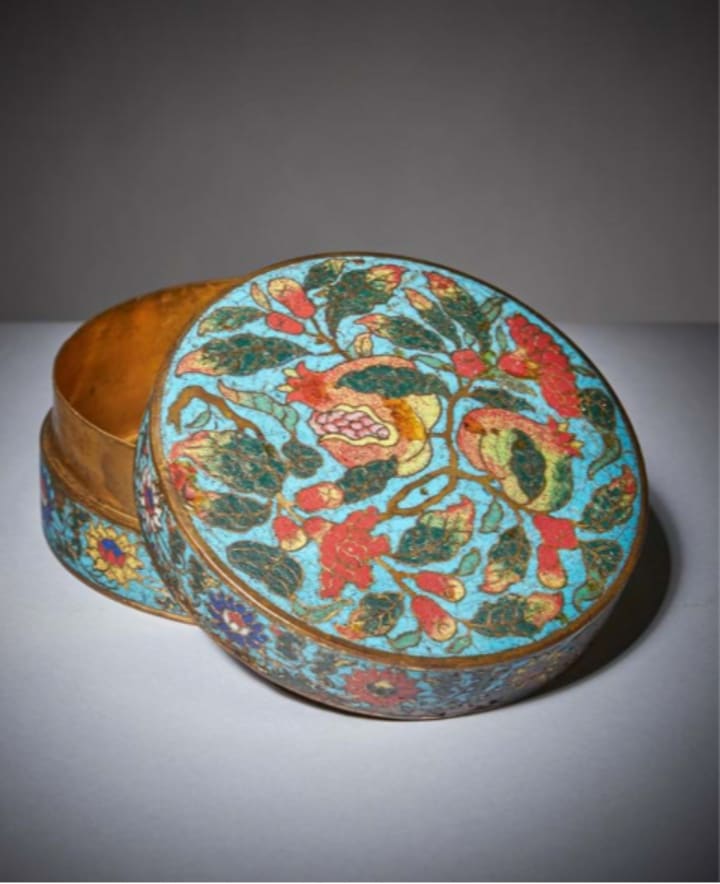
The decoration is formed by first adding compartments (cloisons in French) to the metal object by soldering or affixing silver or gold as wires or thin strips placed on their edges. These remain visible in the finished piece, separating the different compartments of the enamel or inlays, which are often of several colors. Cloisonné enamel objects are worked on with enamel powder made into a paste. The objects are fired in a kiln for finishing. If gemstones or colored glass are used, the pieces need to be cut or ground into the shape of each cloison.
In antiquity, the cloisonné technique was mostly used for jewellery and small fittings for clothes, weapons, or similar small objects decorated with geometric or schematic designs, with thick cloison walls. In the Byzantine Empire, techniques using thinner wires were developed to allow more pictorial images to be produced. These were mostly used for religious images and jewellery, and by then always using enamel. This was used in Europe, especially in Carolingian and Ottonian art. By the 14th century this enamel technique had been replaced in Europe by champlevé. By then, cloisonne technique had spread to China, where it was soon used for much larger vessels such as bowls and vases. The technique remains common in China to the present day. From the 18th century, artisans in the West produced cloisonné enamel objects using Chinese-derived styles.
History
Ancient world
Cloisonné first developed in the jewellery of the ancient Near East, and the earliest works with enamel all used the cloisonné technique, placing the enamel within small cells with gold walls. This had been used as a technique to hold pieces of stone and gems tightly in place since the 3rd millennium BC, for example in Mesopotamia, and later in Egypt. Enamel seems likely to have developed as a cheaper method of achieving similar results.
The earliest surviving undisputed objects known to use enamel are a group of Mycenaean rings from a tomb in Cyprus, dated to the 12th century BC, which used very thin wire.
In the jewellery of ancient Egypt, including the pectoral jewels of the pharaohs, thicker strips form the cloisons, which remain small.In Egypt gemstones and enamel-like materials (sometimes called "glass-paste") were both used.Although Egyptian pieces, including jewellery from the Tomb of Tutankhamun of c. 1325 BC, are frequently described as using "enamel", many scholars doubt that the glass paste was sufficiently melted to be properly so described, and use terms such as "glass-paste". It seems possible that in Egyptian conditions the melting point of the glass and gold were too close to make enamel a viable technique. Nonetheless, there appear to be a few actual examples of enamel, perhaps from the Third Intermediate Period of Egypt (beginning 1070 BC) on. But it remained rare in both Egypt and Greece.
The technique appears in the Koban culture (c. 1200 to 350 BC) of the northern and central Caucasus, and was perhaps carried by the Sarmatians to the ancient Celts, but they essentially used the champlevé technique. Subsequently, enamel was just one of the fillings used for the small, thick-walled cloisons of the Late Antique and Migration Period styles. At Sutton Hoo, the Anglo-Saxon pieces (dated to the 6th or 7th centuries AD) mostly use garnet cloisonné, but this is sometimes combined with enamel in the same piece. A problem that adds to the uncertainty over early enamel is artefacts (typically excavated) which appear to have been prepared for enamel, but which have now lost whatever filled the cloisons. This occurs in several different regions, from ancient Egypt to Anglo-Saxon England. Once enamel becomes more common, as in medieval Europe after about 1000, the assumption that enamel was originally used becomes safer.
Byzantium and Europe
The Byzantines perfected a unique form of cloisonné icons. Byzantine enamel spread to surrounding cultures and a particular type, often known as "garnet cloisonné" is widely found in the Migration Period art of the "barbarian" peoples of Europe, who used gemstones, especially red garnets, as well as glass and enamel, with small thick-walled cloisons. Red garnets and gold made an attractive contrast of colours, and for Christians the garnet was a symbol of Christ. This type is now thought to have originated in the Late Antique Eastern Roman Empire and to have initially reached the Migration peoples as diplomatic gifts of objects probably made in Constantinople, then copied by their own goldsmiths. Glass-paste cloisonné was made in the same periods with similar results – compare the gold Anglo-Saxon fitting with garnets (right) and the Visigothic brooch with glass-paste in the gallery. Thick ribbons of gold were soldered to the base of the sunken area to be decorated to make the compartments, before adding the stones or paste. In the Byzantine world the technique was developed into the thin-wire style suitable only for enamel described below, which was imitated in Europe from about the Carolingian period onwards.
Plaque from the 10th-century Cross of Otto and Mathilde in Vollschmelz cloisonné enamel on gold
The dazzling technique of the Anglo-Saxon dress fittings from Sutton Hoo include much garnet cloisonné, some using remarkably thin slices, enabling the patterned gold beneath to be seen. There is also imported millefiori glass cut to fit like the gems. Sometimes compartments filled with the different materials of cut stones or glass and enamel are mixed to ornament the same object, as in the Sutton Hoo purse-lid.
From about the 8th century, Byzantine art began again to use much thinner wire more freely to allow much more complex designs to be used, with larger and less geometric compartments, which was only possible using enamel. These were still on relatively small objects, although numbers of plaques could be set into larger objects, such as the Pala d'Oro, the altarpiece in Saint Mark's Cathedral, Venice. Some objects combined thick and thin cloisons for varied effect. The designs often (as at right) contained a generous background of plain gold, as in contemporary Byzantine mosaics. The area to be enamelled was stamped to create the main depression, pricked to help the enamel adhere, and the cloisons added.
Two different techniques in Byzantine and European cloisonné enamel are distinguished, for which the German names are still typically used in English. The earliest is the Vollschmelz ("full" enamel, literally "full melt") technique where the whole of a gold base plate is to be covered in enamel. The edges of the plate are turned up to form a reservoir, and gold wires are soldered in place to form the cloisons. The enamel design therefore covers the whole plate. In the Senkschmelz ("sunk" enamel, literally "sunk melt") technique the parts of the base plate to hold the design are hammered down, leaving a surrounding gold background, as also seen in contemporary Byzantine icons and mosaics with gold glass backgrounds, and the saint illustrated here. The wires and enamels are then added as before. The outline of the design will be apparent on the reverse of the base plate. The transition between the two techniques occurs around 900 in Byzantine enamel, and 1000 in the West, though with important earlier examples.

The plaques with apostles of around the latter date on the Holy Crown of Hungary show a unique transitional phase, where the base plaque has hammered recesses for the design, as in senkschmelz work, but the enamel covers the whole plaque except for thick outlines around the figures and inscriptions, as in the vollschmelz technique (see the gallery below for examples of this technique and vollschmelz work).Some 10th-century pieces achieve a senkschmelz effect by using two plates superimposed on each other, the upper one with the design outline cut out and the lower one left plain.
In medieval Western Europe cloisonné enamel technique was gradually overtaken by the rise of champlevé enamel, where the spaces for the enamel to fill are created by making recesses (using various methods) into the base object, rather than building up compartments from it, as in cloisonné. This happened during the 11th century in most centres in Western Europe, though not in Byzantium; the Stavelot Triptych, Mosan art of around 1156, contains both types, but the inner cloisonné sections were probably gifts from Constantinople. Champlevé allowed increased expressiveness, especially in human figures, and was also cheaper, as the metal base was usually just copper and if gold was used, it was generally to gild surrounding bare metal. In turn champlevé was replaced by the 14th or 15th century by painted enamels, once techniques were evolved that allowed the enamel to be painted onto a flat background without running. Limoges enamel was a great centre for both types.
is a related enameling technique which uses clear enamels and no metal backplate, producing an object that has the appearance of a miniature stained glass object - in effect cloisonné with no backing. Plique-a'-jour is usually created on a base of mica or thin copper which is subsequently peeled off (mica) or etched away with acid (copper). In the Renaissance the extravagant style of pieces effectively of plique-à-jour backed onto glass or rock crystal was developed, but was never very common.
Other ways of using the technique have been developed, but are of minor importance. In 19th century Japan it was used on pottery vessels with ceramic glazes, and it has been used with lacquer and modern acrylic fillings for the cloisons.[27] A version of cloisonné technique is often used for lapel badges, logo badges for many objects such as cars, including BMW models, and other applications, though in these the metal base is normally cast with the compartments in place, so the use of the term cloisonné, though common, is questionable. That technique is correctly referred to by goldsmiths, metalsmiths and enamellists as champlevé.
Cloisonné beads.
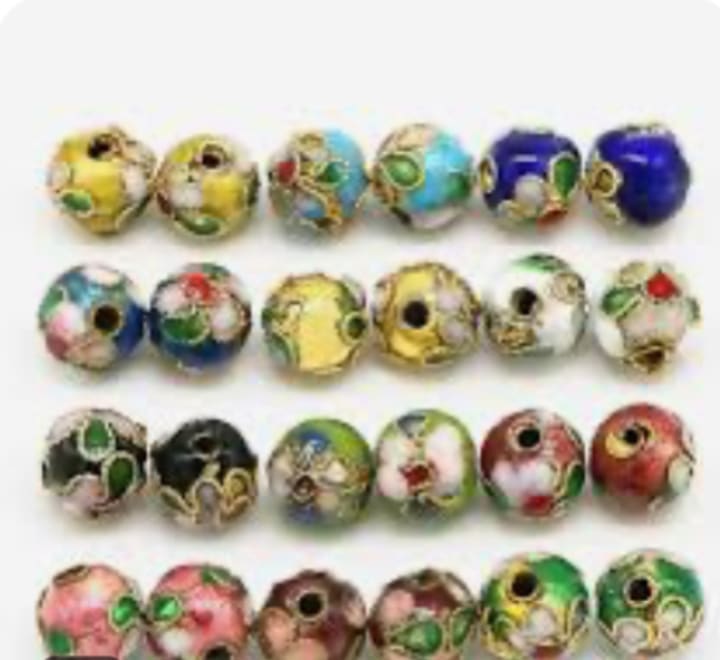
Cloisonné bead history began in the ancient Near East and Egypt around the 14th century BC with the use of inlaid gems and glass-paste, eventually spreading via the Silk Road to China, where it was popularized during the Ming and Qing dynasties. Japan, beginning around the 19th century, developed a uniquely advanced cloisonné bead industry, mastering the technique and known for the "golden age" of Japanese enamels from 1890 to 1910. The technique itself involves creating metal compartments (cloisons) filled with enamel to form intricate designs on a surface, with beads often made with pre-made recessed areas for enamel.
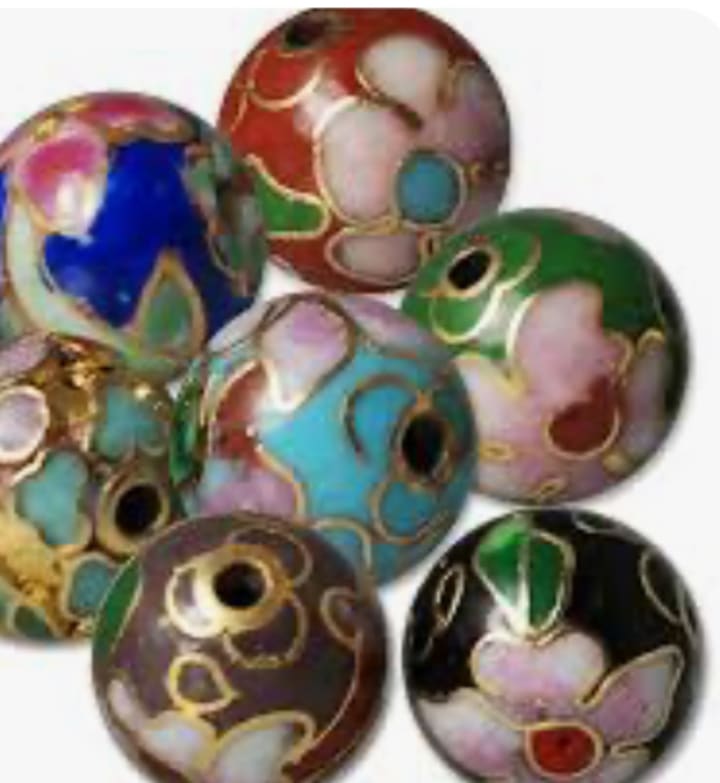
It's totally metal
Cloisonne is an enameling technique that uses metal strips to create delicate designs. The strips are soldered onto an object and hold in place colorful materials such as gemstones, glass, or, more often nowadays, enamel. The object is then fired in a kiln, smoothed, and polished.
It comes from ancient Greece
Despite its French name and prominence in Chinese decorative arts, the earliest evidence of cloisonne comes from ancient Greece. In 1952 a British archaeological expedition unearthed six gold and cloisonne rings in a Mycenaean tomb in Kouklia, Cyprus. Dating back to the 13th century BCE — that's over three thousand years! — they now reside in the Nicosia Museum.

Because of the process of first adding metal wires to an object to create "compartments" into which color materials are placed, the technique was dubbed cloisonne, coming from the French cloison, "a partition." The word cloisonne didn't appear in the English language until about 1863.
It's been in China since at least the 13th century
While cloisonne art dates back to the Yuan Dynasty (1271–1368), it was developed and popularized during the Ming Dynasty (1368–1644). During the Qing Dynasty (1644–1912), the production of cloisonne continued to grow with the emergence a variety of regional styles and techniques.
In China it's known as Jingtai Lan
The technique is believed to have come to China from the Middle East, where blue was a prominent color in the decorative arts. Hence cloisonne's name in China: Jingtai Lan or Jingtai Blue, named for this favorite hue and the Ming Dynasty emperor Jingtai (1449–1457).
It was also called 'Muslim ware'
In The Essential Criteria of Antiquities, Cao claimed cloisonne was "suitable only for lady’s chambers." While it might have been too showy for the home of an austere snob like Cao, it often furnished temples and palaces, and by the reign of the Ming Dynasty emperor Xuande (two reigns before the Jiantai Emperor), cloisonne was highly sought after in the imperial court.
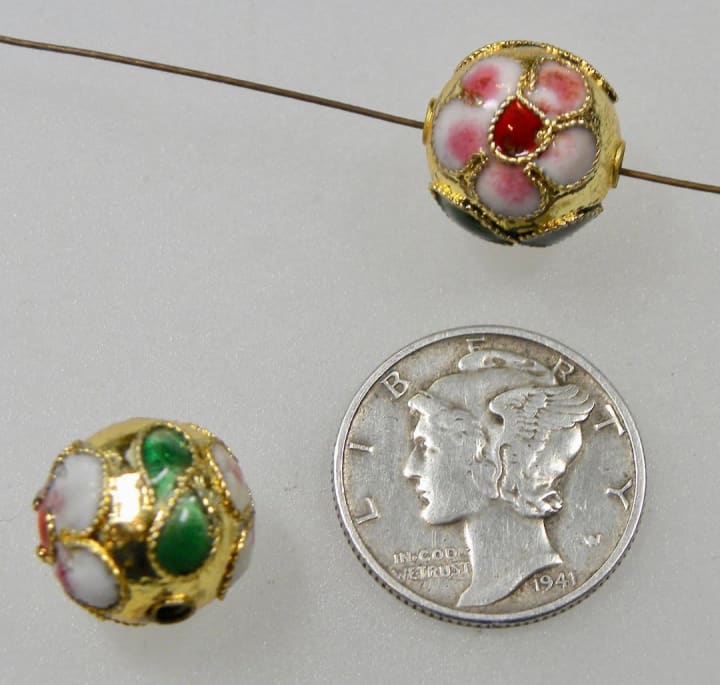
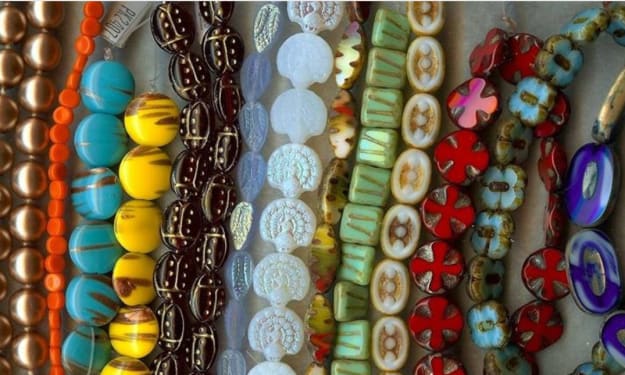
These are Cloisonne beads we sell. Aren’t they beautiful?
From antique to modern, they are true classics.
About the Creator
Guy lynn
born and raised in Southern Rhodesia, a British colony in Southern CentralAfrica.I lived in South Africa during the 1970’s, on the south coast,Natal .Emigrated to the U.S.A. In 1980, specifically The San Francisco Bay Area, California.
'Till Death We Do Art
There would be nothing divine in this world without art. Nature may surpass the divine to all intents and purposes, but like everything it absorbs and is absorbed by, it remains here, stuck on the surface of this world, ever-present, physically bound to the universe.
By Avocado Nunzella BSc (Psych) -- M.A.P 13 days ago in Art
Ida Shaghoian: Painting Memory Through Atmosphere and Light
In the world of contemporary art, few painters capture the subtle interplay between memory and environment as compellingly as Ida Shaghoian. Her work stands at the crossroads of abstraction and landscape, where color becomes language and texture becomes memory. Rather than presenting straightforward depictions of nature, she offers immersive experiences that encourage viewers to slow down, reflect, and reconnect with their own emotional landscapes.
By Ida Shaghoian4 days ago in Art



Comments
There are no comments for this story
Be the first to respond and start the conversation.