
Catalogue
ART NOT ART


These works, by Ray Taylor, (Raymond G. Taylor) are from the Paxton Centre November 2024 Art show. They are all digital artworks from his portfolio, and most are available to purchase from the show. If you are unable to attend and are interested in buying any of these works, please contact the author or the Paxton Centre for details. As digital artworks, they were printed, mounted and framed for the purposes of the Paxton exhibition. They are also available as unmounted prints and can be provided in electronic format on request.
- Paxton Centre Art show: Until Nov 30 2024, South London
- Exhibition price list
Culinary Magic (see below) has a single print edition, which is mounted and framed. This work was exhibited at Tate Modern in August 2024. Other than a single, unmounted artist's proof (AP 1/1) no other copies have been made or will be made, other than low resolution online images for illustration and promotional purposes.
All of the works shown were created using simple digital tools, and in some cases using digital photography (iPhone). The digital tools are mostly applications that can be found on a typical laptop and include things like "Paint" and "Photo." Where the image combines text and graphics, the text was written and set by Ray (me), who has been a professional author since the 1980s when he was a magazine journalist.

Pre-Raphaelite Moments, 2024: Digital image generated with the aid of AI tools and captioned.
All of the works are original, altough they frequently reference other artworks, as do the "Smokin' Pre-Raphaelites" for instance. Some of the digital images are produced with the aid of so-called 'artificial intelligence' tools. In all cases images produced by AI were subsequently edited and combined with other images and sometimes text, and are thus original works that I have created. To my mind, AI is just a tool, like a camera, a graphic design package or, for that matter, a paintbrush. I was at one time a keen amateur photographer and worked with two Pentax camera bodies with interchangeable lenses and various accessories. I did not go overboard on the equipment but I spent more than most people would have done at the time. As a consequence it was not unusual for someone to comment something like "I bet those cameras take good pictures." As you might imagine, this was irritating to say the least. "Hey! Rembrandt! Those are nice paint brushes, I bet they paint really good pictures."
Okay, I know, stretching the point. I am not an artist, have no painterly abilities, and do not presume to have the skills and artistic bent of someone trained or experience as an artist. I do have a lot of experience as a photographer (not professional) however and considerable experience with typography and other aspects of graphic design associated with publishing. On which basis I do put my own skills, as much as they are, into creating my digital works. Certainly the captions deploy my authorly abilities and, in my opinion, contribute to the artistic value of the work. Can words be art? Why not? Visit Tate Modern in London and you will see a whole gallery dedicated to words in pictures.
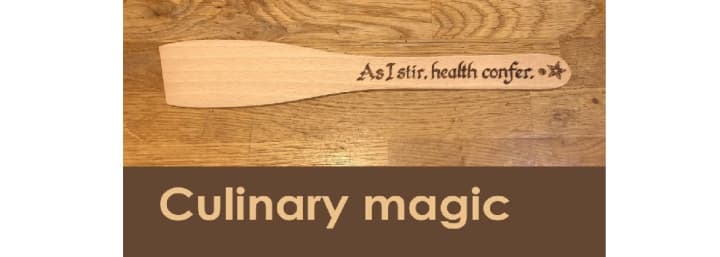
Culinary magic, 2023: RGT. Digital photography, wood pyrography, typography
Ever since I saw a foundation art students' end of year show, some ten years ago in Croydon (Surrey, England), I have pondered the question of whether words can be art. By this I mean, not just words used in a picture or sculpture but words themselves. Can I take the words "Culinary magic" away from the image and, if I did, could they be considered art in their own right? I was inspired by one student's work which consisted solely of words. I don't remember what they were but clearly they intrigued me at the time and continue to do so. Culinary Magic also includes the words "As I stir, health confer" and a pentagram symbol burned into a simple wooden kitchen tool. I bought the inscribed wooden spatula at the Witchfest International festival in Croydon in 2023. Hence the magic in the catchline and the title of the work. The above image was printed and accepted for an exhibition of staff and volunteer art at Tate Modern in August 2024. As someone who has had a work exhibited at a major international gallery, surely I can be considered an artist? Surely anyone who consciously makes art is an artist?
There are no rules to say what is art or who is an artist
Can humour be art?
Who cares? It's either funny or it isn't. Or rather, a person either finds it funny or they don't. The following work is a simple copy of a well-known Rembrandt painting with a silly caption added.

Time of death, 2024: Rembrandt painting captioned
Well, I thought it was funny. The humour in this work also serves another function. It downgrades the work from its status as an item or reverence, an icon if you will, to something more human. The painting The Anatomy Lesson of Dr. Nicolaes Tulp is a 1632 oil painting. Regarded as one of the artists early masterpieces, its home, in the Mauritshuis museum in The Hague, the Netherlands, gives an indication of the painting's fame and its value. My version of the Dutch master lives online (and in the prints I have made of it) and is worth no more than the price I may sell printed copies for.
Smokin' Pre-Raphaelites
Another attempt to inject some humour into some much-loved art works and artists. Smokin' Pre-Raphaelites came about from an unsuccessful attempt to use AI to generate an image resembling the 1888 Waterhouse painting The Lady of Shalott. I ended up with several images that were just begging for funny captions. I hope you find them (and the "Pre-Raphaelite Moments" above) amusing.
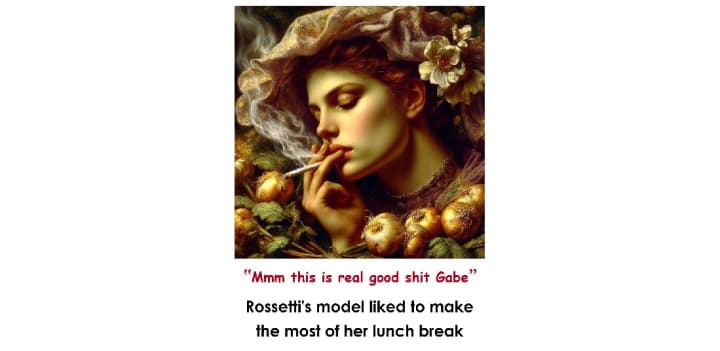
Real good lunch break, 2024: Digital image generated with the aid of AI tools and captioned.
This is one of my favourites. The central image just screeches Pre-Raphaelite with the colours, the flowers, the vegetables and the pouting, red-haired and lush-lipped female subject. The key to this image was cropping down to the essentials. Much like any photographic work.
Along similar, laid-back, themes and hopefully in a way that challenges expectations, I would offer:

Helen of Troy, 2024: Digital image generated with the aid of AI tools and captioned.
A change of approach for this simple photographic image of a bunch of sweet peas, picked from the garden and arranged in a small glass bottle. The point of this work, I would suggest, is to consider the meaning of behind the caption. At one level, simple and obvious. But is there anything in nature that is not worth pondering further?

Sweet roses, 2024: Still life photograph (RGT) of sweet peas, captioned.
Returning to a theme of art history this was originally designed as a book cover for an upcoming collection of short stories Short and Sweet Too:
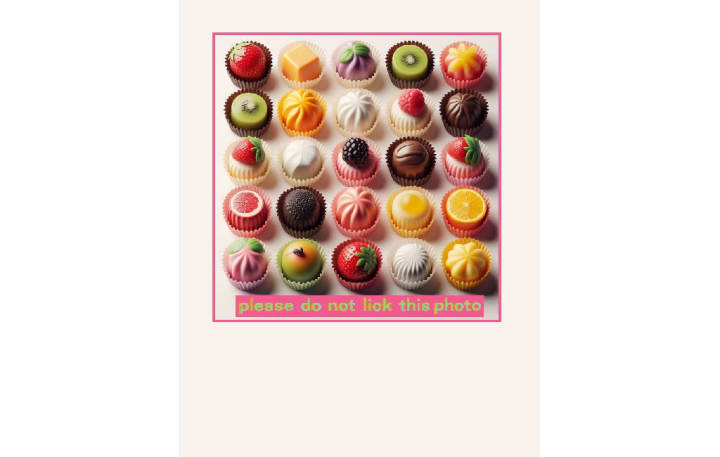
Bon bons, 2024: Digital image generated with the aid of AI tools. Caption added in the style of Warhol, Life Savers.
The reference to the Andy Warhol painting may not be obvious at first and, unlike some of the other works in this catalogue, this design has a practical purpose. It provides the front cover illustration for a book as yet to be published. The previous edition of this book was illustrated using a photograph of a typical English seaside scene.

Short and Sweet, book cover, 2022: Photograph (RGT, Donkeys on Cleethorpes Beach, Lincolnshire, England), title typography.
Last, and I hope not least, is a work that is full of artistic references, hopefully not too smart-arse. The work is a take on Johannes Vermeer, Girl with a Pearl Earring. What about the pipe? The clue is in the caption. "Ceci n'est pas une jeune fille," translated from French, means "This is not a young girl." It is a reference to Rene Magritte, The Treachery of Images, a painting of a pipe that is captioned "This is not a pipe" in French. Can you see why I have done this? There could also be a hint of Warhol and multiple images of Marilyn Monroe.

Girl with a pipe, 2024: Digital image generated with the aid of AI tools. Caption added in the style of Rene Magritte, The Treachery of Images.

What does it all mean?
One could ask this question of any work of art or art exhibition. Too often artistic works are taken for granted, at their face value. If you see a countryside scene by John Constable, you would be forgiven for thinking that this is a pleasant and idyllic rural image and it would look nice on a box of chocolates or as the subject for a 1000-piece jigsaw puzzle. Constable was considered subversive in his day. Take a look at Constable, The Cornfield and ask yourself WHY?
The whole purpose of this exhibition Art not Art is to question our assumptions about art and artists and invite a closer look at, and a deeper consideration of, any work of art. Just as Magritte's Treachery suggests we should do.
I do hope you will will visit the Paxton Centre in November if you are able to. If not, I hope you found something interesting in looking at this catalogue of works.
Paxton Centre Art show: Until Nov 30 2024, South London
Ray Taylor, October 2024
About the Creator
Raymond G. Taylor
Author living in Kent, England. Writer of short stories and poems in a wide range of genres, forms and styles. A non-fiction writer for 40+ years. Subjects include art, history, science, business, law, and the human condition.
Keep reading
More stories from Raymond G. Taylor and writers in Art and other communities.
A new age of art?
As some of those who read my work may realise, I have been experimenting with so called 'artificial intelligence' for the past two years. In addition to testing out generative text applications, I have also used online image generating products such as Dall-E to help produce original designs to illustrate my written work on Vocal.
By Raymond G. Taylorabout a year ago in Art
'Till Death We Do Art
There would be nothing divine in this world without art. Nature may surpass the divine to all intents and purposes, but like everything it absorbs and is absorbed by, it remains here, stuck on the surface of this world, ever-present, physically bound to the universe.
By Avocado Nunzella BSc (Psych) -- M.A.P 15 days ago in Art
Ken Wolverton
By Brian D’Ambrosio Along a dusty roadside of Cerrillos, connected weathered shacks lean into the landscape like a creature molded from the earth itself. Its walls are alive with color: horses rearing across mesas, dreamlike murals, and abstract forms that seem to vibrate with movement. Inside, brushes slant in jars, canvases are stacked against walls, and unfinished murals climb wooden planks. This is the world of Ken Wolverton, an 80-year-old artist whose life has been as itinerant and unconventional as the art he creates.
By Brian D'Ambrosio 4 days ago in Art




Comments (7)
i love all those sassy women, but my favorite is your Short & Sweet book cover!
Love that you are doing this and sharing it with fellow Voc as l art lovers. Your Rose by any other name photo is absolutely wonderful!
Interesting to say the least. I remember some of these from previous articles. Good work and I mainly use "Paint" for my computer artwork. I believe I have posted some here on Vocal.
Nice! That's only a bus ride away 😃 I might pop by for opening night...
Hahahahahahaha the smoking ones were my favourite!
This sounds wonderful, Ray! I wish I could attend the show.
This is a very interesting art exhibit. It seem very complex creation method .