
Cabin on the Lake
"Where the Forest Meets the Shore"

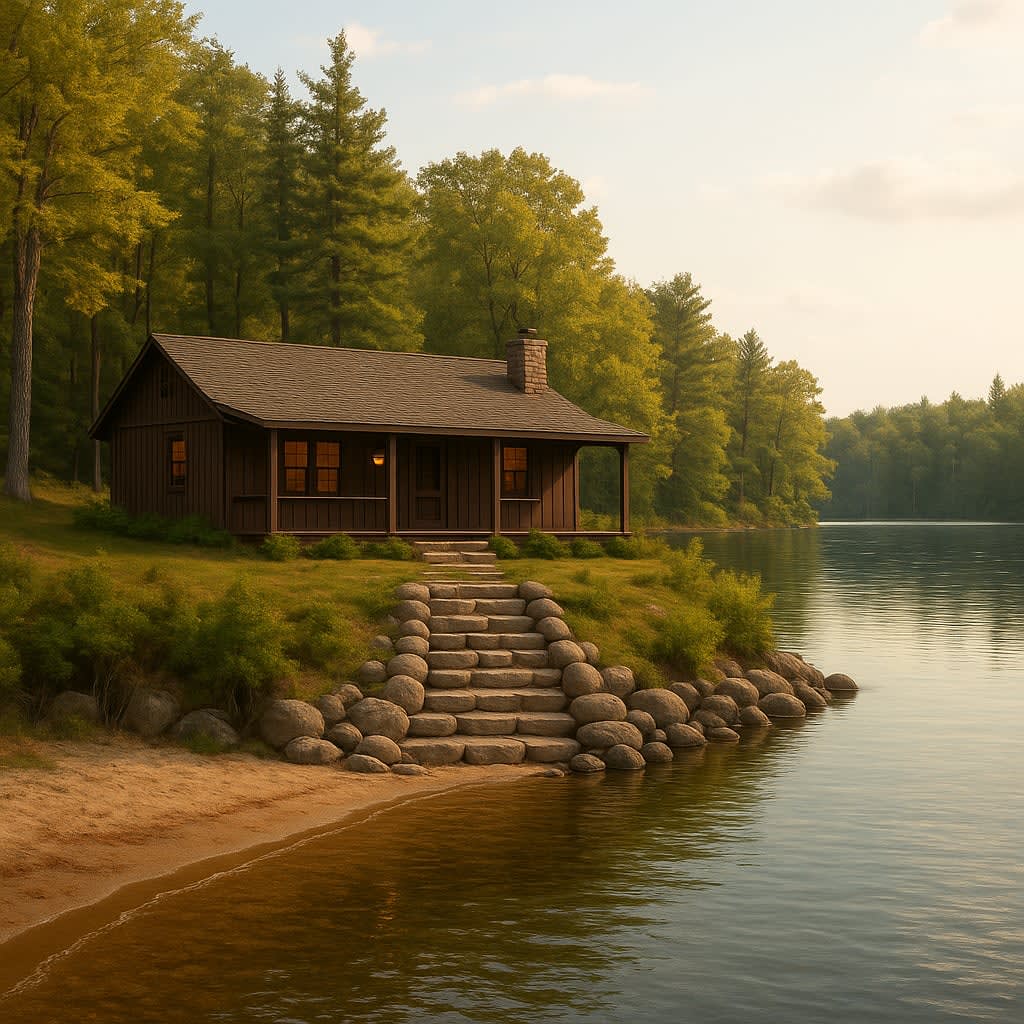
They say the stillness out here is different.
It doesn’t just quiet the noise around you—it hushes something inside. The kind of hush you don’t realize you’ve needed until you're knee-deep in it, standing in the doorway of a weathered cabin, pine needles at your feet, and a lake breathing mist into the dawn.
That’s where I was when it started—the forgetting and the remembering. Or maybe the two are the same thing.
The cabin was old, slouched like a tired man against the hillside. Time had weathered the cedar boards gray and softened the corners of the stone steps. Moss curled in the cracks. A line of birches leaned toward the lake like watchful old women, whispering secrets I wasn’t yet ready to understand.
I had come here not for a vacation, but an escape. Life in the city had grown too loud, too sharp. The constant hum of ambition, the pressure of connection, the performance of happiness—I couldn’t bear it anymore. My chest had become a cage of tight wire. Nights bled into mornings without rest. When I found the listing for the cabin—“Off-grid solitude on a private lake, surrounded by forest. No Wi-Fi. No cell service.”—I booked it without hesitation.
I didn’t even tell anyone I was going.
The first night, the silence rang in my ears like a forgotten melody. I lay on the narrow bed beneath a wool blanket, listening to the creak of the wooden frame, the rustle of trees beyond the window, and the occasional call of a loon across the water.
I slept like I hadn’t in months.
Days unfolded slowly, without schedule or screen. I rose with the sun and wandered barefoot down to the lake’s edge. The water was cold in the mornings, and I’d sink my hands in just to feel something real. There were no mirrors in the cabin, just my reflection in the glassy surface. At first, I barely recognized myself. Pale skin. Tired eyes. But each morning, the face looking back grew a little clearer. Less haunted. More human.
I began to walk. Not with a destination, just following deer trails through the trees. Pines, tall and unwavering, lined the forest like guardians. Their needles formed soft carpets beneath my feet. Occasionally, I’d come across mushrooms blooming like secrets from the forest floor, or hear the crack of a branch—some unseen creature reminding me I was never quite alone.
One morning, as the mist curled low over the lake, I noticed something strange: a tiny rowboat moored just beyond the reeds. It wasn’t mine. I hadn’t seen it before. But there it was—tied to a bent birch, weather-beaten but steady. Curiosity nudged me closer.
I climbed in, careful of the balance. The oars creaked as I dipped them into the water, and soon I was gliding—slow, deliberate—into the middle of the lake.
There, everything disappeared. The forest held its breath. The water became sky. I floated between two infinities—above and below—and felt, for the first time in what felt like years, a profound and wordless peace.
I stayed out there for hours. Watching the way the light changed on the water. Listening to the distant rustle of wings. The world had narrowed to its essence—wind, wood, and water.
And within that stillness, something inside me softened.
I began to write again. Not emails or reports or texts, but letters. To myself. To the person I was before the burnout. Before I confused productivity for worth. I wrote about the silence, about the fireflies at night, about the owl who perched outside my window and blinked like he knew my name.
I wrote about the trees.
Each day, I noticed more about them. How some bent in odd ways, shaped by storms long passed. How their bark bore scars of lightning or old age. How they stood anyway—imperfect, but alive. Just like me.
By the third week, I no longer needed to escape anything. I simply wanted to be. I read books by candlelight. I caught fish and cooked them over the fire. I stopped counting days.
The cabin no longer felt foreign. It smelled of pine smoke and sap. The floor creaked under familiar steps. The lake welcomed me like an old friend.
I knew I couldn't stay forever. Life waited beyond the trees. Responsibilities, people who loved me, a world still turning. But I also knew I wouldn’t be returning as the person who arrived.
On my last morning, I sat on the dock one final time. The mist was thinner now, the sun already warming the boards beneath me. Across the lake, the forest shimmered—green and eternal. The water lapped gently at the shore, saying goodbye without needing to speak.
I pressed my hand to the wooden dock, memorizing its texture.
“Thank you,” I whispered.
Not just to the place, but to the version of myself who had the courage to return to where the forest meets the shore. To slow down. To listen. To heal.
I left the cabin that day with no souvenirs, no photos—just the quiet certainty that somewhere, there exists a place where the world softens, where the wild things still speak, and where, if you're lucky, you can meet yourself again.
About the Creator
Keep reading
More stories from Khubaib saeed and writers in Art and other communities.
Calliope, Queen of Chorus
In the time before time, when stars still whispered secrets to one another and the moon had not yet found its rhythm, there existed a realm known only to gods and muses: Aetherion. Suspended between the mortal world and Olympus, it was a kingdom carved from harmony itself. Rivers shimmered in major chords. Trees sang lullabies in the wind. And above it all ruled Calliope, Queen of Chorus, Muse of Epic Poetry, and bearer of a voice that made even silence bow.
By Khubaib saeed 6 months ago in Art
Ida shaghoian and the Inner Geography of Painting
In contemporary painting, the most compelling work often resists easy definition. It lingers, unfolds, and asks the viewer to participate emotionally rather than observe from a distance. Ida shaghoian belongs to this tradition. Her paintings explore the fluid relationship between memory, feeling, and the natural world, creating spaces that feel both deeply personal and widely resonant. Through a refined balance of abstraction and suggestion, her work challenges conventional ideas of place, time, and perception.
By Ida Shaghoiana day ago in Art
What Happened to Keith Porter?
I am writing this letter with a heavy heart and an unwavering commitment to justice. On New Year’s Eve, our community lost a beloved father, son, and friend—Keith Porter Jr., a 43-year-old Black man whose life was tragically cut short at his Northridge apartment complex. Keith was not just a name in the news; he was a loving father, a “girl dad,” and a man who brought joy and kindness to everyone who knew him. His mother, Franceola Armstrong, described him best:
By Organic Products 2 days ago in Art


Comments
There are no comments for this story
Be the first to respond and start the conversation.