
Ben Folds: The Pianist Who Redefined Rock’s Rhythm
From Alt-Rock Anthems to Symphonic Dreams, a Maverick’s Journey Through Sound and Soul

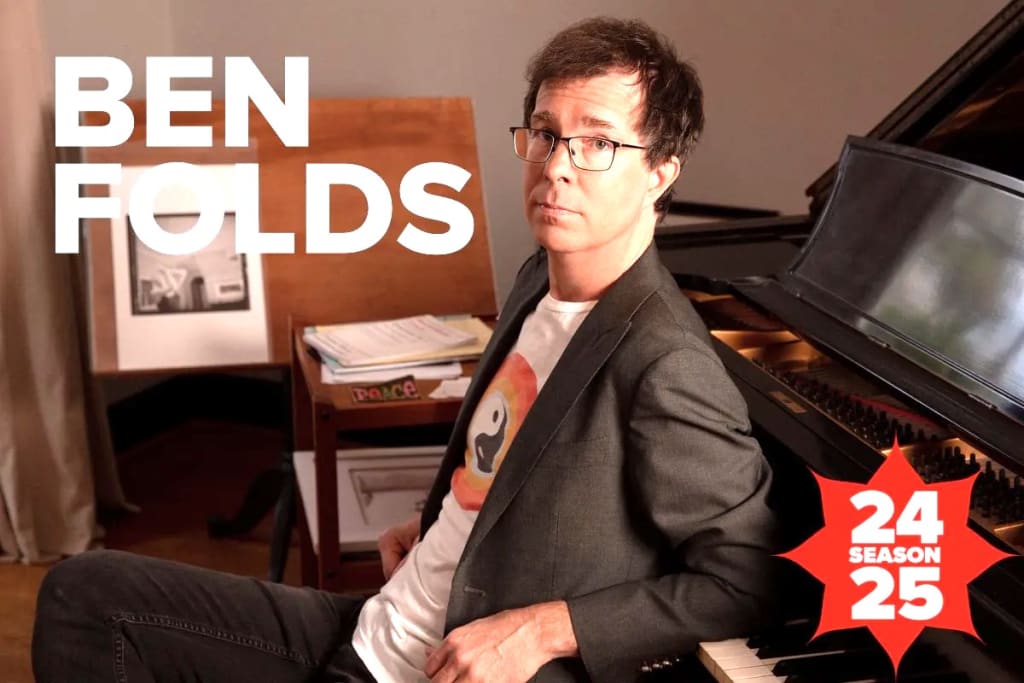
Ben Folds, the Pianist Who Changed the Face of Rock and Roll In a musical landscape dominated by guitars and synthesizers, Ben Folds emerged as an unlikely icon—a piano-pounding, wisecracking storyteller who fused classical virtuosity with rock rebellion. In a catalog that defies genre, Folds has carved out a unique niche over three decades by combining humor, heartbreak, and technical brilliance. From alt-rock anthems to orchestral symphonies, his work transcends labels, proving that a piano can rock just as hard as a Stratocaster.
Ben Folds Five's Rise: No Guitars Allowed Ben Folds, who was born in 1966 in Winston-Salem, North Carolina, spent his childhood immersed in classical music but found his voice in rock's raw energy. He formed Ben Folds Five in 1993, a trio that detested using guitars and relied instead on Folds' frantic piano, the distorted bass of Robert Sledge, and the jazz-inflected drums of Darren Jessee. Their self-titled 1995 debut introduced a sound that was both nostalgic and revolutionary, channeling Elton John’s flair and The Beatles’ melodic genius through a ’90s alt-rock lens.
The eerie ballad "Brick" from 1997's Whatever and Ever Amen marked the band's breakthrough. The song became an unlikely hit thanks to its honest lyrics and melancholy piano line, which told the stark story of a teenage couple having an abortion. Deeper tracks like "Battle of Who Could Care Less" and "Kate" showcased Folds' talent for sharp satire and vivid character studies, while "Brick" established their place in rock history. Although Ben Folds Five broke up in 2000, their legacy persisted. Combining Folds' acrobatic piano runs with the band's trademark wit and warmth, their reunions in 2008 and 2012, which resulted in The Sound of the Life of the Mind, demonstrated that their chemistry remained intact. _
Solo Stardom: From “Rockin’ the Suburbs” to Symphonies
Folds launched a solo career after BFF that broadened his creative horizons. His debut album, Rockin' the Suburbs, released in 2001 established him as a master of irony and empathy, with the title track mocking angsty rock clichés. Songs like "Still Fighting It," a tender ode to parenthood, showed a more gentle side by balancing self-pity and sincerity. The solo work of Folds frequently resembles a musical diary. Albums like Songs for Silverman (2005) and Way to Normal (2008) juxtapose biting humor (“Hiroshima (B B B Benny Hit His Head)”) with raw vulnerability (“Gracie”). With equal precision, his lyrics analyze everyday absurdities and existential crises, transforming everyday events into profound reflections. Never one to rest on his laurels, Folds tried his hand at classical composition in 2014 with the premiere of his Concerto for Piano and Orchestra. His versatility was demonstrated through international collaborations with symphonies, which bridged pop hooks and intricate arrangements. He once said, "I've always seen the piano as an orchestra unto itself." "That vision is only amplified by working with actual orchestras."
Cultural catalyst, curator, and collaborator The collaborative spirit of Folds has resulted in projects that cross genres. He collaborated with the author Nick Hornby on the film Lonely Avenue in 2010, fusing Hornby's poetic narratives with Folds' melodies. Their shared talent for storytelling was demonstrated by songs like "Belinda," which is about the obsession of a washed-up musician, and "Levi Johnston's Blues," which is a satirical take on Sarah Palin's son-in-law. He’s also championed emerging artists, producing works for acts like William Shatner (Has Been) and Regina Spektor, while his role as a judge on NBC’s The Sing-Off (2009–2013) introduced him to mainstream audiences. His sharp criticisms of and support for a cappella music contributed to the genre's legitimacy, paving the way for shows like Pitch Perfect.
The Advocate and Educator Beyond the stage, Folds is a passionate advocate for music education. As a spokesperson for the National Association of Music Merchants (NAMM) and the Kennedy Center, he’s lobbied for arts funding in schools. His “Keys for Kids” initiative donates keyboards to underserved communities, emphasizing music’s power to inspire.
“Music isn’t a luxury—it’s a lifeline,” Folds argues. Kids learn discipline, creativity, and how to connect with others through this program. Students are encouraged to "play like no one's listening" in his workshops and masterclasses, which frequently place an emphasis on improvisation and emotional authenticity.
Live Wire: The Power of Performance
To experience Ben Folds live is to witness a one-man revolution. He turns concerts into events for the whole audience, whether he plays solo or with an orchestra. He encourages the audience to sing harmonies or improvise lyrics, like on "Not the Same." His 2002 live album, Ben Folds Live, captures this spontaneity, featuring a 26-minute medley of fan requests played flawlessly on the spot.
Folds' shows are a mix of rock venue and comedy club. Between songs, he peppers audiences with deadpan anecdotes—like the time he accidentally mooned a crowd mid-solo—or shreds sheet music in mock frustration. Yet beneath the levity lies profound craftsmanship; his fingers dance across the keys with the precision of a concert pianist and the ferocity of a punk rocker.
Legacy: The Pianist for Everyman Ben Folds’ genius lies in his ability to make the extraordinary feel accessible. His songs—populated by underdogs, misfits, and dreamers—speak to universal struggles, whether it’s navigating adulthood (“The Luckiest”) or mourning lost love (“Landed”). He’s a bard of the mundane, finding poetry in grocery stores, suburban ennui, and college dorm rooms.
Folds endures in a time of fleeting trends because he defies classification. He’s a classical composer who mosh-pits. A comedian who makes you cry. A rock star who prefers a Steinway to a Strat. As he quipped in “Rockin’ the Suburbs”: “Let me tell y’all what it’s like / Being male, middle-class, and white.” But Ben Folds is anything but ordinary—he’s a reminder that artistry thrives when we embrace our contradictions.
Final Thoughts At 57, Ben Folds shows no signs of slowing down. Podcasting, composing for film, and writing a memoir (A Dream About Lightning Bugs, 2019) are among the most recent endeavors. Yet his core mission remains unchanged: to celebrate the messy, beautiful chaos of being human. In a world hungry for authenticity, Ben Folds isn’t just a musician—he’s a mirror, reflecting our flaws, hopes, and hidden harmonies.
About the Creator
Keep reading
More stories from Rocky Brahma and writers in Art and other communities.
The Art of Letting Go: Why Holding On Hurts More Than You Think
We’ve all been there—clutching onto something long after it’s served its purpose. a relationship that has ended, a dream that no longer makes sense, or even a resentment that has established itself in our hearts. Letting go feels like losing a part of ourselves, but what if I told you that holding on is the real loss?
By Rocky Brahma10 months ago in Art
The Best Philosophy in the World Is the One You Can Live
Ask ten philosophers what the best philosophy in the world is, and you will receive at least ten different answers—possibly delivered with footnotes, counterarguments, and mild contempt for the other nine. This disagreement is not a flaw of philosophy; it is its essence. Philosophy was never meant to be a universal prescription handed down like a rulebook. It exists to help human beings live better lives. By that standard, the best philosophy in the world is not the most elegant or complex—it is the one that can be lived.
By Fred Bradford3 days ago in Art
How to Succeed at the Benson Directory®
Congratulations and welcome to the Benson Directory® employee #22391! As our newest call handler, you will have the privilege of speaking with dozens of unique and interesting people on a daily basis as well as the opportunity to earn bonuses for high performance. Contained within this handbook you will find a set of ease to follow instructions designed to help you settle in to your new role and begin paving the way to success.
By S. A. Crawfordabout 20 hours ago in Fiction




Comments
There are no comments for this story
Be the first to respond and start the conversation.