
Anita Mui's Song "Time Flows Like Water"
The Voice That Cut Through Time and Taught Me What Remains Unchanged

In my music player, there’s a special playlist. It has no name, like a silent confidant. I rarely choose to play the songs within it, but they always seem to drift in during unguarded late nights on shuffle. And the one that can instantly grip my soul is, without fail, Anita Mui's "Time Flows Like Water."
My first encounter with it was on a messy, exhausting night after a move. Old belongings were strewn across the floor, and outside the window lay an unfamiliar city skyline. An immense sense of being adrift enveloped me. It was then that the song’s ethereal, expansive synthesizer intro began in my headphones, followed by a low, rich female voice that seemed to hold a thousand stories, slowly singing: "Gazing at the sea, a heart full of weariness, without tears or words..."
In that moment, all my fatigue and confusion felt as if they were gently caught and held by this voice. I had assumed it was just a classic, nostalgic song about the passage of time, the collective homesickness of a generation. It wasn't until much later, when I began digging into its backstory like a curious archaeologist, that I realized this song was so much more to me than a melody. It was an artistic "accident," the soul of a film, a stunning moment where a legendary singer and her song became one, and ultimately, a mirror reflecting the inner struggles and steadfastness in each of us.
My Chamber of Emotional Resonance: A Small Boat Adrift on the Sea of Time
The feeling "Time Flows Like Water" evokes in me isn't a heart-wrenching sorrow, but a far deeper wistfulness. It’s like watching the sun sink below the horizon, painting the world in breathtaking gold and crimson, while knowing that the beauty is a prelude to the coming night.
The Key to Memory: "My heart is like a small wooden boat / The distant view unseen / Yet still, it forges ahead." This line is the song’s most precise metaphor and the key that unlocked the floodgates of my own memories. It takes me back to my college graduation, standing at a crossroads in life, the future a vast, impenetrable fog. It reminds me of my first solo journey on a rattling train, watching the scenery fly by, my heart a mix of fear of the unknown and a defiant refusal to give in. Aren't we all just small boats, tossed about in the torrent of time? Unable to see the distant shore, yet still paddling forward on instinct alone.
The Power of Lyrics: The words of Mr. Albert Cheng Kwok-kong possess an understated depth. The genius of Cantonese lyrics often lies in using the plainest language to sketch the most profound sentiments. "Looks have long since changed, circumstances too / But this feeling remains unchanged." In just a few words, he encapsulates the essence of the human condition. Time is a relentless sculptor, changing our faces and our surroundings, but deep down, that most authentic part of us—our beliefs, our core self, our qinghuai (情怀), that unwavering inner spirit—can be the final fortress against a world of change. It’s a tender persistence, a clarity that only comes after being weathered by the years.
The Emotional Canvas of Melody: The composer, Kitaro, is a master of creating atmosphere. The song's arrangement is nothing like a traditional pop song. There’s no dramatic build-up from verse to chorus; instead, it flows like a wide, slow-moving river. The iconic synthesizer, with its Eastern, Zen-like quality, creates a soundscape that is both immense and solitary, as if instantly pulling you from the noisy world and placing you alone in a vast expanse to face your own heart. The melody meanders, long and gentle, like a continuous thread of thought, syncing perfectly with the rhythm of a contemplative heartbeat.
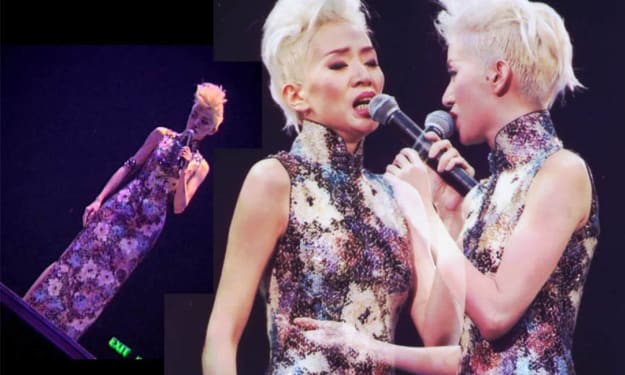
The Singer Who Became the Song: But all of this is ultimately brought to life by Anita Mui’s voice. It’s hard to believe that the artist who sang this song, filled with such a sense of infinite cāngsāng (沧桑)—that weary wisdom that comes from experiencing the world—was only twenty-one years old. Her performance is the perfect embodiment of what cultural critic Lee Chin-fung called "the singer and song as one." Drawing from her unique voice and a difficult early life, she completely internalized the song's meaning. Even more astonishing was her artistic intuition, which defied her age. The music producer, Michael Lai, later revealed that he had originally envisioned it as an upbeat track to give audiences a lift as they left the cinema. But Anita insisted on a slow, lyrical interpretation, holding her ground against the producer’s pressure. Afterwards, even Lai himself admitted that her approach was right; it was she who had forged the song's very soul.
The Archives: A Creation Born of Persistence and Two Pivotal Choices
When I learned about the song's creation, filled with serendipity and conviction, all my vague feelings about it instantly sharpened into focus.
The Source of Inspiration and a Choice: "Time Flows Like Water" was originally the theme for director Yim Ho's film of the same name. The lyricist, Albert Cheng, watched the film six times to capture its essence. Interestingly, he wrote two different sets of lyrics. One was more personal, focusing on the female protagonist's reunion with her first love ("Gazing at his face, reminiscing, reminiscing about the old days..."). The other was more epic, inspired by the film's final scene of a character rowing a small boat in the vast sea. The director chose the latter, and it was this version—about the sea, the boat, and life itself—that ultimately gave the song its vaster artistic scope and universal appeal.
The Singer's Conviction and Pursuit of Perfection: For Anita Mui herself, this song was a monument in her artistic career. It not only marked her transition from a dynamic, avant-garde image to an artist capable of handling profound works but also showcased her absolute dedication to her craft. A little-known detail is that the first version, released on a compilation album, was recorded while she was ill. Dissatisfied with it, she insisted on re-recording it for her 1985 solo album of the same name. The classic version we hear today is the result of her perfectionism and her relentless drive to challenge herself.
When Story Meets Reality: A Deeper Resonance
It turns out that behind the song's deep sense of helplessness and peace lies a story of difficult choices and unwavering persistence. It was born from a director's choice between two brilliant visions and, more importantly, a singer's insistence on trusting her own artistic intuition. This knowledge transformed my admiration for the song, extending it from the melody and lyrics to the dedication and integrity of all its creators.
That classic spoken monologue—"I want you to know, there is someone in this world who will wait for you forever..."—is, in the context of the film, a quiet, steadfast promise between characters. But outside the film, delivered in Anita Mui's voice, it becomes a timeless, warm assurance, a gentle force capable of soothing any wandering soul. It elevated the song in my heart from just "a nice song" to something I hold in reverence.
A Song for All of Us
Perhaps each of us has a river in our hearts called "Time." We were once that youth, gazing at the sea, lost and confused. We have struggled in the crowds, lamenting the whims of fate. And we will all have moments when we look back and realize our "looks have long since changed, circumstances too."
But what this song ultimately gives us is not despair, but strength. It teaches us to acknowledge the passage of time, to accept life's changes, and then, to guard that most precious "feeling" within our hearts. That might be a devotion to a dream, loyalty to a loved one, or a commitment to our own innate kindness. This song is like a mirror, reflecting the extraordinary persistence within countless ordinary people.
To this day, whenever Kitaro's synthesizer intro begins and Anita Mui's irreplaceable voice flows out, I am still struck by that calm, profound power. It feels like a silent confidant that has walked with me through many of life's important crossroads.
So, what about you? In your life, is there a "Time Flows Like Water" that chronicles your own changes and constants? I welcome you to share your story in the comments.
About the Creator
Keep reading
More stories from Pauline Brown and writers in Art and other communities.
Remembering Anita Mui: A Voice That Transcends Time
For those unfamiliar with her legacy, Anita Mui (梅艷芳) was a cultural phenomenon who dominated Hong Kong's entertainment industry from the 1980s until her untimely death in 2003. Often called the "Madonna of Asia," she revolutionized Cantopop with her powerful voice, fearless reinvention, and magnetic stage presence. Beyond music, she was an acclaimed actress whose film performances showcased her remarkable emotional range. Her influence on Asian entertainment remains immeasurable, a dazzling talent whose artistry transcended borders and continues to inspire new generations.
By Pauline Brown9 months ago in Art
2026 Commercial Space Design:How Fbierglass Sculpture Drives Traffic
Today, offline commercial spaces are facing continuous pressure. With e-commerce offering convenient and fast services, physical stores must showcase unique features to attract customers. In this context, fiberglass sculptures are no longer merely decorative items; they have become visual focal points in shopping malls, brand stores, pop-up shops, and mixed-use commercial projects, playing a crucial role in increasing foot traffic.
By Shenzhen Ruiheng Crafts5 days ago in Art
Why Strategic Branding Is Essential for Long-Term Business Growth
In today’s fast-paced digital environment, businesses face constant pressure to stand out. Consumers are exposed to endless choices every day, making attention harder to earn and trust harder to keep. While quality products and services are important, they are no longer the only factors that determine success. Strategic branding plays a key role in helping businesses grow steadily and remain relevant over time.
By Ayush Bagwari5 days ago in Art



Comments (1)
This song sounds powerful. I've had similar moments where a tune hits hard. It's amazing how music can connect like that.