
An Old Monoplane Was Discovered In An Egyptian Pyramid.
The Sakara Bird
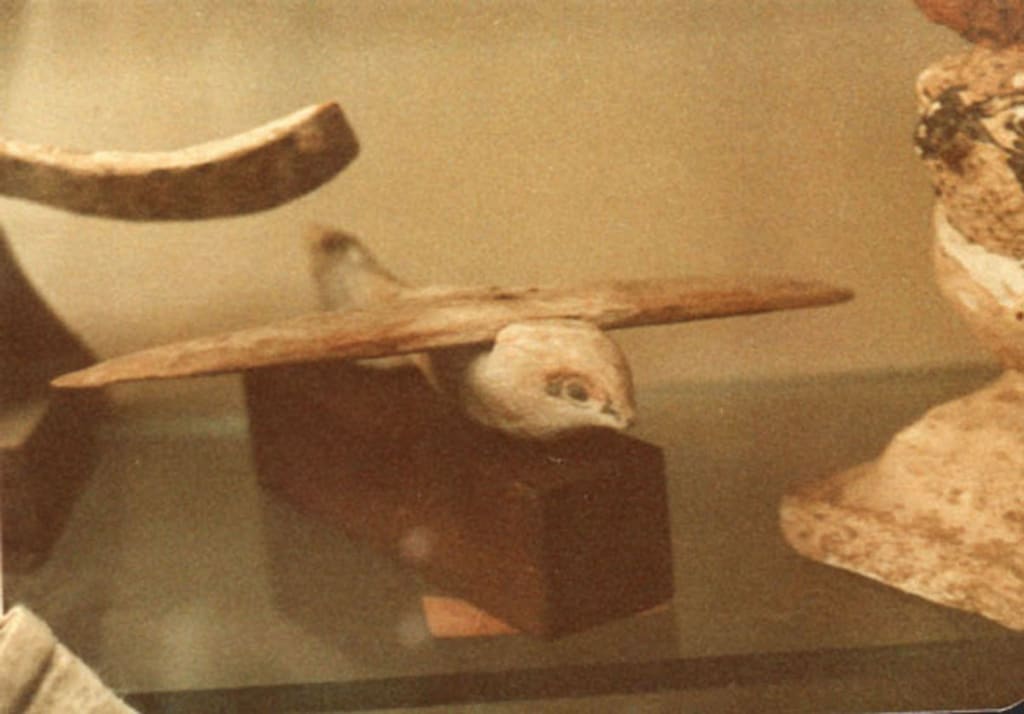
You're participating in excavations at Sakara, a location near Cairo that is full of ancient tombs and pyramids, in the year 1898 In your Indiana Jones mode, you expect to discover something truly amazing that will make you famous.
Your imagination is full of gold, books, treasure, maps, and mummies of famous pharaohs, so when you discover a wooden bird instead, you are greatly disappointed. However, little do you know that years later, it will be suggested that your bird was actually an ancient monoplane.
The artefact known as the Sakara bird is crafted from sycamore wood, measuring a mere seven inches in wingspan and weighing approximately 40 grams. This ancient Egyptian relic, which is more than 2,000 years old, serves as a remarkable and unadorned souvenir. While lacking intricate feather carvings or ornate details, it features a beak and eyes that give it the distinguished appearance of a hawk, symbolising the deity Horus.
The tail of this artefact possesses an unusual square shape, appearing strangely upright. It appears that the sunken portion of the tail is where a piece is currently absent.
Humans have a deep fascination with unravelling mysteries, and as such, various attempts have been made to elucidate the purpose of the Sakara bird. The first and simplest explanation suggests that it served as a ceremonial object. Another notion proposes that it might have been a child's toy from a privileged family, possibly resembling a type of ancient Egyptian boomerang, a popular concept at the time. Additionally, a theory once speculated that the bird functioned as a weathervane, although this idea has been discredited due to the absence of any holes or markings, except for the one added by the Museum in Cairo to mount it on a stick for display, rendering it impractical for hanging.
Many decades after the discovery of the bird, approximately a century ago, the Egyptologist Dr. Khalil Masiha introduced a fresh theory suggesting that it might have been a representation of a monoplane.
He held the belief that the bird was lacking a horizontal tailplane; however, its wings were positioned at a right angle akin to modern aeroplanes. This configuration, he suggested, could potentially have enabled the generation of the necessary aerodynamic lift for flight.
Dr. Masiha also asserted that during that era, it was a prevailing practice to include miniature models of technological innovations within tombs.
Did the ancient Egyptians truly pioneer aviation around 200 BCE? If so, it would certainly challenge the Wright brothers, who are traditionally recognized as aviation's inventors and made one of their earliest flights in 1903.
The only way to ascertain the truth is by conducting tests on the model. However, it's highly unlikely that the revered exhibits at the ancient Museum in Cairo would be permitted to take flight like toys. That's why glider designer Martin Gregory constructed a similar model using balsa wood. His conclusion was that, even with the missing tailplane, the aircraft didn't perform exceptionally well in flight. But the case remained inconclusive. This assessment didn't suffice for the History Channel, prompting them to engage an aerodynamics expert to create another replica of the bird. This expert conducted tests in conditions resembling those in Egypt and was impressed by the small plane's capabilities.
If the ancient Egyptians indeed crafted a prototype of an aircraft during the Pharaonic era, it would serve as a notable instance of an "oopart" (out of place artefact) — an object that stands significantly ahead of its time in terms of both technology and historical context.
The Sakara bird is not the sole instance of such groundbreaking innovation. In 1901, a team of divers recovered the Antikythera mechanism from a sunken shipwreck near the Greek island of Antikythera. This remarkable find has earned the title of the world's first analog computer and is estimated to date back to approximately 100 BCE. Crafted from bronze, this mechanism had the capability to determine the positions of the sun, moon, planets, and stars, in addition to tracking lunar phases.
The Antikythera mechanism not only predicted upcoming solar eclipses but also accurately gauged the moon's speed across the heavens. The identity of its users, its origin, and the methods of its creation remain shrouded in mystery. However, its remarkable precision is undeniably evident, showcasing an advancement far beyond its contemporary era.
The notion that the first flushing toilets were developed in the mid-20th century is a joke. In actuality, both the ancient Minoans on the Mediterranean island of Crete and the Indus Valley Civilization independently conceived this ingenious invention approximately 4,000 years ago.
The plumbing and sanitation systems of that era were executed so effectively that it took nearly 2,000 years before any improvements emerged. A notable example of ancient Minoan lavatory design was unearthed at the Palace of Knossos. This lavatory featured a wooden seat positioned above a tunnel, which skillfully channelled water from a rooftop reservoir into an underground sewer system.
In contrast, different versions of these facilities relied on water from containers or jugs, with the opulent elite being the only ones who could indulge in such luxurious amenities.
In those times, if you were searching for real estate, the presence of a flushing toilet would serve as a clear indicator that you were in an affluent neighbourhood.
Automated doors gained popularity as a seemingly fresh innovation in 1931, but the underlying technology behind them has a much older history.
It is believed that Heron of Alexandria, a mathematician and engineer from the first century CE, devised a hydraulic system to operate temple doors, putting this technology into practice.
To generate heat in this setup, a fire was essential. A brass pot, placed beneath the fire, contained water, and the inventor linked this brass pot to containers serving as weights. As the fire burned, the water transferred into the containers, causing them to descend and pull the ropes. However, this mechanism was quite distinct from today's automatic supermarket doors, which open before you even have a chance to think.
Heron's door required several hours to complete its opening sequence, and once initiated, there was no way to halt the process. Consequently, the doors were exclusively opened once a day, just before people entered the temple. This deliberate timing added an aura of mysticism to temple ceremonies, creating a somewhat eerie ambiance.
It appears that the earliest known battery emerged approximately 2,000 years ago in Baghdad. A German archaeologist discovered an oval-shaped clay jar in 1938. The specific purpose and inventor of this artefact remain uncertain. One hypothesis suggests it may have been employed for electroplating objects with precious metals. When filled with a weak acid such as vinegar, this battery could generate approximately one volt of electricity. Alternatively, there's a theory that it might have been used as a container for sacred scrolls.
Are you interested in purchasing contact lenses personally crafted by Leonardo da Vinci in the year 1508?
He devised a glass lens featuring a funnel on one side, intended for wear with water inside to enhance vision. It does seem somewhat uncomfortable, doesn't it? About a century later, the French scientist René Descartes aimed to refine this concept, transitioning to cornea contact lenses. Hence, the term "contact lenses" emerged because they make direct contact with your eyes—quite clever, isn't it?
While the glass tube with liquid did enhance vision, unfortunately, blinking became an impossible feat.
It took approximately two and a half centuries for advancements in the glass industry to enable scientists to create contact lenses that could comfortably fit into the eye and allow the wearer to blink freely.
Nevertheless, those lenses were crafted from thick blown glass and did not permit proper ventilation for the eye.
Around half a century later, contact lenses transitioned to plastic materials, offering attributes like lightweight, durability, and scratch resistance. However, they continued to envelop the entire eye. Then, in 1948, an English optical technician stumbled upon a discovery: by sanding down a plastic lens, they realised it could remain securely in place even when covering only the cornea.
Consider a scenario where you reside in 19th-century London and need to dispatch a message to New York, a journey that used to consume approximately 10 days by ship. Consequently, when the delivery time significantly decreased from days to mere hours in 1858, it created a genuine sensation. The inaugural message was transmitted by Queen Victoria herself, made feasible by the existence of the transatlantic telegraph cable running beneath the ocean.
Regrettably, this exciting new invention had a brief existence, as it faltered after only a few weeks, necessitating years of effort to resurrect it.
About the Creator
Keep reading
More stories from writers in Art and other communities.
'Till Death We Do Art
There would be nothing divine in this world without art. Nature may surpass the divine to all intents and purposes, but like everything it absorbs and is absorbed by, it remains here, stuck on the surface of this world, ever-present, physically bound to the universe.
By Avocado Nunzella BSc (Psych) -- M.A.P 27 days ago in Art
How Working With a Florist in Jupiter Enhances Your Event Decor
Selecting the perfect floral arrangements can transform an otherwise ordinary event into a visually stunning experience. In Jupiter, Florida, the subtropical climate provides an ideal backdrop for an array of breathtaking floral designs that can enhance any space. By employing the expertise of a local florist jupiter, hosts can elevate their event's aesthetic beyond the commonplace and into the extraordinary.
By Shahid Sipra4 days ago in Art



Comments
There are no comments for this story
Be the first to respond and start the conversation.