
A Mermaid Skeleton
Documentation for a fun project

(Author's note: this is my writeup about my latest project, aimed at the SCA, which is the Society for Creative Anachronism. We study the arts and sciences of the Medieval period, and I may have a reputation for being an instigatrix that likes to push boundaries. With that in mind....)
I know what you're thinking: what the non-period cinnamon toast crunch is THIS?!?
Bear with me, at least till the resources.
I know that we study the arts and sciences of the Medieval period, but some techniques are a bit more blurry than firm dates would like you to admit.
Though I do my research, and know I may be pushing it. I ask odd questions: "Could this have been done in such and so period? Did they have the techniques? Humans would likely think of it, but could they put it into practice? What would that look like? Could it be a one-off, or could it have become popular or common?" Like when I spun up mammoth fur, for instance.
Outside of the scope of the SCA, I have always been fascinated with Fiji mermaids. I still have plans to create a real one, but until such time, Henri3lla will have to suffice. My sewn-together plushie (half fish stuffie, half monkey stuffie) hangs out at my desk or bedstand. I'm thinking of making a real half-mouse, half-fish, but I'm not going to go out and kill something just for my crafting. I chatted with two people who make ethical art with animal bones at Pennsylvania Renaissance faire last month, and that's when I got the idea for this piece.
Anatomical drawings were very well known; see Leonardo da Vinci for the most famous examples. Wax anatomy models were known throughout, from Egypt and Greece (votive offerings) to Italy, where it really took off into a complicated industry. Pottery models? All over the place, and if you know me, you know what my favorite ones are. Moving right along...

Could glass have been used for anatomical studies?
Do I know it's unlikely? Sure. But am I curious enough to try it anyway, knowing there are always rich people trying to one-up each other in the "lookie what I can display" department? See the German late period glass chain mail. One crazy person with a rich patron.
I'm just nutz enough to try it. A skeleton, I mean; I've already done the chain.
I'm absolutely sure someone thought of it, since the wax models became popular. Boxwood carvings of the danse macabre and memento mori show that 3D models were desired. But so far, no documentation or pieces of a glass skeleton have emerged.
But what about the equipment? Is it possible?
With a "Viking" bead kiln, no. With a Roman kiln, yes. With a Chinese Warring States kiln, possibly, but they would have gone with porcelain instead (and did, later, with medical models), or ivory. With a Victorian alcohol lamp, most definitely. With Venetian lamps, definitely. I've played with most of these setups, and the ones I haven't, I know the techniques and temperatures well enough to make accurate guesses.
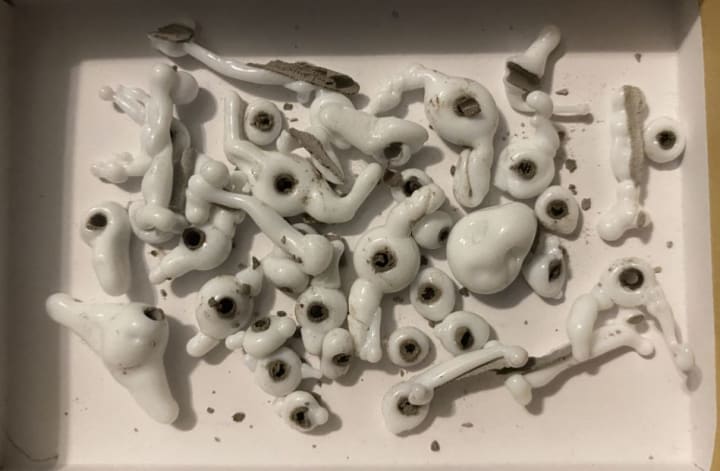
So I waited till I had a tank with little MAPP left in it on a modern lampwork setup, and made beads. It was quite difficult, getting things proportional and on tiny diameter rods. I had quite a boneyard when I was finished with the session, and had enough multiple ribs, vertebrae, and radii to make two more skeletons. It took a while to get into the hang of it, and I had to change tanks when I ran out of gas making a knobbed vertebra - I should have been making a humerus, I was not amused. Proportions on the fly are difficult! Skull, tail fins, and paddle hands were a bit easier (and bigger, thinking fin shapes).
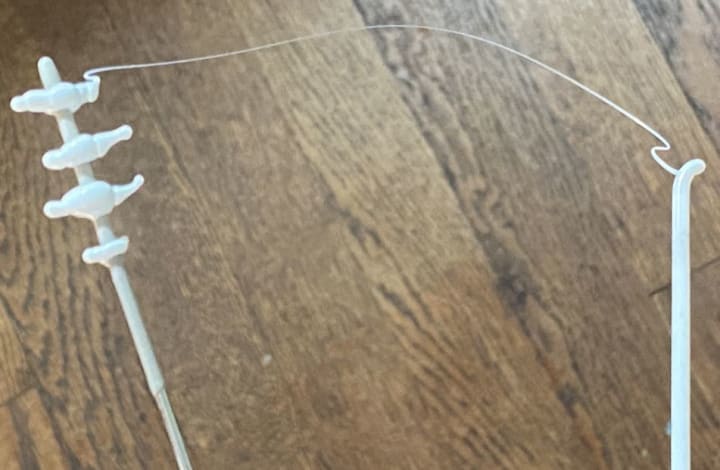
I then assembled the spinal column on fine copper, triple twisted with a drop spindle. It took five tries to get the right bones into the S curve. I then glued the fin onto the "tail," and let it set. Next was the head, with a bit of a wiggly gap. Next was the arm wire, because the arm bones aren't beads, they were made on top of the mandrel and just have a concave space where they can be glued, like some real bones.

After those set, I bent the arm wires a bit, then added the paddle fin-hands to the ends. I made a hanger out of floral wire, and a cloche is on the way for further protection.

I love it! I'm not sure I proved anything other than it was tricky, but ultimately a fun project. Yes, of course I have ideas for fairy and dragon skeletons, why do you ask?

Could it have been done in late period? Definitely. Was it? Maybe. Cabinets of curiosities started in 1599, and taxidermy and displayed skeletons and other mountings show up in the woodcuts and paintings. So yes, it is quite possible, but until the actual documentation surfaces, we will just have to live with plausible speculation.
My next project, already in the works, is an Egyptian glass bead necklace, with my repro fishie front and center!

Sources:
Mounted Skeletons, but dinosaur specific, so quite out of period
https://extinctmonsters.net/2012/05/05/a-brief-history-of-mounted-dinosaur-skeletons/
Period Mermaid Skeleton
Wax Models, and miniatures thereof
https://pmc.ncbi.nlm.nih.gov/articles/PMC2815944/
Votive Offerings
https://museumcrush.org/anatomical-votive-offerings-of-the-greco-roman-world/
https://thevotivesproject.org/2016/11/13/votive-visions-of-the-body/
Boxwood Memento Mori
Images and Information on Alcohol Lampworking Lamps
http://big-bead-little-bead.blogspot.com/2012/01/making-lampwork-glass-beads-what-is.html
http://www.theglassmuseum.com/lampwork.html
Cabinet of Curiosities - for images in period
About the Creator
Meredith Harmon
Mix equal parts anthropologist, biologist, geologist, and artisan, stir and heat in the heart of Pennsylvania Dutch country, sprinkle with a heaping pile of odd life experiences. Half-baked.
Keep reading
More stories from Meredith Harmon and writers in Art and other communities.
'Till Death We Do Art
There would be nothing divine in this world without art. Nature may surpass the divine to all intents and purposes, but like everything it absorbs and is absorbed by, it remains here, stuck on the surface of this world, ever-present, physically bound to the universe.
By Avocado Nunzella BSc (Psych) -- M.A.P 26 days ago in Art
The Front Seat
I found myself waking up in the front seat of the bus. My eyes were filled with the early morning darkness. I had been asleep, but I wasn’t sure for how long. I tried to wake up my body, but my head felt heavy, as though I had been sleeping for an eternity, although I couldn’t pinpoint how much time had passed.
By Aunty Sada2 days ago in Art
Why Didn't Anyone Tell Us
Men, move along. This is not for you. This is for the women. I was forty-five when I began menopause. It is pretty young for that to be going on in a woman’s life, but I had undiagnosed PCOS, my entire life. Thank you to all the gynecologists I had seen my entire life. That in itself should encourage women to keep seeking second opinions, especially when you are not getting correct answers or any at all.
By Alexandra Grant4 days ago in Humans



Comments
There are no comments for this story
Be the first to respond and start the conversation.