
Why the United States Stepped Back from Confrontation with Iran: A 360° Geopolitical Analysis
How Strategy, Regional Diplomacy, and Gulf Pressure—Led by Saudi Arabia, Oman, and Qatar—Forced Washington to Recalculate

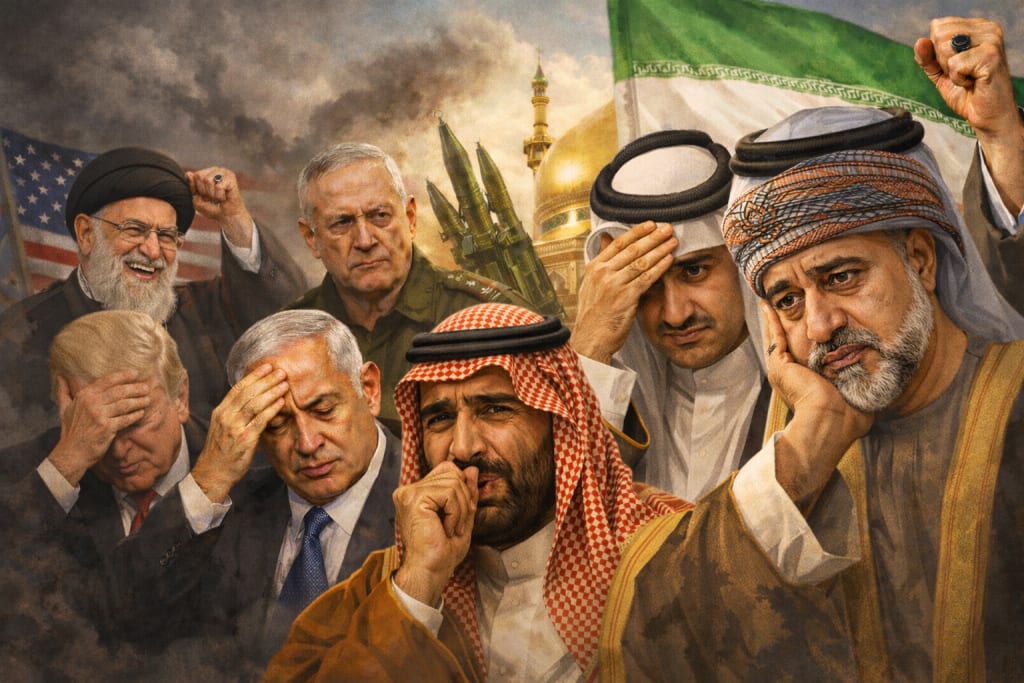
Introduction
In the long and turbulent history of US–Iran relations, moments of escalation have often brought the world to the brink of war. From the Iranian Revolution of 1979 to the sanctions era of the 2010s, and through the proxy conflicts simmering across Iraq, Syria, Lebanon, and Yemen, the tension between Washington and Tehran has become a defining feature of Middle Eastern geopolitics. Yet, despite decades of hostility, every cycle of confrontation has also produced unexpected decisions of restraint.
In early 2026, the world witnessed exactly such a moment.
The United States, after issuing strong statements, raising military readiness levels, repositioning forces, and sending clear signals toward Tehran, unexpectedly stepped back from launching any direct military action. The withdrawal of American personnel from key Middle-Eastern bases, combined with diplomatic messaging that signaled a desire to de-escalate, created widespread speculation:
Why did Washington pull back at the last moment?
While several reasons have been proposed—ranging from strategic caution to intelligence assessments—one factor stood out most prominently:
The unprecedented diplomatic pressure exerted by Saudi Arabia, Oman, and Qatar.
These three Gulf nations, each holding significant geopolitical weight but for different reasons, collectively urged Washington to avoid a war. Their influence shaped American decision-making more deeply than many observers initially realized.
This article provides a deep, nearly 5,000-word exploration of the factors behind America’s de-escalation—covering strategic planning, military risks, Iranian deterrence, domestic US calculations, global power politics, and most importantly, the coordinated pressure exerted by Middle Eastern partners.
Chapter 1: Historical Context — The US–Iran Relationship Built on Tension
To understand the significance of America’s decision to step back, it is important to understand the historical foundation that shaped the rivalry.
1.1 The 1979 Revolution and the Birth of hostility
The overthrow of the US-backed Shah in 1979 and the rise of the Islamic Republic set the stage for decades of adversarial relations. The hostage crisis created massive political trauma in the US, turning Iran into an enduring symbol of opposition.
1.2 The long shadow of the Iran–Iraq War (1980–1988)
During the conflict, the US supported Iraq under Saddam Hussein. Iran still remembers this period vividly, particularly incidents such as:
The shooting down of Iran Air Flight 655 by the US Navy
American support for Iraqi military intelligence
The "Tanker War" in the Persian Gulf
For Iran, these events established a perception that the US would always oppose Tehran’s interests.
1.3 Post-9/11 Middle East and shifting priorities
While Iran helped fight the Taliban early on, relations worsened as the US expanded its presence in the Middle East. American bases in Qatar, Bahrain, Kuwait, and Saudi Arabia dramatically increased Iran’s sense of encirclement.
1.4 Nuclear negotiations and collapse of the JCPOA
The Iran nuclear deal (2015) briefly thawed relations, but Washington’s later withdrawal in 2018 restarted the cycle of sanctions and confrontation.
1.5 Assassination of Qassem Soleimani (2020)
This event brought both countries closer to direct war than at any other time in recent memory. Iran’s retaliatory missile strike on US bases in Iraq proved one thing:
Iran can and will strike back—and it has the capability to do so.
This memory is extremely relevant to the 2026 confrontation.
Chapter 2: The 2026 Escalation — What Brought the US and Iran to a Breaking Point?
2.1 Domestic unrest inside Iran
The US accused Iran of violently suppressing protestors. Iran denied the extent of force used, while regional media reported mixed accounts. The rhetoric escalated quickly, with Washington warning Tehran against further crackdowns.
2.2 Large American troop presence in the region
The US had active military installations in:
Qatar (Al Udeid Air Base)
Bahrain (5th Fleet headquarters)
Kuwait (Camp Arifjan)
Saudi Arabia (Prince Sultan Air Base)
Oman (Duqm Port access)
These bases placed thousands of American troops within range of Iran’s ballistic missiles, drones, and cruise missiles.
2.3 Iranian warnings
Iran’s military establishment made it clear:
“If the US strikes Iran, every American base in the region becomes a legitimate target.”
This was not bluster. Iran demonstrated its missile precision in the 2020 Ayn Al-Asad attack.
2.4 Global uncertainty
At a time when the US was also dealing with rivalries involving China and Russia, policymakers understood that opening a new full-scale conflict in the Middle East could weaken US strategic positioning.
These conditions created a perfect storm of uncertainty—and raised the stakes of escalation dramatically.
Chapter 3: The Gulf Pressure — How Saudi Arabia, Oman, and Qatar Stopped a War
This chapter is the heart of your requested point.
Here is the full detailed coverage:
3.1 Why Saudi Arabia Pushed the US to Step Back
Saudi Arabia has historically had a volatile relationship with Iran. Their rivalry extends across ideological, sectarian, and geopolitical lines. However, in recent years—and especially after the 2023 China-brokered rapprochement—Saudi Arabia began pursuing regional stability first.
A US-Iran war would have catastrophic consequences for Saudi Arabia:
Economic Risks
Saudi oil infrastructure—including Abqaiq and Khurais—has already been targeted in 2019. Another war could:
Halt Saudi oil exports
Crash global energy markets
Bring attacks deep inside the Saudi homeland
Geopolitical Risks
Saudi Arabia does not want to be turned into a battleground.
Its cities, ports, pipelines, and oil terminals lie within range of:
Iranian ballistic missiles
Houthi drones from Yemen
Militias in Iraq
Hezbollah’s long-range capabilities
Diplomatic Momentum at Risk
Under Crown Prince Mohammed bin Salman’s vision, Saudi Arabia is undergoing major economic transformation. A regional war would freeze foreign investment and halt key projects like NEOM and Vision 2030.
Thus, Saudi Arabia firmly told the US:
“We cannot support a conflict with Iran. The Gulf does not want another war.”
3.2 Why Qatar Pressured the United States
Qatar hosts the largest American military base in the Middle East — Al Udeid.
This alone means any conflict between US and Iran would put Qatar directly in harm’s way.
Qatar’s strategic calculations:
Iran is Qatar’s neighbor.
They share the massive North Dome/South Pars gas field.
They maintain largely cordial ties with Tehran.
They rely on regional stability to keep LNG exports flowing.
Qatar’s message to Washington was explicit:
“A US-Iran war begins with Iranian missiles landing in Qatar.”
Qatar cannot risk:
shutdown of LNG shipments
attack on its ports
endangerment of US and Qatari citizens
disruption of the FIFA-era infrastructure and global investments
So Qatar used its diplomatic influence and hosting leverage over US troops to convince Washington to de-escalate.
3.3 Why Oman Played the Most Critical Quiet Role
Oman is historically the neutral mediator of the Gulf.
It played an essential role in:
early secret US–Iran nuclear negotiations
reducing tensions during the Obama administration
backchannel talks between Saudi Arabia and Iran
In 2026, Oman again acted as the diplomatic bridge.
Oman’s warnings to Washington:
Iran will retaliate forcefully.
A war will spread across the Gulf.
Diplomatic channels remain open.
Oman didn’t just pressure the US—it offered solutions, alternatives, and backchannels to cool tempers.
This provided Washington with a face-saving path:
A way to step back without looking weak.
Chapter 4: The US Strategic Recalculation — Why America Chose Restraint
Aside from Gulf pressure, Washington had its own reasons:
4.1 No appetite for a new war
After two decades of Iraq and Afghanistan, the American public has no desire for more Middle Eastern wars.
4.2 Pentagon warnings
Military planners reminded political leaders:
Iran is not Iraq.
Iran has real missile capabilities.
Iran has dozens of proxy militias.
Every American soldier in the region becomes a target.
4.3 Economic and energy factors
A war with Iran would instantly:
Double oil prices
Damage the global economy
Strain US strategic reserves
4.4 Iran’s retaliation capacity
Iran can strike:
US bases
Israeli targets
Saudi infrastructure
UAE ports
Gulf maritime lanes
The Pentagon concluded:
War would not be quick, clean, or easy.
Chapter 5: Proxy Dynamics — The Shadow Actors
Iran’s regional network includes:
Hezbollah
PMF (Iraq)
Houthis (Yemen)
Militias in Syria
Islamic Jihad (Palestine)
Any US strike would activate all of them.
The US cannot afford a multi-front conflict.
Chapter 6: Why the Timing Was Impossible for Washington
6.1 US political timeline
With elections approaching, a full-scale conflict would be politically risky.
6.2 Russia and China
A US-Iran war would push Tehran further into Beijing and Moscow’s arms—strategically weakening the US.
6.3 The shifting global order
The US is focusing on Asia and Europe. Opening a new Middle Eastern conflict contradicts its long-term strategy.
Chapter 7: The Final Decision — Stepping Back
Ultimately, Washington made a decision based on:
Military risk
Regional pressure
Strategic limitations
Diplomatic realities
And most importantly:
Saudi Arabia, Oman, and Qatar told the United States—clearly and firmly—“Do not escalate.”
The US listened.
Chapter 8: What This Means for the Future
1. The Gulf is asserting independence
Saudi Arabia, Qatar, and Oman proved they can influence US decisions.
2. Iran’s deterrence worked
Tehran demonstrated that its missile capabilities and alliances carry real weight.
3. The US is shifting away from “maximum pressure”
Economic tools and diplomacy are becoming the primary strategy.
4. Middle Eastern stability depends on Gulf cooperation
The Gulf bloc is increasingly united on preventing war.
5. The region has entered a post-war maturity
Countries want economic growth—not conflict.
Conclusion: A Moment That Changed Middle Eastern Geopolitics
America’s decision to step back from conflict with Iran was not a sign of weakness—but a moment of calculated strategic realism. Washington realized that the cost of war would be catastrophic, unpredictable, and uncontrollable.
But the most important factor—the one that defined the outcome—was the unified diplomatic pressure from:
Saudi Arabia
Oman
Qatar
These nations not only advised against war—they insisted on preventing it.
Their influence showed that:
The Middle East is no longer a theater where the US acts alone.
Regional powers now shape the decisions of global powers.
And for now, peace—however fragile—has prevailed.
About the Creator
Keep reading
More stories from Muhammad Islam khan swati and writers in 01 and other communities.
Trump, Starlink, and the Battle for Connectivity in Iran
In what has become one of the most volatile periods in recent Iranian history, the convergence of international politics and cutting-edge technology has taken center stage. As mass protests continue to shake cities across Iran and authorities enforce one of the most severe internet blackouts in decades, former U.S. President Donald Trump has publicly linked his response to the crisis with the role of satellite internet — specifically Elon Musk’s Starlink — as a potential lifeline for Iranian citizens.
By Muhammad Islam khan swati3 days ago in 01
AI Agents in Action: Why Your Bot Still Sucks in 2026
I woke up this morning to my agent arguing with a flight carrier. It was glorious. No, seriously. In early 2024, we were all just playing with chatbots that hallucinated legal advice. Now, seeing ai agents in action is like watching a digital concierge with a chip on its shoulder.
By Sherry Walker2 days ago in 01
Instacart VS DoorDash
The on-demand delivery space has exploded over the past decade, with dozens of apps competing for your attention and wallet. Among them, two names consistently rise to the top: Instacart and DoorDash. While both deliver items to your doorstep, they operate quite differently—and choosing between them can significantly impact your convenience, budget, and overall experience.
By Ashish Sudraa day ago in 01




Comments
There are no comments for this story
Be the first to respond and start the conversation.