
Why Smart Management Matters in the Age of AI-Driven Twitter
How intentional strategy and human nuance can still win in a world of automated noise

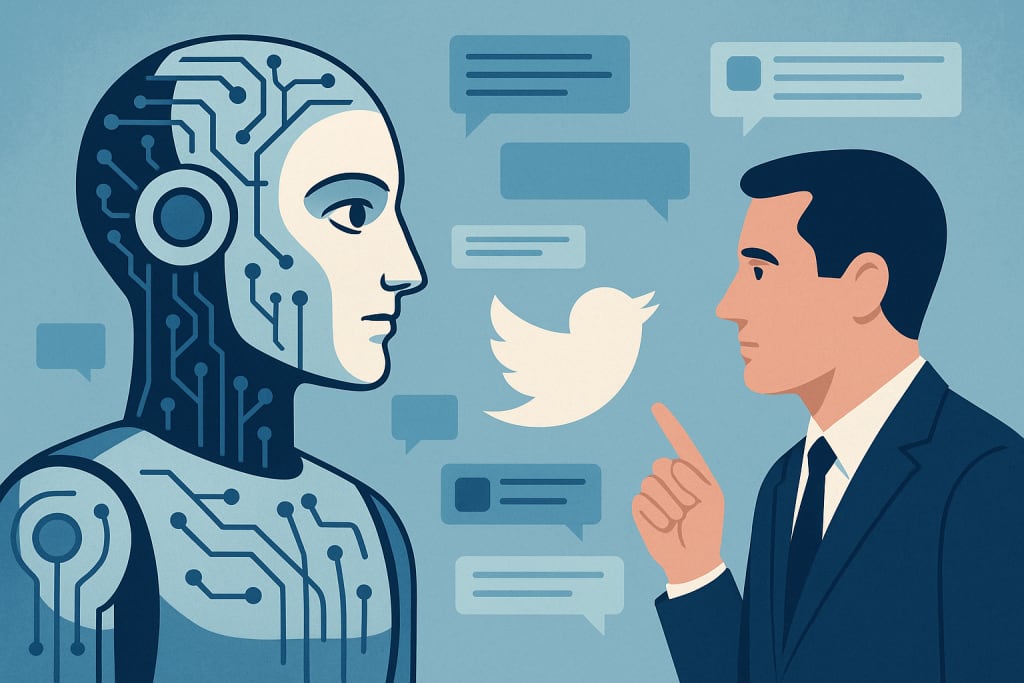
I remember when Twitter was chaotic — but in a human way. A place where journalists debated late into the night, comedians tested raw jokes, and ordinary people shared fragments of their day. It was messy, often brilliant, and undeniably alive. Today, it still is all those things — but also something else entirely. Something algorithmic. Something… AI.
We’re living in a time where Twitter (or X, as we’re now told to call it) is increasingly shaped by machine learning and AI systems. That’s not necessarily bad. In fact, it’s inevitable. But here’s what keeps me up at night: as AI becomes more responsible for what we see, who we reach, and how we’re perceived — the margin for human error shrinks. Wildly.
The Illusion of Automation
You’d think that with AI tools doing everything from content scheduling to engagement optimization, managing a Twitter account would be easier than ever. In some ways, it is. I can now schedule a month’s worth of tweets with a tool like TweetHunter or Hypefury. I can analyze engagement heat maps. Heck, I can even ask ChatGPT to write a thread about productivity hacks in the voice of Naval Ravikant (and it’ll be scary good).
But here’s the catch: these tools don’t replace thought. They amplify it. They don’t fix a weak brand or unclear messaging — they just make it louder.
That’s why smart management matters more than ever. Because while the tools have gotten sharper, the risks have gotten higher. One poorly thought-out post can spiral into a PR nightmare faster than you can say “ratioed.” Just ask anyone who’s watched a scheduled tweet go live during a national tragedy.
The Algorithm Isn’t Your Friend (But It’s Not Your Enemy Either)
Let’s talk about the algorithm — the mysterious force that determines who sees your content and why. Elon Musk claims it's now open-sourced, but understanding it still feels like reading the Talmud backward while blindfolded.
We know a few things: engagement matters. So do bookmarks. Time spent reading a tweet seems to help. And, of course, the blue check (paid or otherwise) offers certain boosts.
But here's the dangerous part — in chasing the algorithm, it’s easy to lose the plot.
I’ve seen creators tweet outrage-bait just to get impressions. Others spam AI-generated “wisdom” that reads like a Tony Robbins bot trapped in an echo chamber. And the saddest part? It works. In the short term.
But long-term? People feel it. They sense when there’s no soul behind a feed. And Twitter, for all its flaws, is still about people. Not personas. Not perfectly optimized posts. Just raw, human connection — however messy that looks.
What Smart Management Looks Like Today
So how do we navigate this AI-driven terrain without losing our voice?Here’s what I’ve learned (and am still learning):
Balance automation with presence.
Schedule tweets, yes. Use AI for ideation, sure. But show up, respond, engage. People can tell when you’re actually there. That little spark of authenticity? It still matters.
Understand your lane.
Not everyone needs to go viral. Sometimes being the trusted expert in a niche is more valuable than chasing trends. I follow an obscure economist who rarely breaks 50 likes — but every tweet teaches me something. That’s real influence.
Adapt fast, but don’t chase every trend.
Twitter moves at lightning speed. But that doesn’t mean you have to. Ask yourself: is this trend relevant to my brand or just noise? The smartest managers know when to pass.
Guard your tone.
AI might write the tweet, but you are responsible for how it lands. Double-check humor. Watch for tone-deafness. One insensitive post can undo months of good work.
Measure what matters.
Impressions are nice. Engagement is better. But community? That’s gold. Are people DMing you? Quoting your tweets? Referencing you in other spaces? That’s the stuff AI can’t fully measure — yet.
The Human Touch Is Still the Moat
AI can simulate a lot. Empathy, maybe. Wit, sometimes. Strategy? To a degree. But it can’t care. It can’t listen between the lines of a trending topic and say, “You know, now’s not the time to promote our new SaaS tool.” Only people can do that.
Good management today isn’t about resisting AI. It’s about using it wisely — as a tool, not a crutch. The same way photographers embraced digital cameras without forgetting how to frame a shot.
And honestly, I’m still figuring it out. I’ve scheduled tweets I regretted. Posted things that flopped. Let the AI overstep. But I’ve also had moments — small ones — where a tweet lands just right. Where someone replies, “Wow, this helped.” Or “You said exactly what I was feeling.”
Those moments remind me why I still log in.
Final Thought: It’s Not About “Gaming” the System
Twitter is becoming more like a game — with scores, boosts, hacks, and penalties. But we have to ask: what game are we playing?
For me, it’s not about followers or reach. It’s about resonance. The feeling that, amid the bots and brand noise, real human voices still matter. That in the age of AI, thoughtful, intentional presence is still the edge.
Because while AI might write the tweet, only we decide what’s worth tweeting.
About the Creator
Ava Thornell
share my own experience of using social media
Keep reading
More stories from Ava Thornell and writers in 01 and other communities.
Being Human Online: Finding Your Voice in the Age of AI
It’s 2025. Every scroll, swipe, and search feels like it’s powered by some version of artificial intelligence. And in a way — it is. AI writes tweets. AI recommends posts. AI even suggests what you should care about today.
By Ava Thornell7 months ago in 01
Top IT and Marketing Recruitment Agencies in Canada
IT recruitment agencies Canada play a crucial role in connecting businesses with skilled tech professionals. In the Canadian IT market, specialized recruiters have deep industry networks and technical expertise. For example, Insight Global is described as “specializing in delivering talent and technical solutions” to major companies, and Wexpand focuses on “staffing, headhunting, and talent acquisition” with a proactive, client-focused approach. Such agencies leverage local and global connections to speed up hiring for roles from software developers to network engineers. By maintaining large pools of vetted candidates and understanding Canadian tech trends, top IT recruiters help companies bridge talent gaps efficiently.
By Kashif Khan2 days ago in 01
Why Your 2025 Presentations Fail: The “Quiet Luxury” Hack Powered by PopAi & Morandi Aesthetics
Description Are you still pulling all-nighters fixing alignment and color palettes? The era of "ugly productivity" is over. As we approach the end of 2025, we analyzed why most corporate decks get ignored and uncovered a workflow shift top creatives are already using. This article explains how PopAi’s Morandi Color Scheme Minimalist Magazine slides transform complex data into refined visual narratives—and why this approach is becoming essential for modern presentations.
By charliesamuel5 days ago in 01




Comments
There are no comments for this story
Be the first to respond and start the conversation.