
Why More Agencies Are Building Their Own AI Products Instead of Selling Services
A look at how agencies are quietly shifting from client work to product thinking using AI-driven systems.
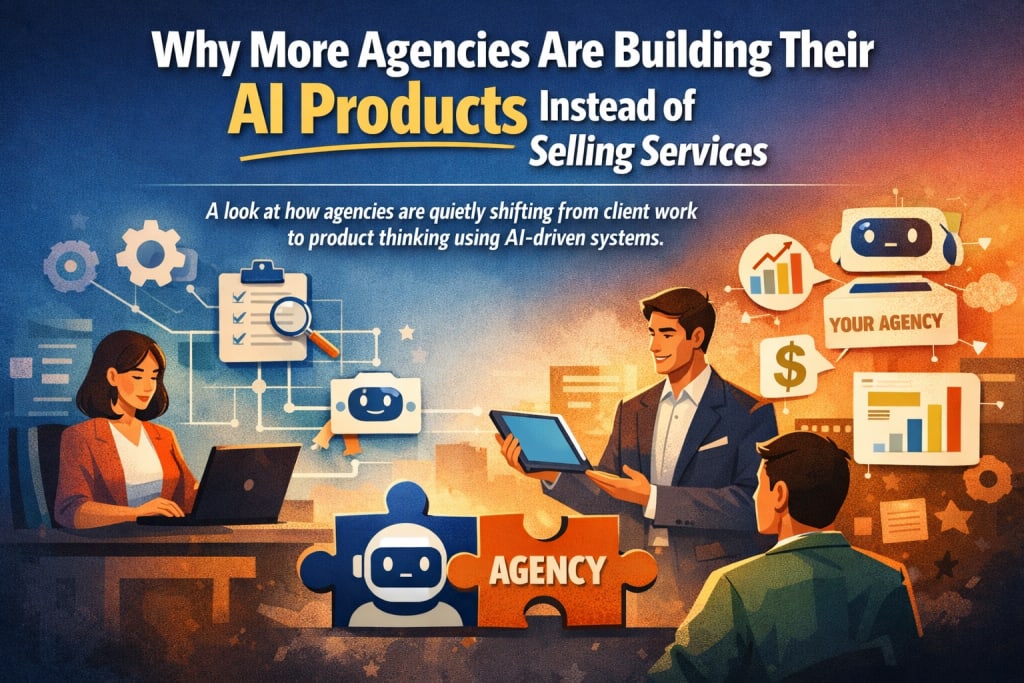
Something interesting is happening inside agencies, and it’s not being talked about very loudly.
For years, the agency model has been fairly predictable. You sell time, expertise, or deliverables. You hire more people when demand increases. You raise prices when capacity becomes tight. Eventually, you hit a ceiling where growth feels harder than it should.
A growing number of agencies are quietly stepping away from that cycle, not by abandoning services entirely, but by changing how they deliver value. Instead of positioning themselves only as service providers, they are starting to build small AI-powered products under their own brand.
Not consumer-facing SaaS platforms with massive roadmaps and investor decks, but practical tools their clients actually use. And once you notice this shift, it becomes clear why it’s gaining momentum.
From Custom Work to Repeatable Systems
Most agencies know the pain of custom work all too well. Every new client brings a slightly different requirement. Every project needs its own setup. Every solution has to be explained, adjusted, and maintained. Over time, even successful agencies find themselves stretched thin.
What’s changing is the realization that many client needs are surprisingly similar beneath the surface. Lead qualification, competitor research, content analysis, customer support, internal workflows, reporting. These tasks show up again and again, regardless of industry.
Instead of rebuilding the same logic for every client, some agencies are packaging that logic into AI agents they can reuse. An agent that analyzes competitors once can analyze them a hundred times. An agent that helps audit a business once can do it again tomorrow for someone else.
This is where the idea of product thinking starts to replace pure service delivery.
Why AI Agents Fit This Shift So Well
AI agents are well suited to this new approach because they are modular by nature. They don’t need to solve everything. They just need to do one thing reliably.
An agent might focus on reviewing a website, another on summarizing market data, another on handling inbound questions. Each agent becomes a building block that can be reused, refined, and deployed again.
Platforms built around agentic AI make this even more practical, because agents are not static scripts. They can follow goals, adapt to different inputs, and operate with minimal supervision. That flexibility allows agencies to create tools that feel intelligent without being fragile.
Instead of selling “hours,” agencies start offering outcomes supported by systems that work quietly in the background.
The Appeal of Whitelabel Models
One of the most appealing parts of this shift is that agencies don’t have to become software companies to participate. Many are using a whitelabel AI agent builder platform to create and manage these tools without exposing the underlying infrastructure.
From the client’s perspective, it looks like the agency built a proprietary solution. From the agency’s perspective, they avoid the cost and complexity of developing everything from scratch.
This model opens up new possibilities. Agencies can bundle AI-powered tools into retainers, offer ongoing access to automated systems, or even create niche products for specific industries. All of this happens without dramatically changing how clients interact with them.
The software becomes part of the service, rather than a separate product that needs to be sold and supported independently.
Why This Matters Beyond Revenue
While recurring revenue and scalability are obvious benefits, the deeper impact is often internal. Agencies that adopt this approach tend to experience less operational friction. Teams spend less time on repetitive groundwork and more time on interpretation, strategy, and client communication.
When an AI agent builder platform handles the heavy lifting, the human side of the agency can focus on decisions that actually require judgment. That balance is hard to achieve with manual workflows, especially as client volume increases.
Over time, this also changes how agencies position themselves. They are no longer just executors of tasks. They become operators of systems that deliver consistent value.
A Subtle but Meaningful Shift
What makes this trend interesting is how subtle it is. Most agencies using whitelabel AI tools are not advertising it aggressively. There are no splashy announcements about “becoming a product company.” In many cases, clients don’t even know AI is involved.
They just notice faster turnaround times, clearer insights, and more consistent results.
That quiet improvement is often more powerful than a loud rebrand.
Looking Ahead
As AI tools become easier to build and customize, the line between services and products will continue to blur. Agencies that understand this early have an opportunity to rethink how they scale without burning out their teams or diluting quality.
Platforms like Botsify sit naturally within this shift, not as a replacement for agency expertise, but as an enabler of it. By supporting whitelabel AI agents and flexible agent-building workflows, they allow agencies to experiment with productized offerings at their own pace.
The agencies that succeed in this next phase will likely be the ones that stop thinking of AI as a feature and start treating it as infrastructure.
Not something to sell loudly, but something to build quietly and use well.
About the Creator
Shaun W.
I’m a digital marketer with over three years of experience. I help brands reach their audiences using strategies like SEO, content marketing, and social media. I focus on data-driven insights to improve engagement and visibility.
Understanding Winter Clothing and Its Role in Women’s Fashion
Winter clothing has long served a practical purpose: protecting the body from cold temperatures, wind, and moisture. Over time, however, it has evolved into a reflection of culture, technology, and personal style. For women in particular, winter wardrobes balance insulation, comfort, and visual appeal, adapting to diverse climates and lifestyles.
By charliesamuel7 days ago in 01




Comments
There are no comments for this story
Be the first to respond and start the conversation.