
Why Choose Flutter for Your Next Mobile App? Pros and Cons
Flutter

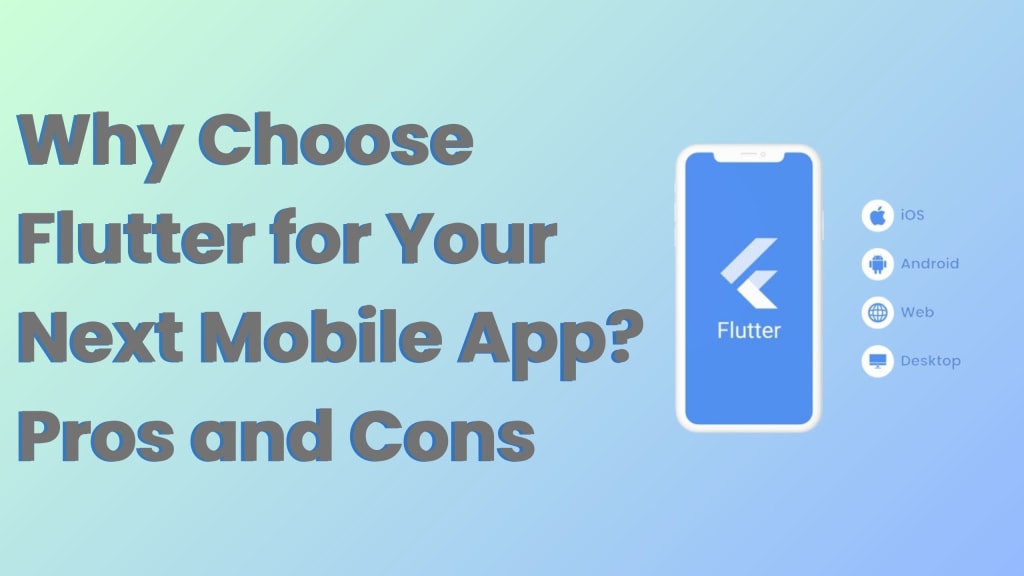
In the ever-evolving world of mobile app development, selecting the right framework for building your next app is critical. With numerous options available, one framework that stands out for its versatility, speed, and reliability is Flutter. If you’re considering building a cross-platform mobile application, Flutter could be the answer to your needs. In this article, we’ll explore why Flutter is an excellent choice for mobile app development, along with its key advantages and potential drawbacks.
As the demand for cross-platform development grows, businesses are looking for efficient ways to reach users on both Android and iOS. Flutter, an open-source UI software development kit (SDK) developed by Google, provides a unique solution to this challenge. Flutter allows developers to write one codebase and deploy it to multiple platforms, which saves time, resources, and money in comparison to traditional native app development.
Understanding Flutter: What is it?
Flutter is a comprehensive framework developed by Google for building cross-platform mobile applications. Launched in 2017, Flutter allows developers to build natively compiled applications for mobile, web, and desktop from a single codebase. The framework is written in Dart, a programming language created by Google, and it’s equipped with a rich set of pre-designed widgets that help create smooth, visually appealing user interfaces (UIs).
Unlike other frameworks that use webview to render the user interface, Flutter uses its own rendering engine, ensuring high-performance results with native-like user experiences.
Flutter's potential has made it one of the go-to frameworks for companies in need of mobile app development services. It’s used by global giants like Alibaba, Google, and BMW, and it continues to gain traction in the development community due to its speed, flexibility, and growing ecosystem.
Pros of Choosing Flutter for Mobile App Development
1. Single Codebase for Multiple Platforms
One of the standout features of Flutter is its ability to create apps for both iOS and Android with a single codebase. This means developers don’t have to write separate code for each platform, which results in faster development times. Whether you are working with a Flutter app development company or a freelance developer, this cross-platform advantage can save both time and money.
Traditionally, businesses would have to hire separate development teams for iOS and Android to ensure compatibility with both platforms. Flutter eliminates this need by providing an efficient solution that allows developers to create applications that run on both platforms seamlessly. This is especially beneficial for small and medium-sized businesses that need to launch their app quickly but don’t want to compromise on quality.
2. Faster Time to Market
Time is critical in today’s competitive market, and Flutter offers a significant advantage when it comes to speed. Thanks to its single codebase and hot reload feature, developers can make changes to the code and instantly see the updates on the app without having to restart it. This reduces development time and allows for rapid iteration, making it easier to fix bugs and add new features quickly.
For businesses looking to stay ahead of the competition, faster development cycles and quicker launch times can be game-changers. Choosing a Flutter app development company ensures that your app is built efficiently, while still maintaining a high standard of quality.
3. Great Performance
Flutter is known for delivering high-performance mobile applications. Since the framework uses native ARM code for rendering, it is able to achieve smooth animations and transitions, even with complex UI components. The Flutter framework also eliminates the need for a JavaScript bridge, which is often a bottleneck in other frameworks.
This high-performance level ensures that Flutter apps feel just as smooth and responsive as native apps, making them highly appealing to users. With growing mobile app development trends favoring performance-driven apps, Flutter stands as a framework that developers can trust for creating fast and efficient mobile experiences.
4. Customizable Widgets
Flutter offers a wide variety of customizable widgets that developers can use to create a unique user interface. These widgets allow for high flexibility, enabling developers to design beautiful and tailored UIs without compromising on performance. Whether you need basic UI components like buttons and text fields or advanced ones like lists and grids, Flutter provides them all.
Flutter also follows the Material Design and Cupertino design principles, which allows developers to create apps that look native on both Android and iOS. This ensures that apps built with Flutter maintain platform-specific designs, offering a seamless user experience across different devices.
5. Open Source and Free
Flutter is an open-source framework, which means it’s free to use, and developers can contribute to its improvement. The open-source nature of Flutter provides access to a wide range of libraries and tools that can be used to extend its functionality. This can help Flutter app development companies create customized solutions tailored to specific client needs.
Additionally, being open-source, Flutter has a large and active community. This community contributes to the framework’s continuous improvement and provides valuable support, resources, and documentation, making it easier for developers to learn and adopt.
6. Strong Google Support
Since Flutter is backed by Google, developers can expect long-term support and regular updates. Google’s backing also ensures that Flutter is integrated well with other Google services and products, such as Firebase, making it easier to implement backend services, authentication, and data storage for your mobile app.
Moreover, Google’s support also ensures that Flutter will be consistently updated with new features and security patches, which is vital for businesses looking to develop scalable and secure applications.
7. Cost-Effectiveness
Using Flutter can reduce development costs, as companies only need to hire a single team of developers to build apps for both Android and iOS. This is a major cost-saving benefit for startups and small businesses that may have limited budgets. By choosing Flutter, businesses can allocate resources more efficiently and focus on marketing, features, and customer engagement instead of dividing efforts between multiple development teams.
Cons of Choosing Flutter for Mobile App Development
1. Limited Libraries and Tools
Although Flutter has come a long way in terms of available libraries and plugins, it still lags behind some more established frameworks like React Native or Swift when it comes to third-party libraries and native integrations. This can be a limiting factor for developers who need to implement very specific functionalities or rely on particular hardware features.
However, this gap is gradually closing as the Flutter community grows, and more libraries and plugins are being developed to enhance the framework. Developers can also create custom plugins to bridge the gap, but this adds additional complexity and development time.
2. Large App Size
Apps built with Flutter tend to have a larger file size compared to those built with native technologies. This can be a concern, especially if your app has many features and requires a lot of assets. For users with limited storage space on their devices, a larger app size might lead to slower downloads and installations.
While Google has made efforts to reduce the size of Flutter apps, it’s still something businesses need to consider when planning the app’s features and functionalities.
3. Limited Support for Certain Native Features
While Flutter supports most common mobile app features, some very specific or advanced native features may not be fully supported out of the box. In such cases, developers may need to write custom native code or use platform channels to communicate between the Flutter code and native code.
For companies that require extensive use of native features like advanced device sensors, Bluetooth connectivity, or heavy multimedia processing, Flutter might not be the best choice unless those specific features can be effectively handled using native code or plugins.
4. Learning Curve for Dart
Flutter uses Dart, a programming language developed by Google, which may be unfamiliar to many developers. While Dart is easy to learn for developers with experience in other object-oriented programming languages like Java or C#, it may require a learning curve for developers new to the language. This can be a barrier to entry for some teams looking to transition from other frameworks like React Native or Xamarin.
However, Dart is growing in popularity, and with the support of the Flutter community, many developers find it easy to pick up over time.
5. Maturity and Ecosystem
Despite its rapid growth, Flutter is still relatively new compared to other frameworks, which means its ecosystem is not as mature. While the Flutter team is continually adding features and refining the framework, some businesses might find it lacking in certain areas, especially when it comes to more advanced, niche requirements.
However, with the ongoing development of Flutter and the increasing adoption by major companies, it’s likely that the ecosystem will continue to expand and mature.
Conclusion: Is Flutter Right for Your Mobile App?
In conclusion, Flutter app development presents a compelling choice for businesses looking to build high-quality, cross-platform mobile applications. The framework’s ability to offer a single codebase, faster development cycles, great performance, and customizable widgets makes it a popular choice among developers and businesses alike. Additionally, its open-source nature and strong support from Google ensure that Flutter is here to stay.
However, like any technology, Flutter does have some drawbacks, including limited libraries, larger app sizes, and native feature support challenges. These factors may influence your decision, depending on your app’s complexity and specific requirements.
For businesses seeking a reliable mobile app development service, partnering with a Flutter app development company can be an excellent choice, especially if you're aiming to create a cross-platform app that performs well across both iOS and Android devices.
Ultimately, the decision to choose Flutter for your next mobile app depends on your specific needs, the complexity of your app, and your development resources. If you need a cost-effective, fast, and scalable solution, Flutter could be the perfect framework for your next project.
About the Creator
Bella Swan
Hi, I’m Swan Bella, a marketing manager with five years of IT experience. At Octal IT Solution, a best android app development company.
Keep reading
More stories from Bella Swan and writers in 01 and other communities.
Laravel and E-commerce: Building a Powerful Online Store with Laravel
The e-commerce industry has exploded in recent years, and businesses today need a robust, reliable, and scalable platform to compete in the digital marketplace. Developing an e-commerce platform requires careful planning, exceptional functionality, and a seamless user experience. To achieve this, many businesses are turning to Laravel, a powerful and flexible PHP framework, to build their online stores.
By Bella Swan11 months ago in 01



Comments
There are no comments for this story
Be the first to respond and start the conversation.