
Top Rollup-as-a-Service Providers to Watch in 2026
Simple Solution Making Blockchain Faster and Cheaper for Everyone

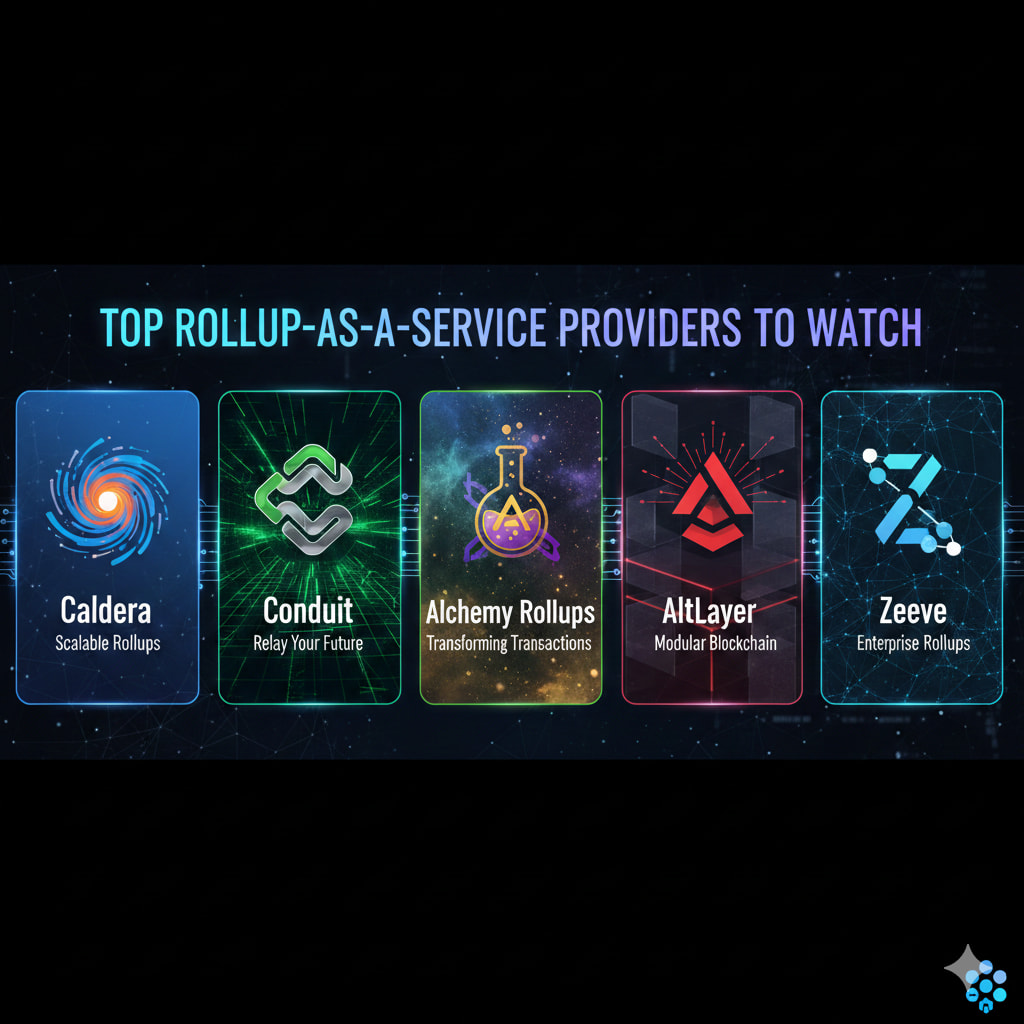
Ethereum has a problem. When too many people try to use it at once, transactions slow down and fees skyrocket. During busy periods, sending a simple transaction can cost $50 or more. For most people, that's unusable.
Rollups solve this problem by processing transactions off the main blockchain, then sending a compressed summary back to Ethereum. This makes everything faster and dramatically cheaper. Think of it like carpooling. Instead of 100 cars clogging the highway, you bundle everyone into a few buses. Same number of people reach their destination, but with far less traffic.
The challenge? Building your own rollup from scratch takes months of work, specialized expertise, and significant money. That's where Rollup-as-a-Service providers come in. They've done the hard work for you, offering ready-made solutions that let you launch a custom blockchain in minutes instead of months.
Let me walk you through everything you need to know about the leading rollups as a service providers in 2026.
What are Rollups?
Before understanding Rollup-as-a-Service, you need to grasp what rollups actually are.
Rollups are Layer 2 scaling solutions that bundle (or "roll up") multiple transactions into a single batch, which is then ported to the parent blockchain (Layer 1 blockchain) at a fraction of the price. This process significantly increases transaction throughput, reduces gas fees, and keeps up the security of the underlying Layer 1 blockchain.
Here's a simple way to think about it. Ethereum (Layer 1) is like a busy restaurant with limited tables. Everyone wants to eat there, so you have to pay premium prices and wait for a table. A rollup is like opening a food truck that prepares the meals elsewhere, then delivers the final dishes to the restaurant for serving. You get the same quality food (security), but faster and cheaper.
Rollups handle all the transaction processing off the main chain. They batch hundreds or thousands of transactions together, compress them, and send a single proof back to Ethereum. This one proof confirms that all those transactions were valid, without Ethereum having to process each one individually.
The result? Up to 10x scalability and 80% fee savings compared to traditional L1 solutions.
What is Rollups-as-a-Service (RaaS)?
Rollup-as-a-Service is a managed service offering that allows teams to launch their own Layer 2 rollups using established frameworks like Optimism, zkSync, Arbitrum Orbit, or Polygon CDK.
Think of RaaS providers as the AWS of blockchain. Just like AWS lets you launch a website without buying physical servers, RaaS lets you launch a blockchain without building infrastructure from scratch.
RaaS, short for Rollup-as-a-Service, is an off-the-rack offering by providers for deploying rollups at the click of a button through a low-code interface. Before RaaS was a thing, developers had to manually set up and manage node infrastructure, write intricate smart contracts, and manage deployment and debugging processes.
Today, RaaS platforms abstract away the complexities and provide a fully managed infrastructure aligned with modular smart contract templates and pre-built bridges.
For businesses and developers, this changes everything. Deployment that used to take 6 to 9 months for a DIY rollup now happens in under 30 minutes with providers like Caldera and Conduit.
Types of Rollups-as-a-Service (RaaS)
There are two main types, and most RaaS providers support one or both.
Optimistic Rollups
Optimistic Rollups assume transactions are valid unless proven otherwise. It is quick as it assumes transactions are correct and the network doesn't need to waste time confirming them.
Think of this like going through airport security with TSA PreCheck. The system assumes you're good to go unless someone raises a red flag. This makes processing fast, but if there's a problem, it takes time to resolve (usually about 7 days for withdrawals back to Ethereum).
Popular frameworks for optimistic rollups include OP Stack (used by Optimism and Base) and Arbitrum Orbit.
Zero-Knowledge (ZK) Rollups
Zero-Knowledge Rollups use cryptographic proofs, Zk-Proof, to validate transactions. These proofs prove that the transactions are accurate, without revealing sensitive information, making Zk Rollups ideal for high-security, privacy-focused applications.
ZK rollups are like having a math proof that confirms everything is correct without showing your work. They're more complex to build but offer faster finality and better privacy. Withdrawals can happen in minutes instead of days.
ZK rollup fees are rapidly dropping due to ongoing improvements in proof generation and recursion technology, and EIP-4844 "blobs" slashed data fees up to 96% for both rollup types.
Several Rollups-as-a-service providers offer hybrid support, which provides ease to users to choose between ZK and Optimistic rollup models based on their requirements.
Top Parameters Considered While Compiling a List of Top-Tier RaaS Providers
Choosing a RaaS provider isn't just about picking a name you recognize. You need to evaluate several critical factors.
Framework Support matters because it determines your flexibility. The best providers support multiple frameworks like OP Stack, Arbitrum Orbit, Polygon CDK, and zkSync. This gives you options based on your specific needs.
Deployment Speed separates leaders from laggards. Can you launch in minutes, or will it take days of configuration? Optimistic RaaS vendors like Conduit, Base, and Caldera deliver "push-button" launches today, while ZK RaaS providers like Starknet Appchains, zkSync Hyperchains, and Polygon CDK now offer templated deployments but still require heavier DevRel support.
Uptime and Reliability are non-negotiable. Reliability in RaaS is defined by uptime, technical support, compatibility with major rollup frameworks, integration with data availability solutions, and the ability to deliver scalable, secure, and cost-effective infrastructure.
Cost Structure includes both setup costs and ongoing operational expenses. Look for transparent pricing and providers that optimize for low transaction fees.
Technical Support becomes crucial when things go wrong. The best providers offer responsive help, comprehensive documentation, and active developer communities.
Security and Audits protect your project and users. Reputable providers undergo regular security audits and follow best practices.
Customization Options let you tailor the rollup to your specific use case, whether that's gaming, DeFi, NFTs, or enterprise applications.
Data Availability Solutions determine where your transaction data is stored. Leading providers integrate with options like Celestia, EigenDA, and Avail.
Top 5 Rollups-as-a-Service (RaaS) Providers
Based on performance, reliability, and developer adoption in 2026, here are the providers leading the space.
1. Caldera
Caldera has established itself as a leading RaaS provider, often praised for its reliability and ease of use.
Dozens of leading EVM chains, including Manta, Apechain, Kinto, Injective, RARI Chain and Zero Network by Zerion, use Caldera's trusted Rollups-as-a-Service platform to enjoy unified connectivity with rollups across all leading frameworks.
What makes Caldera stand out is its focus on performance and simplicity. Caldera is popular among gaming and social applications due to its emphasis on user experience and high throughput.
The platform supports multiple frameworks including Arbitrum Orbit, OP Stack, Polygon CDK, and ZK Stack. Caldera abstracts away the complexity of building blockchains, turning a process that would take multiple engineers dozens of hours into a one-click, no-code deployment process.
Caldera is ideal for teams building consumer-facing applications where performance and user experience matter most.
2. Conduit
Conduit offers plug-and-play rollup deployments across both Arbitrum Orbit and OP Stack. Conduit's approach to simplicity makes it a strong player among the leading Rollups as a Service providers in 2026.
Conduit enables developers to launch their own Layer 2 chains using OP Stack, with zero infrastructure overhead. Their RaaS platform provides automatic deployment, infrastructure scaling, and a dashboard for monitoring. Used by projects like Base, it's ideal for developers who prioritize speed and reliability.
What sets Conduit apart is truly hands-off infrastructure management. Once deployed, their system handles scaling, monitoring, and maintenance automatically. This makes it perfect for development teams that want to focus on building their application rather than managing blockchain infrastructure.
Conduit works well for projects that need reliable, production-ready rollups without complex customization requirements.
3. Alchemy Rollups
Alchemy, which had a Web3 developer platform, joined the RaaS industry in late 2024 and emerged as one of the most reliable Rollup as a Service providers in 2026. Its popularity stems from close integration with pre-existing APIs, monitoring dashboards, and toolkits utilized by thousands of developers globally.
Alchemy's advantage is its mature developer ecosystem. If you're already using Alchemy's infrastructure for node access, APIs, or monitoring, adding a rollup becomes seamless. Everything works together in one platform.
For startups already building on Alchemy's infrastructure, deploying a rollup is now a seamless step forward.
Alchemy makes sense for teams that value integrated tooling and are already familiar with the Alchemy ecosystem.
4. AltLayer
AltLayer is focused on offering "flash rollups" and ephemeral chains for use cases like NFT drops, gaming tournaments, and high-volume events. Its multi-framework architecture supports both ZK and optimistic setups.
AltLayer specializes in ephemeral rollups, short-lived, application-specific chains that can be spun up and down based on usage. This model is especially useful for NFT drops, gaming tournaments, or other high-volume, short-duration use cases.
Think of AltLayer like renting a pop-up store instead of leasing permanent retail space. You get the infrastructure exactly when you need it for high-traffic events, then scale it down when demand drops.
AltLayer is a great choice for teams seeking modular, event-based deployments rather than permanent infrastructure.
This approach is perfect for projects with spiky, unpredictable usage patterns.
5. Zeeve
Zeeve provides a managed RaaS platform that can host both optimistic and zk rollups. It is built for ease of use, offering no-code and low-code deployment options. Zeeve also has monitoring and infrastructure management capabilities.
Enterprise support and managed services make it perfect for startups and businesses that want operational simplicity.
Zeeve positions itself as the enterprise-friendly option, providing white-glove service and ongoing support. If your team lacks deep blockchain expertise or you need someone to handle operations while you focus on your business, Zeeve delivers.
The platform is particularly popular with enterprises transitioning from Web2 to Web3, as it reduces the learning curve significantly.
Benefits of Picking the Right Rollups-as-a-Service Provider
Choosing the right RaaS provider affects every aspect of your project's success. Here are the key benefits of making a smart choice.
Faster Time to Market is perhaps the biggest advantage. RaaS cuts deployment from months to minutes. Instead of spending six months building infrastructure, you can launch your blockchain application this week and start getting user feedback immediately.
Significant Cost Savings come from not having to hire specialized blockchain engineers or maintain complex infrastructure. RaaS offers up to 80% fee savings compared to traditional L1 solutions. Those savings pass through to your users in the form of lower transaction costs.
Reduced Technical Complexity lets your team focus on building great applications rather than wrestling with infrastructure. The RaaS provider handles node management, monitoring, upgrades, and security patches.
Scalability Without Limits means your blockchain grows with your user base. Good RaaS providers automatically handle increased traffic without you manually adding servers or capacity.
Security and Compliance benefit from the provider's expertise and resources. Reputable RaaS companies conduct regular audits, follow security best practices, and stay current with evolving compliance requirements.
Access to Latest Technology keeps your project competitive. RaaS providers continuously upgrade their frameworks, integrate new features, and adopt improvements from the broader blockchain ecosystem.
Professional Support gives you experts to consult when challenges arise. Whether it's optimizing performance, debugging issues, or planning for growth, having experienced support makes a huge difference.
Focus on Your Core Product is the ultimate benefit. By outsourcing blockchain infrastructure to specialists, your team can concentrate entirely on what makes your application unique and valuable to users.
Making the Right Choice for Your Project
The RaaS landscape in 2026 offers excellent options for every type of project. Whether you're building a DeFi protocol, an NFT marketplace, a blockchain game, or an enterprise application, there's a provider that fits your needs.
Start by clearly defining your requirements. Do you need permanent infrastructure or event-based deployments? Is performance more important than privacy? Do you have blockchain expertise in-house, or do you need extensive support?
If you're working with an experienced blockchain development company, they can help evaluate providers and ensure you choose the right infrastructure for your specific goals.
The good news is that switching costs are relatively low early on. You can start with one provider, test the experience, and migrate if needed. The key is getting started, learning from real usage, and iterating based on what you discover.
About the Creator
Matthew Haws
Blockchain and AI enthusiast sharing insights, ideas, and honest takes on the fast-evolving world of tech. I write to simplify complex concepts and spark meaningful conversations.
Keep reading
More stories from Matthew Haws and writers in 01 and other communities.
Solana RWA Tokenization Platform Development
Two weeks ago, something remarkable happened at Solana Breakpoint in Abu Dhabi. A project called Keel announced they were putting $500 million into real world assets on Solana. Not Ethereum. Not any private blockchain. Solana.
By Matthew Haws3 months ago in 01
Adding AI to Your Mobile App: A Practical Guide
Not every app needs machine learning. But if you’re building products that serve thousands of users with different habits and expectations, static logic eventually starts to crack. The same feed, the same suggestions, the same flows for everyone — it works early on, but it doesn’t scale.
By Valeriia Shulga3 days ago in 01



Comments
There are no comments for this story
Be the first to respond and start the conversation.