
Top 5 High Impact Benefits AR Technology Offers to Frontline Workers in Manufacturing Plants
Benefits Of AR Technology

As businesses worldwide struggled to navigate the Covid-19 pandemic, manufacturing plants also saw the need to re-engineer and digitize how they operate. But the most critical and fundamental aspect of their digital transformation efforts is the frontline workforce.
Generally underserved by technology, the frontline segment can play a significant role in the success of your manufacturing business if included in technological innovation planning. But can the standard remote collaboration and digital tools prove effective for frontline workers?
Enters AR, which has emerged as one of the technologies that can truly reimagine the workplace for factory workers and unlock their best interests.
Augmented Reality (AR) is uniquely positioned to help manufacturers bring technology to the frontline and navigate the future of work. It has matured in supporting multiple utilities and tasks such as troubleshooting, quality assurance (QA), predictive and preventive repair/maintenance of equipment, and more.
While AR can benefit manufacturing companies with reduced downtimes, business continuity, resiliency, etc., how can it empower the frontline workers? In this post, we will examine the high-impact benefits of bringing AR capabilities to the frontline workers in manufacturing plants. Let's begin!
Benefits of AR-enabled Tools for Frontline Workers
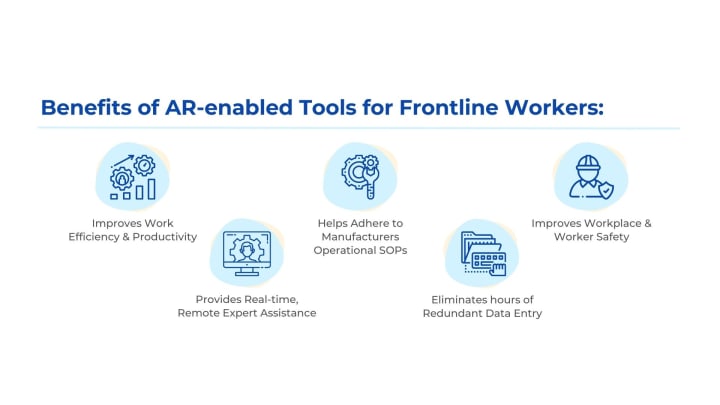
AR brings digital information to the work environment in 3D sights and annotations, so the workers can quickly and visually perceive and access it while doing their job. It accomplishes this with an AR-infused collaboration platform that is device agnostic (mobile phones, laptops, tablets, etc.) and IoT wearables. Marrying the physical with the digital world, below is how AR benefits the frontline workers.
#1 Improves Work Efficiency and Productivity
AR collaboration tools provide fully augmented and guided work instructions to the frontline workers, improving their productivity as they can perform their jobs more independently.
For instance, Volvo improved the productivity and accuracy of its final quality checks on newly-made truck engines with AR work instructions. AR app offers visual guidance to the frontline team on prompt diagnoses, troubleshooting SOP, and so on. As a result, it reduced the TAT of the Plant manager by 60% to achieve first-time fix rates.
Thus, AR drives the productivity of frontline workers by facilitating faster knowledge transfer and accelerating onboarding, learning, and training in the process. Even new, inexperienced, or junior workers can get up to speed with MRO skills via self-learning AR step-by-step
guides and remote assistance from experts.
Moreover, with visual aids, AR experiences, recorded training, and contextual information, workers ensure that every step is correct and verified. It further improves their work efficiency.
#2 Provides Real-time, Remote Expert Assistance
If the workers are unfamiliar with issues, AR-based platforms can virtually connect them to an expert and offer remote assistance. Through AR annotations show, the expert can make notes, capture images & videos, add tags, highlights, and more on the video call. As a result, frontline workers follow instructions accurately while troubleshooting and resolving issues at a manufacturing plant.
Toyota, for example, used AR video calls during Covid to enable experts to remotely oversee plant modifications and worker safety. In addition, non-expert workers (such as outside subcontractors) could also tackle unfamiliar or complex challenges with guidance from a Toyota expert when and where they required it.
As it eliminates the need for travel, frontline workers can connect to subject matter experts worldwide. Further, the experts can provide real-time fault analysis, shorten the assessment time, and resolve issues quickly. Thus, AR can help frontline workers solve problems faster as they can act immediately with on-demand remote collaboration via live video calls.
#3 Helps Adhere to Manufacturers Operational SOPs
Using AR-powered tools to establish digital workflows help frontline workers adhere to the set execution standards easily.
Firstly, it eliminates written instructions, which are a massive problem as they can be easily misinterpreted and may not cater to the MRO experiences of all frontline workers. But pictures or videos show them exactly how to execute a process leaving no room for errors. As a result, workers run assembly, installation, repair, or maintenance at 100% accuracy and quality, enabling them to perform their best.
Secondly, it reduces human errors, which is a significant reason for unplanned downtimes. But AR tools feature intuitive digitized workflows that include step-specific visual instructions, videos, diagrams, and images. So no matter their experience level, frontline workers can perform their jobs right even the first time.
#4 Eliminates hours of Redundant Data Entry
Introducing digital work instructions and checklists ensures every step of a job is done correctly but also eliminates the paperwork. In addition, an AR-based platform captures real-time progress, analyzes, and verifies the job done through photos and videos.
Such reporting is rendered in real-time instead of taking days of paperwork after a job is completed with AR. It eliminates hours of data entry for frontline workers and makes the reports available to relevant stakeholders timely.
#5 Improves Workplace & Worker Safety
The safety of frontline workers continues to be a priority for manufacturing plants. And here, too, AR can prove to be a game-changer. AR, powered with IoT sensors and wearables, can be used to provide real-time equipment performance data to frontline workers.
For instance, they can be warned if a piece of equipment is too hot for maintenance and should be revisited later. As a result, it dramatically improves workers' safety. Moreover, hands-free guides allow frontline workers to perform a task with clarity in a hazardous environment, further enhancing their safety.
Empower Your Frontline Workforce with AR
To sum up, using AR-enabled tools in manufacturing plants can significantly improve frontline workers' workplace environment and culture. It reduces their burdens with timely remote assistance and workflow automation and revolutionizes day-to-day work. This, in turn, benefits manufacturers with reduced downtimes, productive employees, and streamlined timely production.
Plutomen is an AR-based SaaS platform that empowers manufacturing and industrial enterprises with innovative AR solutions. Our products enable interactive remote collaboration and digitize workflows smartly for your frontline workforce. If you are ready to make the life of your frontline workers easier, book a demo with us today!
About the Creator
Keep reading
More stories from writers in 01 and other communities.
How to Choose a Mobile App Development Company in 2026
The Google ecosystem is currently undergoing a structural realignment that fundamentally changes how mobile applications are discovered and validated. We are witnessing a tectonic movement away from traditional index-based search toward a unified Trust Graph where Entity Signals dictate market survival.
By Devin Rosario2 days ago in 01
Top 10 SEO Experts in Pakistan 2026
Pakistan continues to establish itself as a key contributor to the global digital marketing industry. By 2026, the country has developed a mature SEO ecosystem that extends well beyond traditional keyword optimization.
By SEO EXPERT IN PAKISTAN 20254 days ago in 01
Thoughts on Vocal and the way the world is
"Death cannot stop true love, only delay it." – Wesley in The Princess Bride. I decided to come back to Vocal on a very cold and dark night at the end of December. I had been, and still am, convalescing from a horrible staph infection that had gone misdiagnosed for months. This, paired with the increasing challenges of being healthy, making the best choices for my co-parented child, being a wife, and being a director at a new job, was a lot to manage.
By Jazzy 6 days ago in Confessions


Comments
There are no comments for this story
Be the first to respond and start the conversation.