
The Top 5 Software Mistakes Structural Engineers Make in BIM
The Top 5 Software Mistakes Structural Engineers Make in BIM

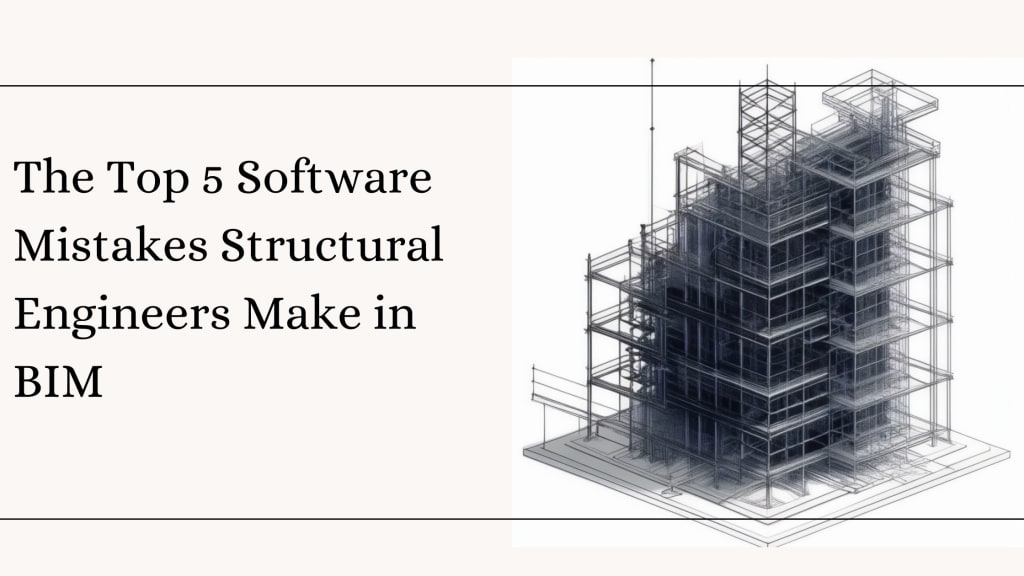
Structural engineers using BIM often face frustrating roadblocks, delays, clashes, and costly rework, not because they lack skills, but because they keep making the same software mistakes. Structural BIM Services are only as good as the people using them and the software decisions they make. However, even experienced structural engineers fall into avoidable traps when working with Structural BIM Modeling Services.
These mistakes aren’t about lacking knowledge, they’re often rooted in assumptions, miscommunication, or rushed workflows that lead to deeper technical and coordination issues.
This blog isn’t about theory. It’s a direct guide to fixing the top 3 BIM software mistakes killing efficiency in structural engineering projects. If you’re tired of last-minute model corrections, clashes slipping through, or contractors rejecting your deliverables, these fixes will help.
1. Modeling with Generic Templates Instead of Project-Specific Families
One of the earliest and most damaging missteps is relying on default templates provided by BIM platforms. These templates, while easy to access, rarely reflect the specific design standards, load requirements, or fabrication realities of a live project.
Using unmodified structural families for beams, columns, footings, or reinforcement leads to Structural Models that may pass initial design checks but break down during detailed coordination. Generic components lack critical metadata, fail to comply with region-specific codes, and create inconsistencies during interdisciplinary reviews.
To avoid such issues, teams working on Structural BIM Modeling Services must develop and maintain a tailored component library. All structural families should align with project requirements, fabrication constraints, and LOD standards established in the early planning phases. This approach not only eliminates model ambiguity but also improves downstream outputs like shop drawings and quantity takeoffs.
2. Remodeling Without a Clear Data Strategy
Another common software-related pitfall is excessive modeling of structural details beyond what is required for a given phase or deliverable. Structural engineers, in an attempt to reflect every physical element, often insert complex geometry, such as full rebar layouts, bolts, gusset plates, and welds, too early or unnecessarily in the BIM workflow.
This level of detail, while technically impressive, overloads the model, increases processing times, and complicates coordination with architectural and MEP trades. Moreover, excessive geometry slows down cloud-based collaboration tools and may confuse stakeholders who are not equipped to interpret granular construction elements.
Effective Structural BIM Services require disciplined modeling strategies, where LOD is defined according to project milestones. Data should drive decisions, not geometry alone. By using symbolic representation, metadata, and conditional visibility settings, engineers can deliver more manageable and purposeful models without sacrificing accuracy.
3. Delaying Cross-Discipline Model Integration
Waiting too long to integrate structural models with architectural or MEP models remains a persistent problem in many project teams. Structural engineers often prefer to work in isolation until the design is complete, only syncing their models late in the process for clash detection. This delay defeats the core advantage of Building Information Modelling early issue resolution through real-time collaboration.
When structural grids, slab penetrations, or load-bearing walls are developed in isolation, they frequently conflict with elements already modeled by other disciplines. As a result, engineers spend valuable time resolving conflicts that could have been prevented through early coordination.
To mitigate this, Structural BIM Modeling Services must be part of the collaborative process from the beginning. Weekly model exchange, shared coordination environments, and alignment with the BIM execution plan are essential. Real-time syncing not only prevents conflicts but also accelerates decision-making between structural engineering teams and other disciplines involved in the project.
4. Mismanaging Software Interoperability Across Platforms
Structural engineering teams frequently operate within mixed software environments. Models may begin in Revit, analysis may occur in ETABS or STAAD, and detailing may involve Tekla or AutoCAD-based tools. However, the transition between platforms often leads to data loss, misaligned geometries, or broken parametric relationships if not handled correctly.
Incorrect use of IFC exports, failure to maintain units and coordinate systems, and loss of analytical model data during imports contribute to significant inefficiencies. These issues not only require time-consuming corrections but also lead to mistrust in the model’s reliability.
To deliver reliable Structural BIM Services, engineers must adopt robust interoperability workflows. This involves standardizing naming conventions, maintaining shared coordinates, and using verified plugins or middleware for file exchange.
Where possible, native file formats should be preserved. Project teams should also document their software versions and exchange protocols within the BIM execution plan to reduce cross-platform issues.
Interoperability isn’t just a technical requirement, it is a foundational part of delivering dependable structural BIM solution outputs.
5. Neglecting QA/QC Workflows within BIM Software
While most structural teams perform quality control on drawings and calculations, they often overlook the model as a source of potential errors. BIM models, especially structural ones, require rigorous quality checks to maintain data integrity, dimensional accuracy, and constructability.
Unfortunately, many engineers treat QA/QC as a post-modeling activity, only to discover fundamental issues late in the design cycle. Examples include incorrect material assignments, incomplete reinforcement details, unsupported structural loads, or invalid parametric constraints.
Neglecting in-model validation leads to inaccurate clash reports, faulty schedules, and compromised documentation. This not only slows down approvals but also risks real-world construction errors that could have been avoided with routine checks.
To uphold the value of Structural BIM Services, engineers must build QA/QC into their digital workflows. Routine clash detection, material audits, rule-based validation, and shared model reviews should become part of weekly deliverables. Several BIM platforms support custom scripts and visual programming tools to automate these processes, saving time while increasing reliability.
For those operating under tight deadlines, working with structural BIM outsourcing services can support internal teams with QA-focused deliverables that align with both global and local project standards.
From Theory to Jobsite
The promise of Structural BIM Modeling Services lies in their ability to deliver accurate, coordinated, and construction-ready information. However, that promise often falls short due to preventable software-related mistakes made during the modeling process. From the misuse of generic templates to poor platform interoperability and delayed collaboration, each mistake adds friction to the design and construction pipeline.
Structural engineers who prioritize project-specific libraries, model only what’s needed, engage early with other disciplines, manage cross-platform workflows, and adopt in-model QA/QC practices will experience smoother project delivery and fewer coordination headaches.
These improvements are not just technical adjustments but they’re mindset shifts. The goal is not to create a flawless model but to develop a reliable, readable, and buildable digital representation of the structure. That is the core of meaningful Structural BIM Services.
Firms aiming for consistency, speed, and coordination can further strengthen their outcomes by working with experienced structural BIM outsourcing services that bring established standards and proven BIM workflows to every project. Whether in high-rise developments, industrial plants, or infrastructure projects, eliminating these five software mistakes is a direct step toward improved quality and reduced risk in structural engineering.
About the Creator
lisa Brown
Building Information Modelling delivers high quality out performing designs in Electrical BIM Services. We collectively work as a team and we believe in delivering end to end solutions in electrical designs and drawings.
Keep reading
More stories from lisa Brown and writers in 01 and other communities.
Why Are HVAC BIM Services Essential for Modern Engineering Projects?
This is the real-world scenario every engineer, builder, modeler, and drafter knows well. When mechanical systems like HVAC ductwork collide with plumbing or structural components on-site, it is not just a technical issue. It becomes a delay, a cost spike, and often, a complete design rethink.
By lisa Brown10 months ago in 01
These Billionaires Bet Big On GreenLand—After Trump Took Interest
Topline Just months after President Donald Trump first expressed interest in the United States possibly gaining control over Greenland, some of the richest people in the world—including Jeff Bezos, Bill Gates and Michael Bloomberg—began making strategic investments in the mineral-rich island.
By Dena Falken Esq3 days ago in 01
How, Too
Many people wonder how, too. You are not alone, and I am an expert. I will teach you how, too! First, you need to remit a small application fee and fill out an application describing the nature of your financial situation and how often payments will be made, as this will have great bearing on how well I teach you how, too.
By Harper Lewis3 days ago in Fiction



Comments
There are no comments for this story
Be the first to respond and start the conversation.