
The Future of AI Companions: From Digital Chatbots to Personal Robots
Exploring the Evolution of AI Companions, From Virtual Chatbots to Intelligent Personal Robots Transforming Human Connection

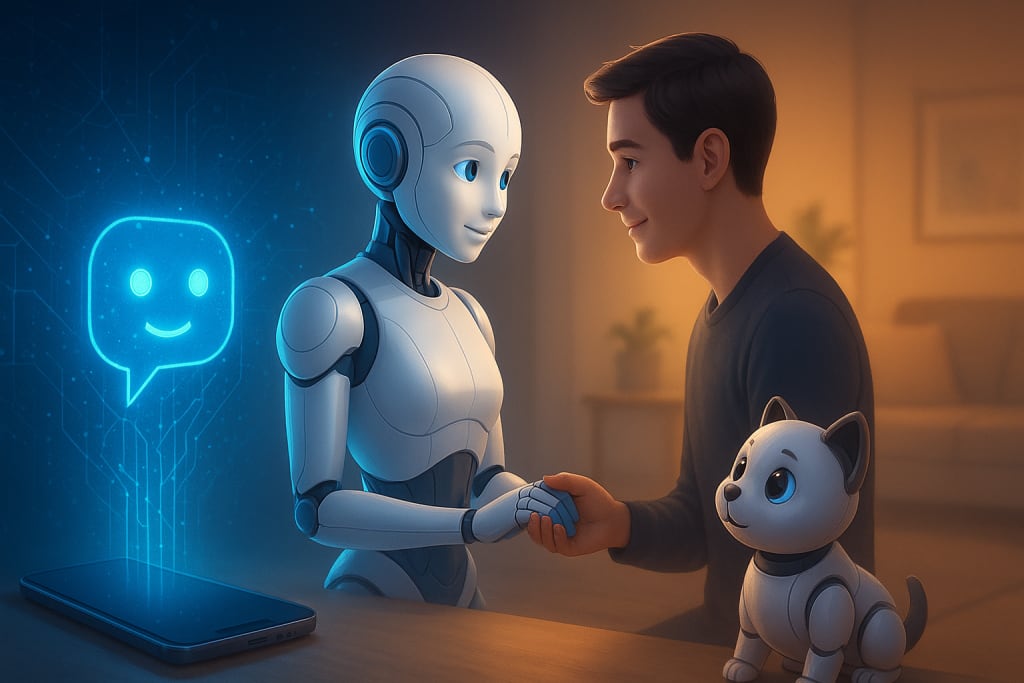
Artificial intelligence is no longer just a tool for crunching data or powering search engines—it is becoming something more personal. AI companions represent one of the most intriguing developments in technology: machines designed not just to answer questions, but to engage, support, and in some cases, emotionally connect with humans.
The idea of machines as companions has existed for decades in science fiction, but advances in machine learning, robotics, and natural language processing (NLP) have moved this vision closer to reality. The journey from simple text-based assistants to potential robotic partners shows how quickly technology is evolving—and raises important questions about what it means to coexist with artificial beings.
The Origins: Chatbots and Digital Companionship
The earliest AI companions were not very intelligent. In the 1960s, Joseph Weizenbaum’s ELIZA program simulated a psychotherapist by reflecting a user’s statements back as questions. Despite its simplicity, many users felt genuine attachment to the program, illustrating how quickly humans project emotion onto machines.
For decades, chatbots were largely novelties—used in entertainment, marketing, or customer service. They relied on pattern matching rather than true understanding, which often led to frustrating or repetitive exchanges.
Things began to change in the early 2010s with the arrival of voice-based assistants like:
- Siri (Apple) – brought conversational interfaces to mainstream smartphones.
- Alexa (Amazon) – turned smart speakers into a household presence.
- Google Assistant – combined search intelligence with contextual awareness.
These systems expanded the role of AI from simple task execution to daily integration, handling reminders, music playback, navigation, and more. Still, they were transactional, not relational.
The Turning Point: AI That Learns and Remembers
What separates modern AI companions from early chatbots is the ability to learn, adapt, and recall past interactions. Thanks to deep learning and advanced NLP models, AI can now:
- Understand subtle context rather than rely on scripted replies.
- Retain memory of prior conversations, enabling continuity.
- Detect tone and sentiment, adjusting responses accordingly.
- Personalize dialogue based on preferences, habits, and goals.
For instance, an AI companion might not just remind you of a doctor’s appointment but notice patterns in your sleep schedule and encourage healthier routines. Tools like Replika are designed to simulate friendship, using emotional cues and memory to create ongoing relationships with users.
This emotional intelligence is a critical milestone. People are not just using AI as tools—they are beginning to view them as entities with whom they can build ongoing connections.
Enter the Physical World: AI Companions as Robots
Digital-only companions are powerful, but when merged with robotics, the experience transforms. Personal robots bring companionship into the tangible world.
Current Examples:
- Sony’s Aibo: A robotic dog that learns its owner’s behavior, responds to affection, and develops a unique personality.
- SoftBank’s Pepper: A humanoid robot designed for retail, healthcare, and education that recognizes faces and emotions.
- Moxie by Embodied: A robot for children, teaching emotional and social learning through natural interaction.
Unlike screen-based chatbots, robots can provide physical interaction, such as gestures, touch responses, or even mobility. For the elderly, robots can offer companionship and assistance with daily tasks. In classrooms, they can serve as tutors or engagement tools.
The combination of AI + robotics creates a new category of machine: not just a helper, but a presence.
Why People Want AI Companions
The appeal of AI companions is complex and deeply human. People are turning to them for reasons that go beyond utility:
- Loneliness and Isolation: AI companions provide nonjudgmental interaction for individuals who may feel disconnected.
- Consistency: Unlike human relationships, AI companions are available 24/7 without emotional fatigue.
- Personalization: These systems remember preferences, unlike traditional technology.
- Accessibility: For people with disabilities, AI companions can serve as guides, helpers, or conversational partners.
- Education and Growth: Adaptive companions can act as tutors, coaches, or mentors, adjusting lessons to individual progress.
In a world where social structures are shifting and digital life dominates, the demand for companionship in new forms is only growing.
Benefits Across Different Fields
AI companions have the potential to reshape multiple industries:
Healthcare: Robots that monitor patient health, remind them of medications, and provide comfort.
- Education: Personalized tutors that adapt in real time to student needs.
- Workplaces: AI systems that act as brainstorming partners or productivity coaches.
- Elder Care: Companions that alleviate loneliness, assist with mobility, and provide emergency alerts.
- Entertainment: AI characters that evolve with the player in games, or digital performers that interact with fans.
The versatility of these companions lies in their ability to blend function with emotional connection—something traditional machines could never offer.
The Ethical and Social Challenges
However, the rise of AI companions comes with concerns that cannot be ignored.
- Data Privacy: AI companions often require personal and behavioral data. Who controls this information, and how is it protected?
- Emotional Dependence: Users may develop attachments that affect their real-world relationships.
- Bias and Representation: Companions trained on biased data may reflect harmful stereotypes or cultural blind spots.
- Economic Divide: Advanced AI robots may remain too costly for many, reinforcing inequalities.
- Blurred Reality: As AI grows more lifelike, it becomes harder to distinguish between genuine empathy and simulated response.
Organizations like the AI Now Institute are pushing for ethical guidelines to ensure these systems enhance human life without exploiting vulnerabilities.
Where AI Companions Are Headed
Looking forward, several trends are likely to define the evolution of AI companionship:
Seamless Hybrid Companions
AI that exists both in digital form (apps, wearables) and physical form (robots), offering continuity across platforms.
Hyper-Personalized Ecosystems
Companions that integrate with cars, homes, and workplaces, creating a unified support system.
Advanced Emotional Simulation
Systems capable of mimicking empathy so convincingly that interactions feel indistinguishable from human relationships.
Collaborative Companions
AI that doesn’t just serve individuals but supports teams, mediating group dynamics or aiding collaboration.
Societal Integration
From classrooms to hospitals, companions may become standard features, acting as both helpers and companions to entire communities.
The progression from chatbots to personal robots signals more than just a leap in technology—it reflects a cultural redefinition of companionship itself. These systems are moving from tools we use to partners we interact with, offering presence, empathy, and support.
Yet with this opportunity comes responsibility. Developers, regulators, and users must navigate privacy risks, emotional dependence, and ethical design. The future of AI companions will not simply be about machines becoming more humanlike. It will be about society deciding how much space to grant them in our emotional, personal, and social lives.
The question is no longer whether AI companions will shape the future, but how deeply they will shape us in return.
About the Creator
Richard Bailey
I am currently working on expanding my writing topics and exploring different areas and topics of writing. I have a personal history with a very severe form of treatment-resistant major depressive disorder.
Keep reading
More stories from Richard Bailey and writers in 01 and other communities.
AI in Gaming: Tools, Gadgets, and Innovations Reshaping How We Play
Artificial Intelligence has quietly woven itself into nearly every aspect of gaming. From the way enemies react on-screen to the gadgets players hold in their hands, AI is no longer a background feature—it’s a driving force changing the rules of play. What was once a niche experiment in design has become the backbone of modern gaming experiences, shaping everything from realism and immersion to personalization and competitive balance.
By Richard Bailey2 months ago in 01
Outlook Account Hack: Complete Guide to Crack a Password
The Reality of Email Account Vulnerabilities Microsoft Outlook accounts represent more than just email inboxes—they serve as gateways to personal data, professional communications, and often as single sign-on keys to numerous other services. With over 400 million active users worldwide, Outlook has become a prime target for cybercriminals employing increasingly sophisticated methods. This comprehensive guide examines the legitimate security landscape, revealing how attackers exploit vulnerabilities while providing actionable strategies to fortify your digital identity. Understanding these threats isn't about enabling malicious behavior—it's about empowering users and administrators with the knowledge needed to build impenetrable defenses in an era where email security is paramount to both personal privacy and organizational integrity.
By Alexander Hoffmanna day ago in 01
AI Agents in Action: Why Your Bot Still Sucks in 2026
I woke up this morning to my agent arguing with a flight carrier. It was glorious. No, seriously. In early 2024, we were all just playing with chatbots that hallucinated legal advice. Now, seeing ai agents in action is like watching a digital concierge with a chip on its shoulder.
By Sherry Walker3 days ago in 01


Comments
There are no comments for this story
Be the first to respond and start the conversation.