
Temple of the First Woman Pharaoh, Hatsheput
Temple of the First Woman Pharaoh, Hatsheput

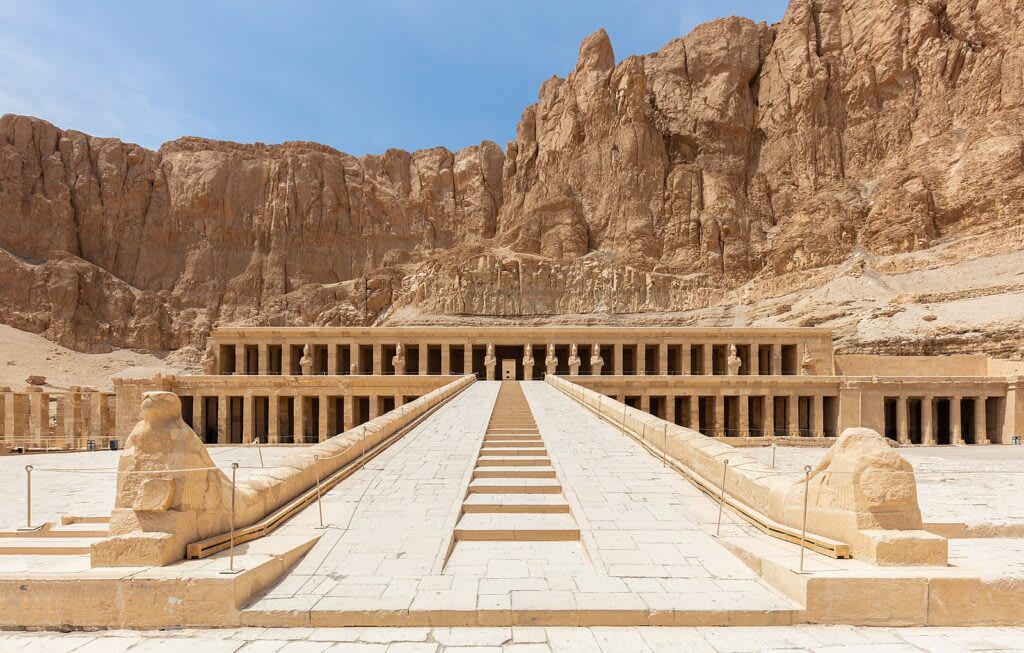
The Temple of Hatshepsut, also known as the Mortuary Temple of Hatshepsut, is one of the most iconic and impressive monuments of ancient Egypt. Located on the west bank of the Nile near the Valley of the Kings, this stunning structure was dedicated to the memory of Pharaoh Hatshepsut, the Fifth Pharaoh of the Eighteenth Dynasty, who reigned from around 1479 to 1458 BCE. Her temple is a testament to her power, legacy, and the complex political and religious roles she played during her reign. It is not only a remarkable feat of architecture but also a symbol of Hatshepsut’s unique role as one of the few female pharaohs in Egypt's history.
Background on Hatshepsut’s Rise to Power
Hatshepsut was born around 1507 BCE, the daughter of Pharaoh Thutmose I and Queen Ahmose. Upon the death of her father, the throne passed to her younger half-brother, Thutmose II. Hatshepsut was initially married to Thutmose II, but when he died, the throne passed to her stepson, Thutmose III, who was just a child at the time. Although Thutmose III was the rightful heir, Hatshepsut took on the role of regent, and over time, she assumed full control of the throne, declaring herself pharaoh.
Hatshepsut's rise to power was not without controversy, as it was rare for a woman to assume the title of pharaoh. To solidify her legitimacy, she adopted many of the traditional symbols of kingship, including the male dress of the pharaoh, the false beard, and the kilt. She was depicted in statues and reliefs as a male king, often with her features subtly modified to appear more masculine, a deliberate move to avoid undermining her authority in a male-dominated society.
Despite the unconventional nature of her reign, Hatshepsut proved to be an exceptionally capable ruler. She focused on building infrastructure, promoting trade, and restoring Egypt's stability. One of her most significant achievements was her trade expedition to the Land of Punt, which brought vast wealth to Egypt. Hatshepsut’s reign was marked by peace, prosperity, and monumental building projects, including the construction of her magnificent mortuary temple at Deir el-Bahari.
The Construction of the Mortuary Temple
Hatshepsut’s mortuary temple was designed by her architect, Senenmut, and it was constructed over a period of about 15 years, beginning around 1479 BCE. It was built into the cliffs of Deir el-Bahari, a site that was sacred to the ancient Egyptians due to its association with the god Amun. The temple is a marvel of ancient Egyptian architecture, featuring a series of terraces that rise in a series of ramps from the valley floor to the temple's uppermost platform. The design of the temple follows the typical Egyptian pattern for mortuary temples, with a grand entrance, courtyards, and sanctuaries dedicated to various gods and to the deceased pharaoh. However, the temple’s striking use of the natural landscape and its grand scale set it apart from other monuments of its kind.
The temple was designed not only as a tomb but as a site for the worship of Hatshepsut, ensuring that her name would be honored by future generations. At the heart of the temple was a sanctuary dedicated to the god Amun, who was central to Hatshepsut’s political legitimacy. Statues of Hatshepsut as both a female and male figure adorned the temple, reinforcing her dual role as a woman and as pharaoh. The grand terraces of the temple were lined with a series of reliefs that depicted the major events of her reign, including her famous expedition to Punt.
The Expedition to Punt
One of the most significant scenes in the temple is the depiction of Hatshepsut's expedition to Punt, a land thought to be located in the region of modern-day Somalia or Ethiopia. The expedition is celebrated in vivid reliefs on the second terrace of the temple, which show Hatshepsut’s ships arriving in Punt, trading goods such as incense, gold, and exotic animals. The scenes emphasize the wealth and prosperity that the expedition brought to Egypt, and they helped solidify Hatshepsut's image as a wise and capable ruler.
The Punt expedition is often considered one of the highlights of her reign. The reliefs show Hatshepsut’s envoys bringing back treasures, and the king of Punt is depicted as presenting her with exotic goods and even strange animals, such as monkeys and leopards. These scenes served not only to commemorate a significant diplomatic and economic achievement but also to link Hatshepsut's reign to divine favor and the success of her rule.
Posthumous Effacement of Hatshepsut’s Memory
Hatshepsut’s reign was largely successful, but after her death, her legacy was systematically erased. Thutmose III, who succeeded her as pharaoh, sought to diminish her memory, possibly out of a desire to solidify his own legacy or due to the unusual nature of her reign as a female pharaoh. Many of her statues and reliefs were defaced, and her name was removed from official records. Some scholars believe that Thutmose III may have ordered this destruction in an effort to restore a more traditional male line of succession.
This campaign of erasure continued for centuries, and by the time of the later New Kingdom pharaohs, Hatshepsut had largely been forgotten. It was only during the 19th century, when archaeologists began to study the monuments of ancient Egypt more systematically, that Hatshepsut’s accomplishments were rediscovered and her legacy was revived.
The Rediscovery of the Temple
The Temple of Hatshepsut, like much of ancient Egypt, fell into ruin over time. However, it remained an impressive and enigmatic structure, attracting the attention of travelers and archaeologists. In the early 20th century, the temple was excavated and restored by the famous archaeologist Herbert Winlock. His work uncovered much of the temple’s grandeur and restored many of the reliefs that had been damaged or defaced. Today, the temple stands as one of Egypt’s most visited and celebrated sites, offering a glimpse into the life and reign of one of Egypt’s most remarkable rulers.
Hatshepsut’s Legacy
Hatshepsut’s legacy has undergone a dramatic transformation over the centuries. Initially, her reign was overshadowed by the efforts to erase her memory, but modern scholars and archaeologists have reappraised her role in history. Today, she is recognized not only as a successful ruler but also as one of the most important female figures in ancient Egyptian history. Her temple, with its grand architecture, beautiful reliefs, and symbolic connection to her reign, serves as a testament to her vision and achievements.
The Temple of Hatshepsut remains one of the most important monuments in Egypt, both for its architectural brilliance and for the story it tells about the power, politics, and religious significance of ancient Egypt. It is a reminder that despite the efforts to erase her memory, Hatshepsut’s legacy endures, etched into the stone of her magnificent temple, and preserved for future generations to admire and learn from.
About the Creator
The Hidden Technology That Powers Every Pickup and Delivery Request
In the modern digital economy, convenience has become one of the most important factors influencing customer behavior. People expect services to be fast, reliable, and accessible at the touch of a button. Pickup and delivery platforms have emerged as a powerful solution that connects businesses with customers in real time, making the movement of goods easier than ever before. Whether it is food, groceries, parcels, or retail items, these platforms have transformed the way people send and receive products.
By Nayel Basim Al Shehhi2 days ago in 01




Comments (1)
What a fascinating temple! Great work!