
Spotify vs. Apple Podcasts
Is Spotify taking over Apple Podcast?


Let's face it. Apple vs. Spotify has been a great dinner table conversation for as long as I can remember now. Agreed that these are some of the most popular podcasting platforms out there, but it seems like one might outperform the other this year.
The world has been driven by audio content for almost a decade now. What started as audio blogging in the late 1980s has become one of the most popular forms of infotainment in 2021. But increasing popularity means increased competition in the market.
Despite a cutthroat competition, Apple Podcasts and Spotify are considered some of the most popular podcasting platforms. But is Spotify taking over Apple Podcasts? Read on to know what the fuss is about.
Spotify’s glorifying numbers!
Spotify has been betting its money on podcasting for years now. This year, Spotify may finally see a decent ROI coming in looking at its increasing popularity.
According to a report by eMarketer, Spotify’s US podcast listenership will overtake Apple Podcasts this year with over 28.2 million podcast listeners over Spotify. Apple, on the other hand, is standing right behind with 28 million listeners via Apple Podcasts.
According to a report by eMarketer, Spotify’s US podcast listenership will overtake Apple Podcasts this year with over 28.2 million podcast listeners over Spotify. Apple, on the other hand, is standing right behind with 28 million listeners via Apple Podcasts.
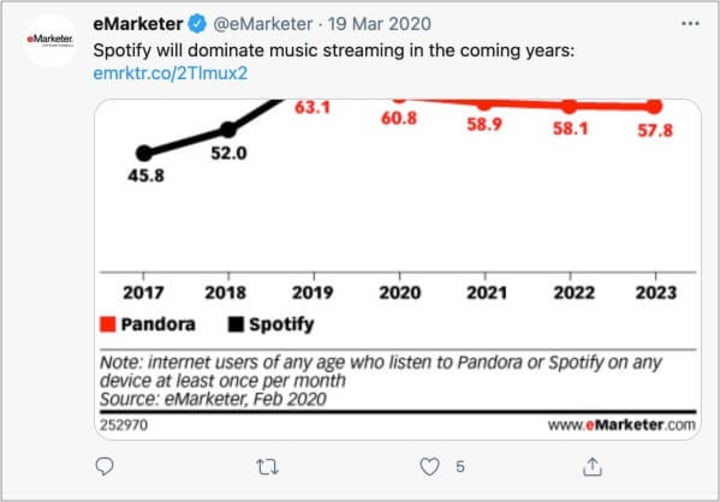
The competition may seem little, but the annual numbers don’t give a happy feeling to Apple. Apple’s market share has fallen from 34% in 2018 to 28.3% in the year 2021. In comparison, Spotify is expected to rise to 41.3% this year.
But what has gotten investors’ attention is the moving number’s average. Despite Apple having a more significant market share(over 35%), Spotify’s 90-day moving average is astonishing.
The 90-day moving average for Apple rose by 45% this quarter, whereas for Spotify, it hit 67%, which is quite overwhelming for the marketers.
What could be a possible reason behind this? The primary reason might be the company being a one-stop destination for music and audio content, whereas the other platform streams podcast only. However, these are just speculations, and we need to dig deeper to get to the core of the matter. Let’s dive right in now, shall we?
Apple and Podcasting
The concept of podcasting became widely popular in 2004. It all started when the top 10 podcasts were named, four of which were tech podcasts.
2004 was an era of podcasting; people were interested in the nascent technology when Apple decided to jump in.
In June 2005, Apple added podcasting to its iTunes 4.9 music software, and they started building a directory of podcasts at iTunes 4.9. iTunes allowed its users to subscribe, download, and organize podcasts, an all-in-one platform that made all the existing platforms unwanted. This instantly killed the competition for Apple.
However, Apple wanted its unique touch added to this technology, which is when Apple started promoting podcasts using GarageBand and QuickTime Pro software. Apple also insisted on MPEG 4 Audio format; instead of the OG MP3.
Spotify’s debut into podcasting
For the next two years, Apple enjoyed its fame in the audio industry until 2008, Spotify’s launch. And this changed the face of the audio industry forever.
Spotify introduced podcasts in the same year too. However, in 2018, Spotify opened podcasting for all its users, two years after Apple had separated Podcasts from iTunes.
By the end of 2018, Podcast listeners on Spotify grew up to 175%. The company has been adamant about using one platform to stream music or podcasts, which is considered an important reason for its growing popularity. Recently, Spotify has started streaming video podcasts to its platform as well, thereby increasing its popularity.
Spotify's ad-free world!
With more than $600 million invested in the podcasting business itself, the world is eyeing Spotify’s action map for the next financial year. How will the company manage its status as the world’s best audio platform and gain ROI?
It is a no-brainer that Spotify’s primary source of income is its advertisements against premium subscriptions. With a premium subscription, you can stream music ad-free; and the streaming platform has to pay the money to the record label for listening.
However, this is not the case with the podcast. With an exclusive podcast, the company doesn’t have to pay a dime to other companies. To top it up, the company is also making money with every listens because of ad-placements, regardless of your subscription. Even a premium member has to listen to ads during the podcast, making this a gold mine for Spotify.
If the explanation doesn’t appeal to you much, the numbers might: According to Midroll, advertisers pay $18-$50 per 1000 listeners for each episode. The best podcast ads are voiced live by hosts, increasing the charges even more.
Now, if numbers are to be believed, Joe Rogan’s Show reaches 190 million downloads per month, bringing in $3million/month in ad-revenue for Spotify. This is just one show. Spotify has a handful of more exclusive podcasts where this theory can be applied.
Spotify minting money: Multiple revenue streams
Spotify is also equally focussed on providing tools to people interested in creating their podcasts, thereby increasing the revenue streams.Spotify hosts more than a million podcasts, 70 percent of which were created by Anchor, a Spotify podcasting tool. These are multiple revenue streams.
On top of these acquisitions, Spotify is creating new technology for inserting ads. With its new streaming ad insertion tool, targeted ads are placed into shows while listeners stream the episode. Quoting Spotify,
Streaming Ad Insertion (SAI) delivers the intimacy and quality of traditional podcast advertising with the precision and transparency of modern-day digital marketing. SAI introduced an entirely new set of data-driven insights to podcast advertising, including a fully digital suite of planning, reporting, and measurement solutions. SAI is available in the U.S., Canada, Germany, and the UK, and we plan to launch in additional markets later this year.
With video podcasts now available across the platform, this is driving more audience to the streaming platform. Every form of podcasting is available to its users within the same app, thereby making the platform user-friendly.
Apple’s limited financial incentive
Apple has always been keen on its security and disagrees with the idea of inserting ads during the episodes. To top it off, podcasts are free to download from the platform, and the company is not taking any cuts from the creators as well, thereby limiting the number. Thus, podcasting for Apple is just the cherry that the company uses to sell its cake (hardware).
Apple has had this conservative approach towards podcasting since 2005, sticking to Job’s ideas. “It’s sort of like TiVo, for radio, for your iPod,” he said. “It’s not just the ‘Wayne’s World’ of radio, but real radio is jumping onto this. It is getting exhilarating.” he said.
Jobs himself fumbled with the words while talking about this new audio streaming service, for he wasn’t sure how to describe it. But he was talking about podcasting and indeed had some great suggestions to put this to action.
Fifteen years later, the industry is thriving, reaching its triumph with each passing day, making the world concerned if Apple cares about the system. Apple gave birth to an industry, supported during the initial years, and plans to do nothing with it when it’s time to rope in monetary benefits concerns the audio industry’s gurus.
Creators are spitting dissatisfaction over Apple
In a statement, Mr. Cue of Apple said,
“We have more people than ever focused on podcasting, including engineers, editors, and programmers.”
He added,
“Podcasts hold a special place with us at Apple.”
This statement is enough to make the creators believe in Apple’s vision of podcasting. But, the inconsistencies over podcast data constitute a significant concern for the creators. The podcasting industry is at an age where it generates millions in revenue if done the right way.
Though it is still minuscule, the possibilities are endless. It is undoubtedly where media networks are offering podcasting as full-time jobs, expanding the business, especially after the COVID hit.
With all these opportunities, Apple showed a ray of hope by announcing podcast analytics in WWDC 2017 and launched a beta almost six months later. Going full-fledged with it in WWDC 2018, Apple sure promised some great insights into podcasting.
Until now, there has been comically little to no analytical data over the streaming platform, disappointing the advertisers and the creators.
Did it bring fundamental changes to the podcasting business? No, not really. But, it sure has come with a set of positives. Creators and advertisers can now have access to understanding things like unlistened downloads, ad-skipping, and episode retention rates.
Revenue yielding machine: Spotify or Apple?
Apple’s format with its podcasting business hasn’t evolved much since Job’s announcements, but their hardware has transformed the world. When radio-like shows (as Jobs quoted it) were introduced in iTunes, iPhones were nowhere to be seen for the next two years at least.
This created a void in the market, creating room for competitors to enter. Probably this is how Spotify came into existence and is now leading the path crossing Apple with its numbers.
Not just Spotify, further competitions in the market are emerging solely to bridge the gap the leading audio streaming platforms are creating.
While it is easier for contenders to beat Apple, Spotify is getting stronger every day, making it challenging for the lesser-known platforms to deal with the giant. With an ever-expanding listener base, easy ad-positioning, better analytics, and a working mechanism that mints money, it is a win-win situation for the creators to focus on developing their presence over Spotify increasing their chances of exclusivity with the channel.
This is gradually creating a loop that is impossible to escape. The exclusivity brings more people to the platform, thereby introducing them to other content and keeping them hooked. As it turns out, the loop works for both the creators and the listeners. Hence no one is complaining, and everyone is making money at the end of the day.
While podcasting will undoubtedly be a goldmine for Spotify in the coming decade, it has started showing vital signs already. With Apple, it has two healthy choices to make:
Jump to the game and provide some vital metrics to prevent its listener base from driving elsewhere.
Showing a blind eye to the booming industry and keep considering it as an add-on service for its userbase.
Keep your friends close and enemies closer?
With more streaming platforms available across the market now, Spotify wants to be in a profitable stage. Call it a smart business move or a marketing gimmick, Spotify is now collaborating with small competitors such as Overcast by launching podcast API.
This API allows third-party apps to connect with Spotify to manage user’s podcast libraries, search from their vast array of podcasts and fetch detailed information about the episodes.
More importantly, this is Spotify’s way to widen its userbase, and it offers access to Spotify’s exclusive shows outside of Spotify for the first time!

Spotify vs. Apple: Who wins the championship?
Spotify is becoming the one-stop solution for everything audio, not just podcasting. Apple, on the other hand, needs to pay more attention to catch hold of its creators. If the complaints keep rising like this and Spotify offers lucrative opportunities to both the advertisers and creators, it will be an exciting match to see.
For now, I am looking forward to seeing Apple’s further steps; and how fruitful Spotify’s gamble is going to turn up. While we discuss podcasts, do not forget to stream into my podcast, The iGeeksBlog Show, now streaming across all the major platforms.
What are your views on this feud? Let me know in the comment below.
About the Creator
Harshanki Thakker
Find a better word for multitasker and replace it with her name; that's Harshanki for you all. A perfectionist working across multiple domains, Harshanki works in multiple domains; a tech writer, podcast host at iGeeksBlog.com
Keep reading
More stories from writers in 01 and other communities.




Comments
There are no comments for this story
Be the first to respond and start the conversation.