
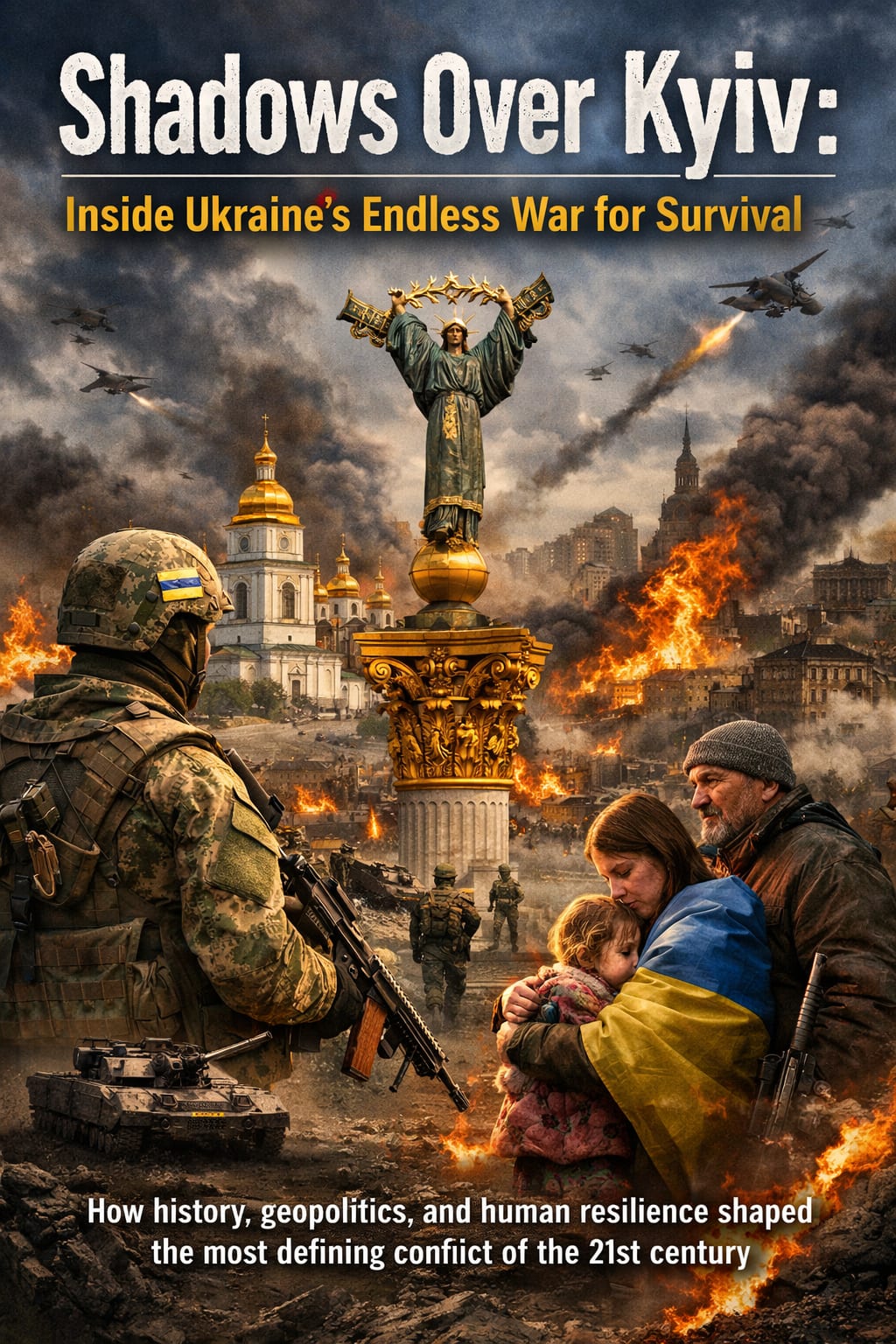
Shadows Over Kyiv: Inside Ukraine’s Endless War for Survival
How history, geopolitics, and human resilience shaped the most defining conflict of the 21st century

Prologue: The Winter That Would Not End
The winter sky over Kyiv carried a strange silence. It was not the peaceful quiet that comes after a snowfall, nor the kind that signals rest. It was the silence of anticipation—an uneasy tension that had settled into the bones of a country waiting for the next strike, the next missile, the next message that would arrive in the form of fire.
Ukraine had learned to read the sky. Every drone’s buzzing echo. Every distant thud. Every jet slice in the cold air. Each sound told a different story, and none of them ended softly.
War had not come suddenly. It had been growing like a shadow that creeps inch by inch before swallowing the light entirely. It was a story that began long before the world’s eyes turned toward Ukraine, long before the missiles fell on Kyiv, long before families decided which memories to carry as they fled across borders and which to leave behind in the ruins.
This is the story of Ukraine’s struggle—political, historical, economic, and human.
A story of power and pride, mistakes and miracles, allies and betrayals.
A story of how a nation became a symbol of resistance in the face of overwhelming odds.
CHAPTER 1: ROOTS OF THE STORM
To understand Ukraine’s present, one must understand the ghosts that live in its soil.
Ukraine has always been more than a country—it has been a crossroads. A bridge between Europe and Russia. A land fertile with wheat and heavy with history. A place where empires clashed, cultures intertwined, and borders were rewritten by outsiders more often than by Ukrainians themselves.
For centuries, Ukraine had struggled for identity. Caught between Tsarist Russia, Polish influence, Ottoman forces, Soviet rule, and Western aspirations, its journey was anything but simple. Every era wrote a new chapter, layered with conflict and resilience.
The collapse of the Soviet Union in 1991 was supposed to grant final clarity. Ukraine emerged independent, hopeful, and uncertain. It carried vast resources but a fragile political system. It carried industrial power but lacked stable institutions. It inherited Soviet corruption but also inherited dreams of Europe.
And between these dreams stood Russia—a neighbor that viewed Ukraine not as a separate sovereign nation but as part of its historical narrative. Russia’s political doctrine, shaped by old imperial instincts, believed that Ukraine drifting toward the West was not merely a diplomatic threat—it was a betrayal of shared history.
The westward drift accelerated after the 2014 Maidan revolution. Ukrainians had taken to the streets demanding dignity, transparency, and alignment with Europe. The world watched as President Yanukovych fled, Russia annexed Crimea, and conflict erupted in the Donbas region.
Eight years later, those unresolved tensions were ready to explode.
CHAPTER 2: THE INVASION BEGINS
The morning of February 24, 2022, felt unreal. People spoke in whispers, as though loud voices might invite the missiles directly.
At 4:50 a.m., Kyiv time, the first explosions ripped through the outskirts of the capital. Russian forces surged across the borders from multiple directions—north from Belarus, east from Russia, and south from the occupied Crimean Peninsula.
Russia’s plan was clear:
A lightning strike. A rapid decapitation of Ukrainian leadership. A forced political collapse within days.
But something happened that Moscow had not calculated properly—Ukraine did not collapse.
President Volodymyr Zelensky refused evacuation.
Ordinary civilians lined up for weapons.
Farmers used tractors to drag away abandoned Russian tanks.
Grandmothers confronted soldiers with curses sharper than any weapon.
Cities became fortresses, villages became trenches, highways became battlegrounds.
The world witnessed a nation that refused to go quietly into the night.
The media showed dramatic images—a lone Ukrainian soldier shouting “Russian warship, go f*** yourself,” a couple holding a wedding in military uniform, civilians blocking tanks with their bodies.
But behind the scenes, the Ukrainian struggle was much deeper, much heavier. People were dying in the hundreds every day. Cities like Mariupol were reduced to ashes. Families slept in subway stations, unsure if they would wake up.
The war was not only physical—it was psychological, economic, and geopolitical.
It was a struggle that reshaped the world order.
CHAPTER 3: KYIV HOLDS THE LINE
As Russian columns approached Kyiv, the world braced for the fall of the capital. Analysts predicted 48 to 72 hours before Ukraine’s government collapsed.
But the city did what seemed impossible—it held.
The forests, rivers, and muddy terrain around Kyiv slowed Russian tanks. Ukrainian special forces executed ambushes with surgical precision. Civilians provided intelligence through social media. Drone footage guided artillery. Western weapons, though limited in the early days, arrived in time to boost morale.
The battles of Irpin, Bucha, and Hostomel became legendary.
In Hostomel, Russia attempted to capture the airport to bring in troops by air. Ukraine destroyed the runway and the planes that landed.
In Bucha and Irpin, Ukrainians slowed the Russian advance street by street.
When Russia eventually retreated from the Kyiv region, the world discovered the horrors left behind—mass graves, tortured civilians, burned homes. Bucha became a symbol of war crimes and suffering.
Ukraine had not only defended its capital—it had rewritten the momentum of the war.
CHAPTER 4: GEOPOLITICS AND THE GREAT SHIFT
The war reshaped geopolitics like an earthquake.
NATO, which had been losing unity for years, suddenly found purpose.
Finland and Sweden abandoned decades of neutrality.
European countries began rethinking their dependence on Russian gas.
The United States emerged again as a central power broker.
Billions of dollars in aid flowed into Kyiv.
Sanctions hammered Russia’s economy.
Global alliances shifted in ways unseen since the Cold War.
But not every country took the same stance.
China maintained a calculated distance—supporting Russia economically while avoiding direct military involvement.
India continued purchasing Russian oil at discounted prices.
Middle Eastern countries balanced between the two sides.
The war became not just a conflict between Ukraine and Russia—it became a global contest between different visions of power and governance.
CHAPTER 5: THE EASTERN FRONT – A SLOW-BURNING FIRE
While the world celebrated Ukraine’s defense of Kyiv, the war shifted toward the Donbas region. This was a different battlefield—flat landscapes, industrial towns, wide open fields ideal for artillery warfare.
Russia changed tactics.
No more lightning strikes.
No more ambitious multi-axis invasions.
Instead, it began grinding warfare—slow, destructive, costly.
Cities like Severodonetsk, Lysychansk, Bakhmut, and Avdiivka turned into ruins.
Each inch of land cost dozens of lives.
Ukraine’s counteroffensive in 2023 reclaimed cities in Kharkiv and parts of Kherson. For a moment, optimism returned. Some believed Ukraine could push Russia back entirely.
But Russia adapted. It built the “Surovikin Line”—layers of trenches, minefields, artillery nests, and anti-tank obstacles stretching hundreds of kilometers.
Ukraine’s counteroffensive slowed dramatically.
Both sides suffered staggering casualties.
It was no longer about rapid victories.
It was about endurance.
CHAPTER 6: THE HUMAN COST
Behind every statistic was a story.
A mother in Kharkiv who buried her son after a missile destroyed their apartment block.
A grandmother in Odessa who cooked soup every day for soldiers passing by.
A father in Mariupol who searched for his family among the rubble.
A teacher in Lviv who converted her school into a refugee shelter.
A teenage girl in Dnipro who learned to study in bomb shelters.
Ukraine became a nation of broken hearts and unbreakable spirit.
Millions fled to Europe—Poland, Germany, Romania, the UK.
Others stayed, unwilling to leave their homes no matter the danger.
Families were separated for months, even years.
Children grew up learning the sound of air-raid sirens before learning math.
And yet—life continued.
Restaurants reopened.
Schools adapted.
Weddings happened in military fatigues.
People laughed, cried, dreamed, and hoped.
War tried to silence Ukraine.
But Ukraine kept singing.
CHAPTER 7: RUSSIA’S CALCULUS
From Moscow’s viewpoint, the war was not optional—it was existential.
Putin believed NATO expansion threatened Russia’s influence.
He believed Ukraine’s shift toward the West could inspire similar movements in other former Soviet territories.
He believed Russia must reclaim its sphere of influence or risk decline.
Russia’s strengths—vast territory, huge population, natural resources—clashed against its weaknesses—corruption, outdated industrial systems, global isolation.
Yet Russia adapted quickly.
Its economy survived sanctions better than expected.
It expanded arms production.
It found new markets in Asia and the Middle East.
It recruited Wagner mercenaries, mobilized troops, and used Iranian drones.
The war became a test of Russia’s long-term resilience.
CHAPTER 8: WESTERN FATIGUE AND UNCERTAIN ALLIES
By 2024, cracks began showing.
Some European nations started doubting endless support.
U.S. political divisions threatened future aid.
Economic pressures made citizens question the costs of war.
Ukraine understood the danger.
Without sustained Western support, its military strength would weaken.
Meanwhile, Russia counted on waiting the West out.
It believed time was on its side.
The world watched uncertainly.
Would Ukraine receive enough weapons?
Would the West stay united?
Would Russia escalate?
The answers were unclear.
CHAPTER 9: THE WAR'S NEW PHASE
By 2025, the war had shifted again.
Ukraine focused on precision strikes deep inside Russia—oil depots, military bases, logistical routes.
Russia intensified attacks on Ukraine’s cities and infrastructure.
Both sides adapted tactics constantly—drones, electronic warfare, cyberattacks.
The battlefield was no longer just physical.
It was digital, economic, informational, psychological.
And yet, through all this, the hope for negotiations remained distant.
Neither side was willing to concede its core demands.
CHAPTER 10: THE FUTURE – A PATH COVERED IN MIST
What comes next?
Some analysts predict a long, frozen conflict—like Korea.
Others see a possible negotiated settlement.
Some fear escalation into a wider regional war.
Ukraine hopes for full liberation.
Russia hopes for recognition of territorial gains.
The world hopes for peace but hesitates on how to achieve it.
One thing is certain:
Ukraine has changed forever.
Its identity strengthened.
Its people united.
Its place in the world redefined.
The war may end someday, but its consequences will echo for generations.
EPILOGUE: THE LIGHT IN THE RUINS
On a quiet night in Kyiv, long after curfew, a woman named Olena lit a single candle in her apartment.
The power grid was down again after a missile strike.
Her daughter slept in the next room.
Outside, the city lay in darkness. But the candle’s flame danced softly, refusing to die.
She whispered a lullaby—one her grandmother had sung decades before during another war.
And for a moment, everything felt still. Everything felt human. Everything felt possible.
Because even in war, there are moments of fragile peace.
Moments where hope hides gently in the shadows.
Moments where the world remembers that Ukraine, despite all it has endured, still breathes, still dreams, and still believes in dawn.
And dawn always comes.
About the Creator
Keep reading
More stories from Muhammad Islam khan swati and writers in 01 and other communities.
Why the United States Stepped Back from Confrontation with Iran: A 360° Geopolitical Analysis
Introduction In the long and turbulent history of US–Iran relations, moments of escalation have often brought the world to the brink of war. From the Iranian Revolution of 1979 to the sanctions era of the 2010s, and through the proxy conflicts simmering across Iraq, Syria, Lebanon, and Yemen, the tension between Washington and Tehran has become a defining feature of Middle Eastern geopolitics. Yet, despite decades of hostility, every cycle of confrontation has also produced unexpected decisions of restraint.
By Muhammad Islam khan swatia day ago in 01
2026 Reality How Mobile Apps Are Developed Now
In 2026, the question how are mobile apps developed no longer describes a linear build process. It reflects a structural shift inside the Google ecosystem where AI Retrieval, Zero Click discovery, and entity-level evaluation now determine whether apps gain visibility, authority, or fade into functional obscurity.
By Mary L. Rodriquez4 days ago in 01
Understanding Car Key Replacement in Modern Cities
Losing access to a vehicle is one of those problems that seems small until it happens. For many people, a car is not a luxury but a daily necessity tied to work, family responsibilities, and personal independence. When a key goes missing or stops functioning, the disruption can be immediate and stressful. This reality has made car key replacement a topic that many drivers only think about once they are forced to deal with it.
By charliesamuel7 days ago in 01




Comments
There are no comments for this story
Be the first to respond and start the conversation.