
Scaling Video Streaming Infrastructure: Lessons from Cloud Gaming (i3D.net)
by Mark Donnigan


Streaming video engineers are constantly battling against buffering, latency, and unpredictable network issues. But what if the solution lies in a different industry altogether? The gaming world has spent decades perfecting real-time networking to ensure smooth, low-latency experiences for players across the globe.
What Video Engineers Can Learn from Gaming Infrastructure
This article explores insights from Stefan Ideler, CIO of i3D.net, a company that has been scaling infrastructure for gaming giants like EA, Ubisoft, and Discord. As i3D.net expands into video streaming, their unique approach challenges the traditional Content Delivery Network (CDN) model and offers valuable lessons for anyone optimizing live and VOD streaming.
Many assume that scaling video streaming infrastructure means adding more servers and bandwidth. However, i3D.net approaches it differently. By owning everything from data centers to the network backbone, i3D.net avoids third-party bottlenecks and traffic spikes. Instead of scrambling for last-minute capacity, proactive infrastructure planning is essential, and monitoring every layer is necessary. Scaling video is not about adding more servers but smarter end-to-end control.
Gamers demand sub-50ms latency to avoid lag. Meanwhile, many live-streaming solutions still struggle to achieve sub-second latency. Unlike traditional CDNs that rely on isolated Points of Presence (POPs), i3D.net operates a global private backbone with over 9,000 direct peering relationships, ensuring predictable routing and making it one of the most connected networks in the world.
Traditional CDN Failures Under Real-Time Demand
Most video CDNs were built for on-demand streaming, not live content delivery. This means they prioritize bulk data transfer over real-time interactions where packets must be delivered sequentially, creating significant challenges for low-latency applications.
Many CDNs offload video to third-party networks as quickly as possible, adding unpredictable delays and making troubleshooting difficult. Without ownership of the backbone, CDNs cannot reroute traffic effectively when congestion occurs. If viewers in different continents need to interact, such as during live sports events, gaming streams, or auctions, traditional CDNs often fail to maintain real-time synchronization.
The alternative approach taken by i3D.net involves carrying video packets as close as possible to the viewer’s ISP before handing them off. This ensures minimal lag and complete control over the network and delivery paths, significantly improving the real-time video experience.
If your streaming service involves real-time interaction, a private backbone is a game-changer compared to third-party-reliant CDNs.
Cost Traps in Streaming Infrastructure and How to Avoid Them
Cost optimization is one of the biggest concerns for video providers. Many companies get locked into expensive cloud-based CDN models, only to find OPEX spiraling out of control at scale. A typical cost pitfall in streaming infrastructure is hidden fees for premium routing. Many cloud CDNs offer cheap baseline pricing but charge steep fees for low-latency routing. Another issue is overpaying for flexibility. Public cloud pricing is designed for elasticity, but dedicated infrastructure becomes much cheaper once a company scales.
Smarter OPEX strategies involve using a hybrid cloud and bare metal approach. i3D.net’s Flex Metal solution allows companies to balance cloud elasticity with dedicated machines for cost predictability. Additionally, utilizing VPUs for efficient encoding dramatically reduces per-stream compute costs compared to CPU-based encoding. Moving from per-stream SaaS pricing to per-instance infrastructure can save millions at scale.
Cloud-based CDNs are convenient to start with, but hybrid infrastructure with VPUs offers massive cost advantages for large-scale video streaming. This is where i3D.net shines.
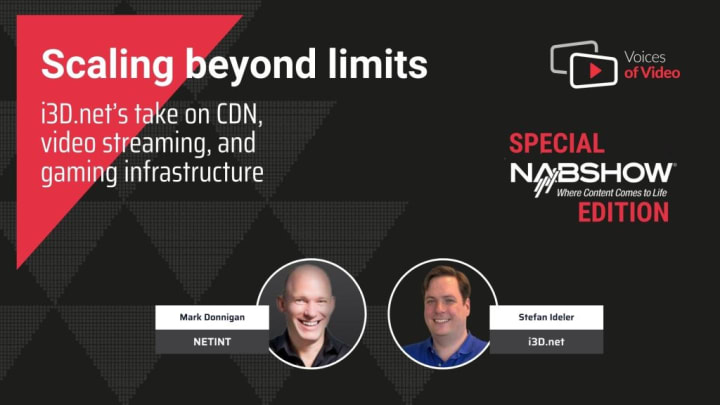
Voices of Video – NAB special:
Scaling beyond limits: i3D.net’s take on CDN, video streaming, and gaming infrastructure with Stefan Ideler from i3D.net
Picking the Right Infrastructure Partner
If you are evaluating infrastructure for your streaming service, asking the right questions can save you from downtime, hidden costs, and poor performance. When selecting a CDN or streaming provider, consider the following questions:
– How many direct ISP peering relationships do they have? More peering relationships result in lower latency.
– Do they own their backbone, or do they lease from third parties? Owning a backbone provides greater control over traffic flow.
– What happens when congestion occurs? Look for providers that offer dynamic routing instead of relying on best-effort delivery.
– Can they guarantee stable pricing as you scale? Avoid providers with hidden costs that only become apparent as usage increases.
– Do they support hybrid cloud and dedicated metal solutions? A flexible approach allows for cost optimization without overpaying for scalability.
The best streaming infrastructure providers focus on network control, cost predictability, and real-time optimization rather than just the number of POPs they operate
The Future of Video Streaming Infrastructure
The streaming industry is shifting from generic CDNs to specialized, real-time-optimized networks. Streaming engineers can adopt lessons from gaming infrastructure to reduce latency with direct ISP peering and private backbones, improve reliability by controlling more of the network stack, and optimize costs through hybrid cloud, bare metal, and VPUs.
If your streaming service needs ultra-low-latency, high-performance delivery, it is time to move beyond traditional CDNs and rethink how video flows across the internet.
by Mark Donnigan
About the Creator
NETINT
NETINT Technologies is a leading innovator in the field of video processing solutions. We specialize in developing ASIC-based (Application Specific Integrated Circuit) solutions for low-latency video transcoding.
Personal Tax Accountants: A Practical Guide for Individuals in the UK
Personal Tax Accountants are no longer seen as a luxury reserved for high earners or business owners. Across the UK, more individuals are choosing professional tax support simply because the tax system has become harder to navigate alone. With frequent rule changes, stricter HMRC checks, and more people earning income in different ways, personal tax accountants offer clarity, reassurance, and practical help that many now consider essential rather than optional.
By Outsourced Bookkeeping Solutionsa day ago in 01
Mexico Online Grocery Market Opportunity and Forecast 2025–2033
Introduction Mexico’s grocery retail landscape is undergoing one of the most significant transformations in its history. What was once dominated by neighborhood tiendas, supermarkets, and open markets is now being reshaped by smartphones, digital platforms, and fast-evolving logistics networks. Online grocery shopping—once considered a niche convenience—is quickly becoming an essential channel for millions of Mexican consumers.
By Aaina Oberoiabout 11 hours ago in 01
Silver Screen Magic with Mae West
American actress and singer Mae West became a popular film actress during the Great Depression. She started entertaining in vaudeville, then performed on Broadway, and finally went to Hollywood. She signed up with Paramount Pictures and made her debut in the 1932 film “Night After Night.” She also starred in musicals, comedies, and crime dramas. The American Film Institute named her one of the best classic Hollywood actresses.
By Rasma Raisters3 days ago in Geeks




Comments
There are no comments for this story
Be the first to respond and start the conversation.