
Rethinking EPR for E-Waste Management: Building Value in the Reverse Supply Chain
Explore how EPR for e-waste management drives circular supply chains, brand trust, and long-term efficiency. Go beyond compliance and turn responsibility into business value.

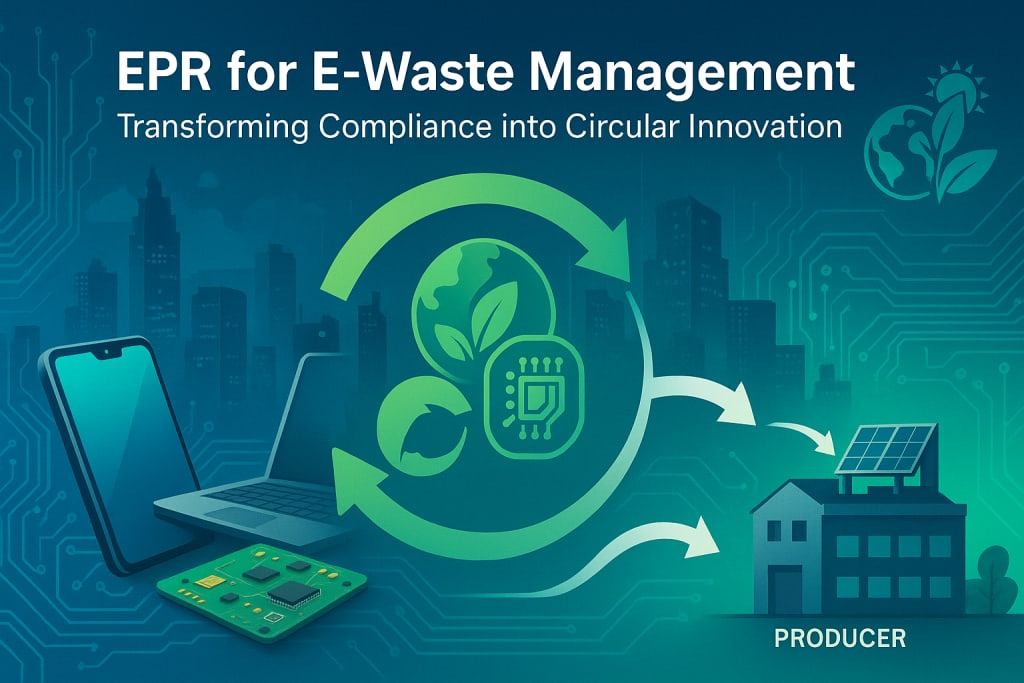
In the backdrop of India’s booming digital economy, a silent and growing challenge threatens the sustainability of progress e-waste. While the spotlight often remains on innovation, device launches, and consumption patterns, the real story is happening at the tail end of the product life cycle. That is where EPR for e-waste management becomes not just a regulatory requirement but a transformative force shaping the future of responsible manufacturing and sustainable business models.
The extended producer responsibility (EPR) framework is often seen through the lens of obligation. But what if the process of collecting, managing, and recycling post-consumer electronics could unlock business efficiency, brand value, and long-term resilience?
The Reverse Chain as a Strategic Asset
Most businesses have invested heavily in forward logistics distribution channels, delivery models, customer experience platforms. But few have mastered the reverse flow of materials. That is where the real opportunity lies.
E-waste is not just junked gadgets and obsolete parts. It contains valuable metals, rare earth elements, and reusable components that, when recovered effectively, can reduce procurement costs and dependency on imported raw materials. EPR frameworks give producers the authority and responsibility to build reverse supply chains that are not only compliant but resource-efficient.
Establishing a robust backend infrastructure for e-waste collection and processing can transform a producer from a linear manufacturer into a circular innovator. Businesses that invest in intelligent reverse logistics under the umbrella of EPR for e-waste management are essentially creating an internal economy of resource recovery.
Creating a Brand of Accountability
In an era where sustainability is no longer a marketing buzzword but a consumer expectation, environmental transparency plays a defining role in brand perception. When a brand adopts EPR not just to fulfill mandates but to establish visible accountability in managing the afterlife of its products, it earns more than compliance it earns trust.
Today’s consumers want to know what happens to their devices once they are discarded. Offering return programs, take-back initiatives, and seamless disposal channels under a credible EPR framework positions a brand as responsible and future-oriented. It demonstrates a commitment that goes beyond the point of sale.
Implementing EPR for e-waste management is a chance to make sustainability part of your brand DNA, not just your annual ESG report.
Operational Intelligence Through Data
One of the most undervalued outcomes of a mature EPR program is data. The process of registering under EPR, reporting collections, and maintaining traceability forces producers to map their supply chains in reverse. This results in a wealth of insights that can drive smarter procurement, better product design, and improved market predictions.
For instance, if certain regions consistently produce more e-waste per product sold, it might indicate design flaws, user behavior trends, or service delivery gaps. Similarly, tracking recyclability percentages can highlight opportunities to redesign for easier disassembly or use materials that retain higher post-consumer value.
Under EPR for e-waste management, data stops being a compliance burden and becomes an engine of operational intelligence.
Aligning with National and Global Sustainability Agendas
India’s E-Waste Management Rules and the evolving framework under the Ministry of Environment, Forest and Climate Change are only the beginning. Global trends point toward increasing pressure on manufacturers to account for the end-of-life impact of their products.
Exporters looking to access European or North American markets must already comply with WEEE and RoHS directives. Aligning domestic practices through EPR for e-waste management prepares businesses for global competitiveness and regulatory harmonization.
Furthermore, with India’s climate goals and push toward circular economy principles, future government support, subsidies, and incentives will favor producers who demonstrate measurable e-waste recovery and recycling efforts.
Looking Forward
E-waste will continue to grow, and so will expectations from producers. The real question is whether your business will treat EPR as a checkbox or as a tool for value creation.
Those who choose the latter will be the ones who future-proof their operations, strengthen their reputation, and build circular ecosystems that turn discarded devices into business continuity.
EPR for e-waste management is no longer just a policy it is a path toward building the next generation of responsible, resilient, and regenerative businesses.
About the Creator
Corpseed ITES Pvt. Ltd
Corpseed is a business consulting firm specializing in regulatory compliance and environmental solutions. We provide expert assistance for EPR registration, certification, and authorization across various waste categories.
Keep reading
More stories from Corpseed ITES Pvt. Ltd and writers in 01 and other communities.
The Silent Revolution: How EPR for Plastic Waste Is Redefining Modern Industry
Plastic isn’t just choking our oceans—it’s exposing a fundamental flaw in capitalism’s linear "take-make-waste" model. While most discussions about EPR for plastic waste management fixate on compliance checkboxes, a deeper transformation is underway. Extended Producer Responsibility (EPR) frameworks are quietly dismantling century-old industrial paradigms, forcing companies to reconcile profit motives with planetary boundaries. This isn’t about waste management—it’s about rewiring the DNA of global commerce.
By Corpseed ITES Pvt. Ltd10 months ago in 01
Top 10 SEO Experts in Pakistan 2026
Pakistan continues to establish itself as a key contributor to the global digital marketing industry. By 2026, the country has developed a mature SEO ecosystem that extends well beyond traditional keyword optimization.
By SEO EXPERT IN PAKISTAN 20255 days ago in 01
Best AR15 Rail Systems for Home Defense, Duty & Range Use
The AR15 platform is renowned for its modularity, and choosing the right rail system—also known as an AR15 handguard or AR15 rail—can significantly enhance performance for specific applications. For home defense, the Aero Precision ATLAS S-ONE stands out as a lightweight, slim M-LOK option that allows quick accessory mounting like lights for low-light scenarios. In duty use, the Midwest Industries Combat Rail excels with its rugged quad-rail design for heavy attachments. For range sessions, the STNGR HWK M-LOK handguard offers excellent value, balancing weight and versatility for extended shooting.
By Ar15handguard6 days ago in 01
Affection and Healing for Yourself
During the night of the last quarter moon, I gathered my ritual supplies. I carefully handled the chunk of black tourmaline that would protect me from your overall negative and narcissistic energy. I carefully walked the house with my stick of selenite in hand, asking the universe to cleanse our working space.
By Alisha Wilkins ✒️🦋🖋️5 days ago in Fiction


Comments