
Rafale Fighter Jet: The Pride of French Aviation
A Symbol of French Engineering Mastery and Air Dominance.

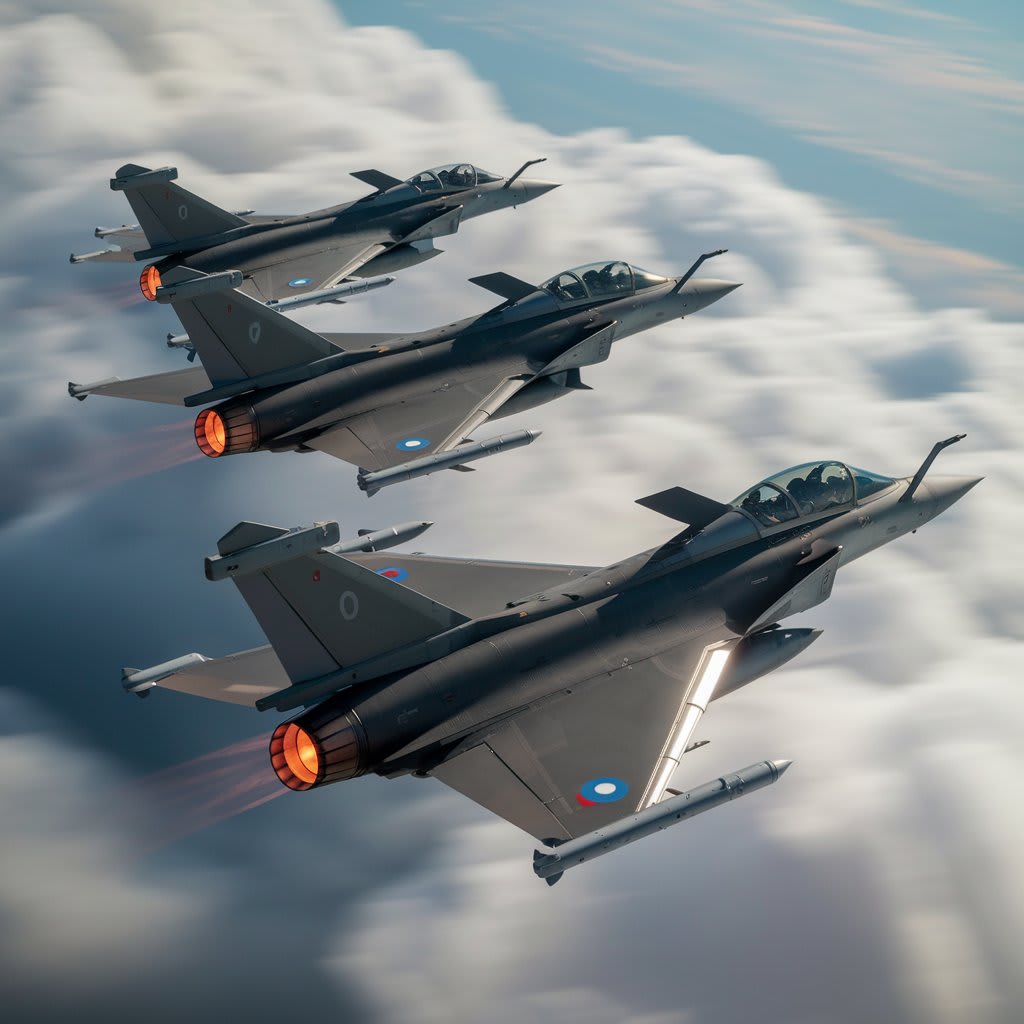
The Dassault Rafale, a twin-engine, multirole fighter aircraft designed and built by Dassault Aviation, stands as one of the most advanced and versatile warplanes in the world today. Developed for the French Air Force and Navy, the Rafale is a symbol of France’s commitment to defense autonomy, combining cutting-edge technology with exceptional agility, stealth, and weapon capabilities. The word Rafale translates to "gust of wind" in French, and this aircraft truly lives up to its name, offering speed, flexibility, and power in a compact frame.
1. Multirole Capabilities
One of the most celebrated aspects of the Rafale is its "Omnirole" capability. Unlike aircraft designed for a single mission type, the Rafale can carry out multiple roles simultaneously. It can perform air superiority, ground support, reconnaissance, nuclear deterrence, and anti-ship missions — all in one sortie. This allows a single Rafale to replace several specialized aircraft, reducing overall fleet costs and logistical complexity.
2. Stealth and Survivability
Although not a stealth fighter in the class of the F-35 or F-22, the Rafale incorporates several stealth features to reduce radar cross-section. These include radar-absorbent materials, careful design of fuselage lines, and minimized heat emissions. Its advanced SPECTRA electronic warfare system offers a high level of situational awareness and jamming capabilities, protecting it from radar-guided and infrared missiles. The aircraft is built to survive contested airspaces, which makes it ideal for high-risk missions.
3. Avionics and Cockpit
The Rafale’s avionics suite is state-of-the-art. It features a glass cockpit with a wide-angle holographic head-up display (HUD), two head-down flat-panel color displays, and a hands-on throttle-and-stick (HOTAS) control system. The cockpit is designed to minimize pilot workload and maximize efficiency, particularly in combat scenarios.
One of its standout systems is the RBE2-AA active electronically scanned array (AESA) radar, which offers long-range detection, tracking of multiple targets, and high resistance to jamming. This gives the pilot critical targeting and surveillance capabilities, even in cluttered or hostile environments.
4. SPECTRA Electronic Warfare System
Rafale is equipped with SPECTRA (Self-Protection Equipment to Counter Threats for Rafale Aircraft), an integrated electronic warfare system that provides radar warning, laser warning, missile approach warning, jamming, decoys, and threat identification. This system enables the Rafale to detect threats early, take defensive action automatically, and even jam or spoof enemy systems. SPECTRA plays a key role in the aircraft's survivability and is one of the most advanced EW systems in the world.
5. Weapons and Payload
The Rafale can carry an impressive payload of over 9.5 tons, spread across 14 hardpoints for the Air Force variant (Rafale B and C) and 13 for the carrier-based Navy version (Rafale M). It is compatible with a wide range of weapons, including:
MICA air-to-air missiles (infrared and radar-guided)
Meteor beyond-visual-range air-to-air missiles (one of the most lethal in the world)
SCALP-EG cruise missiles
AM39 Exocet anti-ship missiles
AASM (Armement Air-Sol Modulaire) precision-guided bombs
Nuclear-capable ASMP-A missile (for France’s strategic deterrent)
This weapons flexibility allows the Rafale to engage in a wide range of missions with devastating effectiveness.
6. Performance and Agility
Powered by two Snecma M88-2 engines, the Rafale can reach speeds of Mach 1.8+ and climb at over 60,000 feet per minute. The aircraft’s aerodynamic design, including canard delta wings, provides superior agility and maneuverability. These features make it highly effective in dogfights and evasive maneuvers.
The Rafale also has an in-flight refueling capability, extending its range for long-distance missions, and it features high angle-of-attack performance, allowing tight turns and agile flight behavior in close air combat.
7. Naval Variant
The Rafale M is the carrier-capable version designed for the French Navy. Unlike many fighters that require significant modifications for carrier use, the Rafale M features reinforced landing gear, tail hooks, and can operate from CATOBAR (Catapult Assisted Take-Off But Arrested Recovery) aircraft carriers like France’s Charles de Gaulle.
8. Combat Proven
Rafale has been battle-tested in various operations including Afghanistan, Libya, Mali, Iraq, and Syria. It has proven its capabilities in both air-to-air and air-to-ground missions under real combat conditions. Its reliability and effectiveness in harsh environments and high-threat zones have cemented its reputation among the world’s top combat aircraft.
9. Global Operators
Apart from France, countries like India, Egypt, Qatar, Greece, and Croatia have inducted the Rafale into their air forces. Its popularity is due to its combat
About the Creator
Keep reading
More stories from Shams Urahman and writers in 01 and other communities.
The Old Man and the Snake
In a quiet village nestled between two great hills, there lived an old man named Arun. He was a solitary figure, with a long white beard and eyes that had seen too much of the world. His cottage, made of stone and wood, stood at the edge of the forest, where the trees whispered ancient secrets and the wind carried stories lost to time.
By Shams Urahman9 months ago in 01
Soundtrack of a City: How Local Music Scenes Reveal the True Soul of a Destination
Music as a Cultural Language Every city has a sound. Long before you understand its history or customs, you can often feel its spirit through the music that fills its streets, clubs, and neighborhoods. Local music scenes act as a living language, expressing everything from struggle and celebration to identity and pride. When you travel, listening to that soundtrack gives you access to emotions and stories that guidebooks can never fully explain.
By Devon Alexis4 days ago in 01


Comments
There are no comments for this story
Be the first to respond and start the conversation.