
Preparing Your Documents for ISO 22000 Certification Audits
Importance of Document Readiness for Compliance
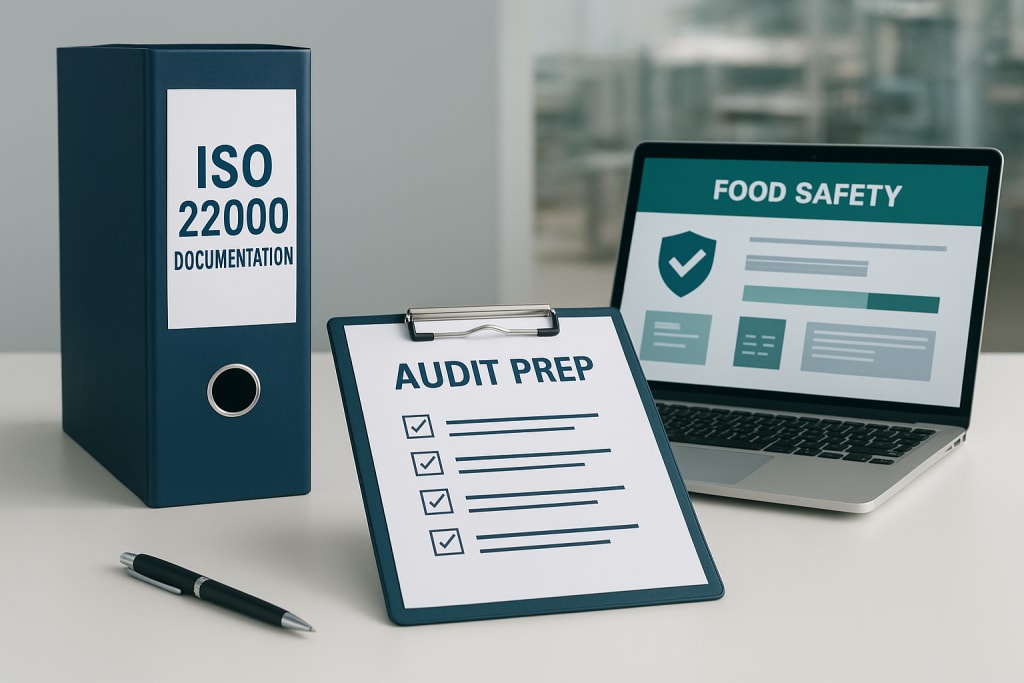
Documentation is the backbone of any ISO 22000 food safety management system. Auditors rely on documented evidence to verify compliance, so documents must be complete, current, and well-organized. Whether your business is a manufacturer, processor, caterer, packager, or supplier, having thorough ISO 22000 documentation demonstrates a commitment to food safety and prevents audit surprises. A clear filing system for all policies, procedures, and records shows that the FSMS is effectively implemented.
Key ISO 22000 Documentation
To prepare for an ISO 22000 audit (initial certification, annual surveillance, or a three-year recertification), compile and maintain the main required documents. These include:
• Food Safety Policy: Top management’s formal commitment to food safety, setting overall FSMS objectives.
• HACCP or Food Safety Plan: Documented hazard analysis and control measures. It should include process flow diagrams, identified hazards and risks, critical control points (CCPs), critical limits, and monitoring or corrective actions.
• Control Procedures and SOPs: Written procedures for operational controls and prerequisite programs (e.g. sanitation, allergen control, training). Each procedure should specify the control methods and include any monitoring or record forms.
• Traceability and Recall Records: Records that trace ingredients through production and document recall procedures. These ensure any affected batch can be quickly identified and removed.
• Internal Audit Reports: Documentation of internal FSMS audits, including findings, nonconformities, and corrective actions. These reports show that the system is regularly reviewed.
• Management Review Minutes: Records of management review meetings (agenda, attendees, decisions). These demonstrate that top management is overseeing and improving the FSMS.
Additionally, include monitoring logs and related records (temperature charts, cleaning checklists, calibration certificates, etc.) and any corrective action forms. Organize all documents in a logical filing system so that any required record can be retrieved promptly during an audit.
Initial Certification Audit
The initial ISO 22000 certification audit typically involves two stages. In Stage 1 (document review), auditors examine your FSMS documentation to confirm that each standard requirement has an associated document or record. Any gaps or missing documents identified at this stage must be corrected before moving on.
In Stage 2 (on-site audit), auditors verify that the documented processes are actually implemented. They tour the facility, observe operations, and interview employees to ensure work is done according to procedures. For each critical control point (CCP), auditors will review monitoring records (e.g. temperature charts) and check that corrective actions were taken when limits were exceeded. They may also conduct traceability drills, following the documented trace records. Management review minutes should be available to show that top management has evaluated and maintained the FSMS as required.
Surveillance Audits
After initial certification, your organization will face regular surveillance audits (usually annually) to maintain the certificate. These audits focus on continued compliance and improvement. Keep all FSMS documentation current by adding new records since the last audit—such as internal audit findings, corrective actions, training logs, equipment calibration certificates, and any updated procedures.
During a surveillance audit, the auditor reviews recent documentation to ensure the system is still operating effectively. They check that issues from previous audits were addressed and that management review meetings have been held and documented. If processes have changed or new hazards have been identified, the related documents (such as the HACCP analysis or SOPs) should have been updated accordingly. By continuously updating your ISO 22000 documentation and records, your organization stays prepared for any audit.
Recertification Audit
A full recertification audit occurs at the end of your certification cycle (typically every three years) and is similar in scope to the initial audit. Review your entire FSMS documentation in advance: ensure policies are still appropriate and that all procedures reflect any operational changes or new legal requirements since the last cycle.
Auditors will expect to see a documented history of your system’s performance. Maintain a complete set of records from the past cycle: all internal audit reports, corrective action logs, management review minutes, and any customer complaint records. Demonstrating that identified nonconformities were corrected and improvements were made will facilitate the recertification audit. Essentially, having updated and well-maintained documentation helps renew your ISO 22000 certification.
Best Practices for Documentation Management
Maintain a clear document control system. Use a register or index of all FSMS documents and records, with version numbers and revision dates. Ensure that only the latest approved documents are in use (mark older copies as obsolete). Train staff on how to access and complete all procedures and forms.
Organize documents so they are easy to find: use labeled binders or an electronic document management tool, grouping files by clauses or processes. Before each audit, use an internal checklist or conduct a mock audit to verify that all required documents and records are present. By keeping procedures, hazard plans, and logs orderly and up to date, any organization—from a small caterer to a large processor—can ensure its ISO 22000 documentation is current and audit-ready.
Conclusion
Thorough, well-organized documentation is essential to a successful ISO 22000 audit. By preparing all required records in advance of each audit—initial certification, surveillance, or recertification—organizations can demonstrate compliance smoothly. Emphasizing key documents (food safety policy, HACCP plan, control procedures, traceability logs, internal audit reports, and management review minutes) highlights the strength of the FSMS. When documentation is complete and accurate, an organization can face any audit with confidence and ensure ongoing food safety performance.
About the Creator
Keep reading
More stories from jessica parker and writers in 01 and other communities.
ISO 20000 vs ISO 9001 Documentation: 5 Key Differences
ISO 20000 and ISO 9001 are international standards with distinct scopes. ISO 20000 focuses on IT service management, whereas ISO 9001 covers quality management in any industry. Understanding how ISO 20000 documentation differs from ISO 9001 documentation is essential for IT service professionals, compliance managers, and other stakeholders. Each standard’s documentation reflects its own objectives and context. The following sections outline five key differences in documentation, focusing on structure, purpose, document types, process scope, and stakeholder focus.
By jessica parker3 months ago in 01
Why Your AI Agents Still Can't Talk to Each Other (And How 2025 Fixed It)
Look, if you've been building AI agents lately, you know the frustration. Your shiny new LangGraph agent can't talk to your colleague's Autogen setup. Your company's chatbot lives in its own little bubble.
By Eira Wexford4 days ago in 01
So You Decided To Become a Nurse Practitioner:
So you decided to become an "Advanced Practice" nurse. Congratulations!... is what I would say if this was a good idea. Grad school? In this economy? What were you thinking? Likely it was something along the lines of either 1) “I've seen these other chucklefucks do it— Why can't I?” or even 2) “I've got a nice career, I should shake it up. I miss feeling like I have no clue what I'm doing.”
By Sandor Szabo7 days ago in Fiction




Comments
There are no comments for this story
Be the first to respond and start the conversation.