
Why Your AI Agents Still Can't Talk to Each Other (And How 2025 Fixed It)
I spent months watching my AI agents live in isolation. Then three protocols emerged that changed everything about how autonomous systems communicate.

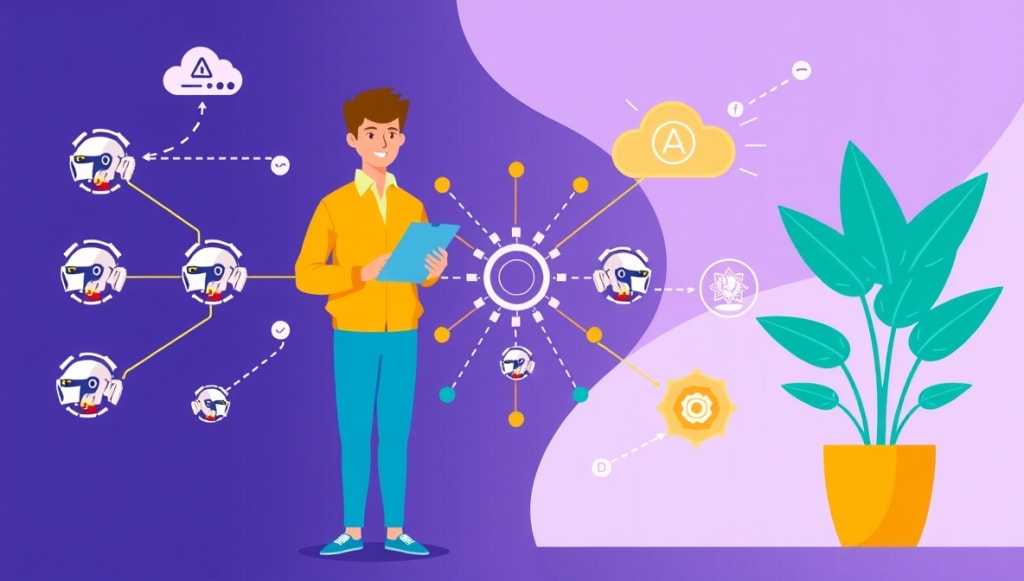
Look, if you've been building AI agents lately, you know the frustration. Your shiny new LangGraph agent can't talk to your colleague's Autogen setup. Your company's chatbot lives in its own little bubble.
Real talk. The AI agent interoperability problem kept me up at night for months.
But here's the thing. 2025 changed everything.
Why AI Agent Interoperability Matters Right Now
Gartner dropped a prediction that shook the industry. By 2026, 40% of enterprise applications will integrate task-specific AI agents. That's up from barely 5% in 2025.
Let that sink in.
We're not talking about chatbots answering FAQs anymore. These are autonomous systems making decisions, executing tasks, and coordinating with each other.
Without proper interoperability standards, you're looking at:
- Isolated agents that can't share context
- Duplicate work across frameworks
- Security nightmares when agents try to communicate
- Scalability walls you'll hit fast
Thing is, the industry finally woke up.
The Big Three Protocols Changing Everything
Model Context Protocol (MCP)
Anthropic released MCP in November 2024. Became the de-facto standard faster than anyone expected.
Think of it as the USB port for AI agents. Your agent needs data from Slack? MCP. Reading files? MCP. Executing code? Still MCP.
It's an open-source framework using client-server architecture. Developers build MCP servers to expose tools and data. AI applications connect as clients.
Pretty elegant, honestly.
By 2025, industry adoption was bonkers. Major platforms scrambled to add MCP support.
Agent-to-Agent (A2A) Protocol
Google jumped in on April 9, 2025 during Cloud Next. Their angle was different.
While MCP connects agents to tools, A2A connects agents to each other.
The protocol launched with 50+ partners. Atlassian. Salesforce. SAP. ServiceNow. By July 2025, that number hit 150+ organizations.
Key features that matter:
- Agent Cards: JSON descriptions letting agents discover each other's capabilities
- Task-based communication: Everything treated as defined units of work
- Modality agnostic: Text, audio, video streaming all supported
- Enterprise security: OAuth 2.0, RBAC, and ABAC baked in
Google donated it to Linux Foundation in June 2025. Smart move for adoption.
Agent Communication Protocol (ACP)
IBM's BeeAI team built ACP as the "HTTP for AI agents". Bold claim but they're onto something.
Uses standardized RESTful API. Supports synchronous and asynchronous interactions. Discovery mechanisms built right in.
The real beauty? Framework agnostic. Your LangGraph agent talks to Autogen talks to BeeAI. No drama.
Curious about building unified workflows? Companies like Mobile app development colorado are already integrating these protocols into complex applications requiring seamless agent coordination.
How These Protocols Work Together
Here's where it gets interesting. These aren't competing standards fighting for dominance.
They're complementary layers.
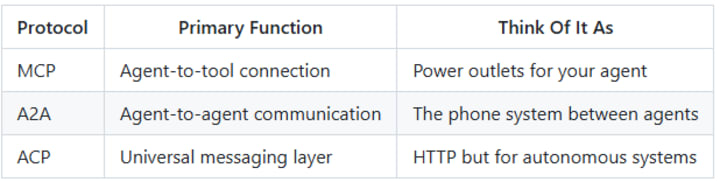
MCP equips your agent with tools. A2A lets agents collaborate on complex tasks. ACP provides the underlying communication fabric.
The Linux Foundation recognized this. In December 2025, they formed the Agentic AI Foundation. Founding members read like a tech all-star roster:
- Anthropic
- OpenAI
- Microsoft
- AWS
- Block
Their goal? Prevent fragmentation. Keep the ecosystem interoperable.
Building Your First Interoperable Agent System
Enough theory. Let's get practical.
Start With Discovery
Your agents need to find each other. A2A's Agent Cards solve this elegantly.
Each agent publishes a JSON document describing:
- What it does
- What inputs it accepts
- What outputs it produces
- Authentication requirements
Other agents query these cards to find suitable collaborators.
Standardize Your Communication Layer
Pick your transport. ACP's REST-first approach means almost anything can participate.
Got a legacy system that only speaks HTTP? No problem. It can join the party.
Think About Security From Day One
Enterprise deployments need:
- Strong authentication between agents
- Authorization controls for sensitive operations
- Audit trails for compliance
- Encryption in transit and at rest
A2A bakes in OAuth 2.0 support. Don't roll your own.
Design for Async Operations
Real-world agent tasks take time. Sometimes hours.
Build for long-running operations from the start. Support status updates. Handle failures gracefully.
Common Pitfalls I've Seen (And How to Avoid Them)
Ignoring State Management
Stateless is clean. But agents often need context from previous interactions.
Design your state handling early. MCP supports both stateful and stateless operations for a reason.
Over-engineering Discovery
Simple discovery works. Don't build a massive service mesh when Agent Cards suffice.
Start minimal. Scale when you actually need it.
Forgetting Human Checkpoints
Autonomous doesn't mean unsupervised. Build approval gates for sensitive operations.
Your CEO will thank you when an agent doesn't accidentally approve a million-dollar purchase order.
What's Coming in 2026 and Beyond
The pace isn't slowing down.
January 2026 already brought news. Linux Foundation's CAMARA project released guidance on integrating AI agents with telecom infrastructure via MCP.
Gartner's prediction about 40% enterprise adoption? We're watching it happen in real-time.
Expect to see:
- More protocol consolidation
- Better tooling for multi-agent orchestration
- Standardized testing frameworks for agent interactions
- Industry-specific compliance guidelines
The AI agent interoperability landscape is maturing fast.
Final Thoughts on Building Interoperable Systems
We're past the early experimentation phase. Standards exist. Major players aligned.
Whether you're building internal automation or customer-facing agent systems, interoperability isn't optional anymore.
Start with MCP for tool connectivity. Add A2A when agents need to collaborate. Layer ACP for universal messaging.
The protocols work. The ecosystem is ready.
Your AI agent interoperability strategy just needs the execution.
About the Creator
Eira Wexford
Eira Wexford is a seasoned writer with 10 years in technology, health, AI and global affairs. She creates engaging content and works with clients across New York, Seattle, Wisconsin, California, and Arizona.
Keep reading
More stories from Eira Wexford and writers in 01 and other communities.
Top 7 React Native IDEs and Editors for App Development in 2026
The React Native ecosystem has exploded, with over 42% of mobile developers now relying on cross-platform frameworks to build apps faster. But having a powerful framework isn't enough; you need the right environment to write, debug, and ship code efficiently.
By Eira Wexford2 months ago in 01
Sergey Brin Becomes World’s No. 3 Richest—Overtakes Jeff Bezos, Larry Ellison After Alphabet Hits $4 Trillion
Topline Sergey Brin leapfrogged Oracle’s Larry Ellison and Amazon’s Jeff Bezos on Tuesday to become the world’s third-richest person, ranking again behind fellow Google cofounder Larry Page as parent firm Alphabet stock rallied to its latest milestone.
By Dena Falken Esq6 days ago in 01



Comments
There are no comments for this story
Be the first to respond and start the conversation.