
My Roomba Used to Be Magic. Now It’s a Cautionary Tale.
Why suing your competitors and waiting for a buyout is a death sentence for innovation.

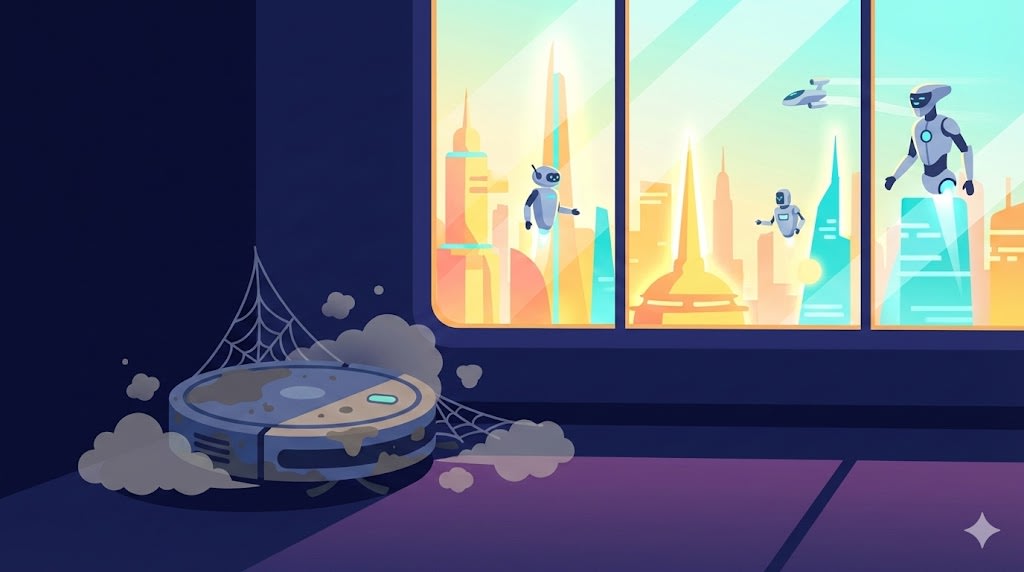
I still remember the first time I saw a Roomba. It was 2004.
It felt like I was looking at an artifact from the future. While the rest of us were pushing loud, heavy upright vacuums back and forth, this little plastic disc was humming across the floor, making decisions, turning corners, and doing the work for us.
It was more than a product; it was a promise. It promised that the drudgery of domestic life was over.
For nearly two decades, iRobot was the king of this castle. They defined the category. They owned the intellectual property. They were the “Xerox” of robot vacuums.
Fast forward to today.
I recently walked through an electronics store. The iRobot section looked tired. The machines appeared largely unchanged from how they looked five years ago.
Meanwhile, just a few feet away, competitors like SharkNinja, Roborock, and Ecovacs were displaying machines that could mop, empty themselves, use AI to avoid dog poop, and map your home with military-grade lasers — often for a fraction of the price.
iRobot’s stock has collapsed. Their acquisition by Amazon was blocked. They are laying off massive portions of their workforce.
What happened?
Most analysts will tell you it was just “bad luck” with regulators.
But if you look closer, you see a much darker story. It is a story about a company that stopped listening to the only people who truly matter — its customers — and started relying on lawyers and bureaucrats to save it.
Here is why iRobot failed, and why your business might be next if you don’t understand the brutal nature of the market.
The Arrogance of the First Mover
There is a dangerous disease that infects successful pioneers. I call it “The Incumbent’s Coma.”
When you invent a category, you enjoy a period of monopoly. iRobot had this for years. They could charge premium prices for decent hardware because there was no alternative.
However, in a free market, profit serves as a signal.
Those high margins screamed to the rest of the world: “Come here! There is money to be made!”
Instead of sprinting to stay ahead, iRobot began to coast. They fell in love with their own engineering heritage rather than obsessing over the user experience.
While competitors were aggressively integrating LIDAR (laser navigation) for precision cleaning, iRobot stuck to camera-based navigation for too long, which struggled in low light.
While competitors were building “all-in-one” docks that washed the mop pads and refilled the water tanks, iRobot insisted on selling separate mopping robots (the Braava), forcing customers to buy two machines instead of one.
They forgot the Golden Rule of Business:
The customer does not care about your legacy. The customer is a ruthless dictator who asks only one question: “What have you done for me lately?”
By the time iRobot woke up to the reality that consumers wanted combo units (vacuum + mop), they were years behind the curve. They had let the “moat” of innovation dry up.
The Litigation Trap: Rent-Seeking vs. Value Creation
When a company realizes it can no longer out-innovate its competitors, it often turns to a desperate tactic: Litigation.
In economics, we call this “Rent-Seeking.” Instead of creating new wealth, you try to use the legal system to extract wealth from others.
iRobot spent years and millions of dollars waging a patent war against SharkNinja.

SharkNinja is a fascinating case study. They are ruthless aggregators. They look for existing technologies, simplify them, manufacture them at scale, and sell them for 30–50% less.
iRobot looked at SharkNinja and screamed, “They are copying us!”
They sued Shark for patent infringement, trying to ban their products. They poured resources into courtrooms that should have been poured into R&D labs.
This was a fatal misallocation of capital.
While iRobot’s executives were high-fiving lawyers, SharkNinja’s engineers were figuring out how to make a self-emptying base that didn’t cost $800.
The market does not reward you for protecting your past; it rewards you for inventing the future.
Eventually, the lawsuits settle, or patents expire. And when the dust settles, the company that focused on the product usually wins. SharkNinja didn’t win because they had better lawyers; they won because they gave the median household a “good enough” robot at a price they could actually afford.
The Regulatory Suicide: The Amazon Mirage
The final nail in the coffin was the failed acquisition by Amazon.
In 2022, Amazon offered to buy iRobot for $1.7 billion. For iRobot, this was the exit strategy. Amazon’s logistics and AI prowess could have revitalized the brand.
But then, the European Commission and the FTC stepped in.
Regulators blocked the deal. Their argument? They claimed that if Amazon owned iRobot, Amazon might bias its search results to favor Roombas, thereby hurting competition.
This is the absurdity of modern antitrust law.
The regulators claimed they were “protecting the consumer.”
Let’s look at the reality of what happened:
- The deal was blocked.
- iRobot could not access the capital it needed to compete with Chinese manufacturers.
- iRobot’s stock crashed by over 80%.
- iRobot laid off 31% of its workforce (about 350 people).
- The CEO stepped down.
Did this help the consumer? No.
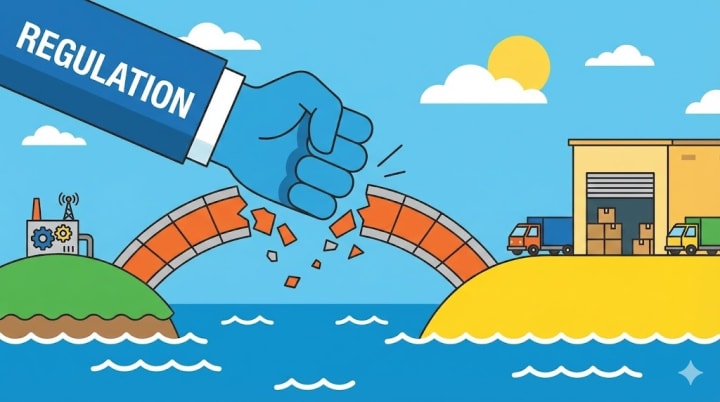
It left the consumer with a zombie company that can no longer afford to innovate. It destroyed shareholder value. It destroyed jobs.
The regulators operated on a static view of the world. They assumed iRobot was a dominant monopoly that needed to be restrained.
In reality, the market had already restrained iRobot. Roborock and Shark had already eaten their lunch.
The antitrust action didn’t prevent a monopoly; it prevented a dying company from finding a lifeline. It prevented the reallocation of resources that is necessary for a healthy economy.
The Service Void
While the lawyers were fighting in court and the executives were courting Amazon, the actual paying customers were being ignored.
If you browse the subreddit r/Roomba or look at recent Trustpilot reviews, you see a pattern.
- Software updates that “brick” the robots, making them spin in circles.
- Customer support lines with hour-long wait times.
- Hardware that breaks just outside the warranty window.
This is the invisible cost of losing focus.
When a company’s leadership is distracted by M&A (Mergers and Acquisitions) and litigation, the culture of “service” rots from the inside out.
Consumers today have infinite information. Before I buy a $600 vacuum, I watch three YouTube reviews and read ten Reddit threads.
If the consensus is “the software is buggy, and support is ghosting me,” I don’t care if you have the original patent. I am buying the Roborock.
iRobot treated its brand loyalty as an infinite resource. It wasn’t. It was a battery, and they let it drain to 0%.
The Lesson for Founders: Do Not Build a “Moat” of Paper
If you are building a company today, let the fall of iRobot be your guide.
1. You do not own your customer. The moment you stop exceeding their expectations, they will leave. There is no such thing as “loyalty” in a free market, only a temporary alignment of interests.
2. Litigation is a tax on your soul. If your primary strategy is suing competitors, you are already dead. You are fighting the last war. Use that energy to build something that makes your competitor’s product irrelevant.
3. Do not rely on the “White Knight.” iRobot bet the farm on the Amazon acquisition. When the government blocked it, they had no Plan B. Never build a business that requires an acquisition to survive. Build a company that can stand alone.
4. The Government is not your friend. Whether it is antitrust blocking your exit or regulations increasing your costs, state intervention introduces chaos. The only hedge against this is to be so efficient and so beloved by your customers that you can survive the external shocks.
Creative Destruction Does Not Negotiate

The Roomba was a miracle. It changed how we live.
But capitalism is a process of creative destruction. It is not kind to those who rest.
iRobot built a monument to its past glory and tried to charge admission. Meanwhile, the market simply built a better road around them.
Don’t be iRobot. Don’t fall in love with what you did.
Fall in love with what you are going to do next.
About the Creator
Cher Che
New media writer with 10 years in advertising, exploring how we see and make sense of the world. What we look at matters, but how we look matters more.
Wikimedia reviews begging approach
Do you ever wonder why some stories or articles you write and publish online get more reader interest than others? I do, and sometimes the reason is obvious, sometimes not. Of course we expect our best work to get the most attention, but sometimes it does not. Sometimes we write about something that gets much more interest than we had anticipated. Why?
By Raymond G. Taylor7 days ago in 01
How to Choose the Right Tech Stack to Develop a Web Application
Imagine spending six months building your web application, only to realize the technology you chose can't handle your growing user base. Now you're stuck — rewriting code, burning budget, and losing time you can't get back.
By Nico Gonzalez3 days ago in 01
Staying sane in the insane world.
”It is no measure of health to be well adjusted to a profoundly sick society.” Jiddu Krishnamurti This quote has been one of my favourites since the moment I first laid my eyes on it. To me, it cuts right through the fog of the illusion of normality that permeates our lives. And since I am someone who has never felt (well) adjusted to this society, Krishnamurti’s words gifted me with the realisation that there isn’t anything inherently wrong with me.
By Eva Smittea day ago in Humans



Comments
There are no comments for this story
Be the first to respond and start the conversation.