
How to Choose the Right Tech Stack to Develop a Web Application
Learn how to choose the right tech stack to develop a web application that scales well, performs efficiently, and fits your budget.

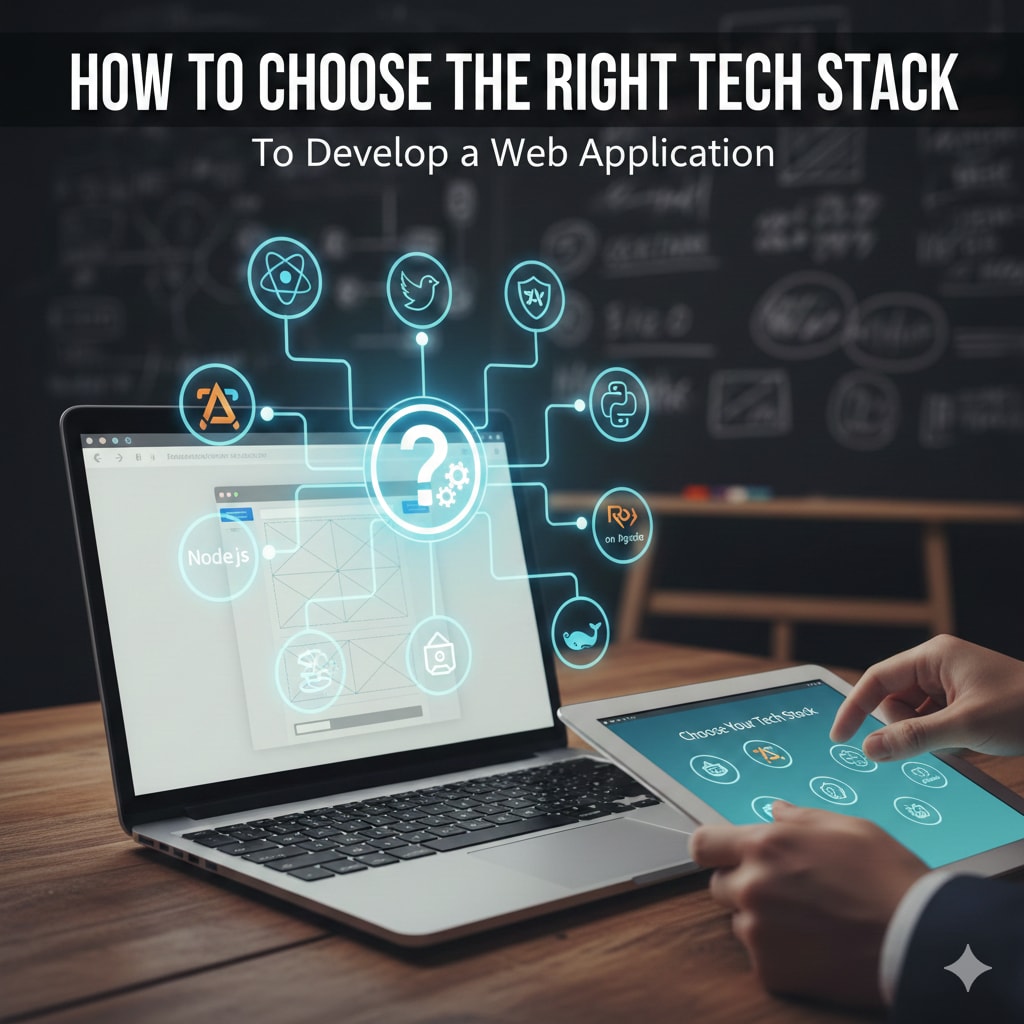
Imagine spending six months building your web application, only to realize the technology you chose can't handle your growing user base. Now you're stuck — rewriting code, burning budget, and losing time you can't get back.
This is more common than you'd think. And it almost always comes down to one decision made early on: choosing the wrong tech stack.
The tech stack for web application development is the combination of programming languages, frameworks, databases, and tools that power everything your users see and experience. Get it right, and your app runs smoothly, scales easily, and stays affordable to maintain. Get it wrong, and you're fighting the tools instead of building the product.
This guide walks you through exactly how to make that decision — without the jargon, without the hype.
What Is a Tech Stack and Why Does It Matter?
A tech stack is simply the set of technologies used to build and run your web application. Think of it like the materials and tools used to construct a house — your choices affect how strong, flexible, and expensive your home turns out.
A typical web app tech stack has three core layers:
- Frontend (Client-Side): What users see — buttons, pages, forms, animations. Common tools: React, Vue.js, Angular.
- Backend (Server-Side): The logic that processes data and handles requests behind the scenes. Common tools: Node.js, Python (Django/Flask), Ruby on Rails.
- Database: Where your data lives. Options include SQL databases like PostgreSQL and MySQL, or NoSQL options like MongoDB.
Your tech stack choice shapes how fast you can build, how much it costs to hire developers, and how well your app performs under pressure. It's a long-term commitment — not just a technical preference.
Key Factors to Consider Before Choosing a Tech Stack
There's no universally "best" tech stack. The right choice depends on your specific situation. Here's what to think through before making a decision.
Project Type and Complexity
A simple content website has very different needs than a real-time SaaS platform. A basic marketing site can be built with almost anything — WordPress, Webflow, or plain HTML/CSS. But if you're building something with user dashboards, live data, or complex logic, you'll need a more capable stack from day one.
Scalability Requirements
Ask yourself: where do you expect to be in two or three years? If you're planning to grow from 1,000 to 100,000 users, your stack needs to handle that without a full rewrite. Technologies like Node.js and cloud-friendly architectures (AWS, Google Cloud) are built with scalability in mind. Plan for growth early, even if you're starting small.
Your Team's Expertise
The best tech stack is one your team already knows. Switching to a new language or framework adds learning time, which adds cost. If your developers are experienced in Python, building on Django or Flask makes far more sense than forcing them to learn something trendy. That said, if you're hiring or outsourcing, consider what's most widely supported in the talent market.
Budget and Time to Market
Some stacks let you move faster than others. JavaScript-based stacks (like MERN) let one developer work across both frontend and backend, which can reduce costs for early-stage projects. If speed is the priority, pick a stack with strong documentation, reusable components, and a wide library ecosystem.
If you're trying to estimate how budget connects with your tech decisions, it helps to look at a breakdown of developing web app costs before committing to a direction.
Community Support and Ecosystem Maturity
A technology is only as good as the support behind it. An active community means more tutorials, faster bug fixes, and a larger pool of developers to hire. Avoid niche or poorly maintained frameworks unless you have a very specific reason to use them.
Most Popular Tech Stacks for Web Applications in 2025
Here's a practical look at the most widely used stacks today and when each one makes sense.
MERN Stack (MongoDB, Express.js, React, Node.js)
One of the most popular choices for modern web apps. Everything runs on JavaScript — frontend to backend — which keeps things consistent and your team lean. It's a great fit for startups, MVPs, and dynamic single-page applications. MongoDB's flexibility is ideal when your data structure might change as your product evolves.
MEAN Stack (MongoDB, Express.js, Angular, Node.js)
Similar to MERN but uses Angular instead of React on the frontend. Angular is more structured and opinionated, which works well for large enterprise teams that need strict conventions and maintainability across many developers.
LAMP Stack (Linux, Apache, MySQL, PHP)
A tried-and-tested stack that's been powering websites for decades. PHP is still widely used, especially with WordPress. If you need something reliable, affordable to host, and well-supported, LAMP is a solid choice though not the go-to for highly interactive modern web apps.
Python-Based Stack (Django or Flask + PostgreSQL)
Python is clean, readable, and backed by a massive ecosystem. Django is a full-featured framework great for data-heavy applications and rapid development. Flask is lighter and more flexible, better suited for APIs or projects that need custom architecture. PostgreSQL is the database of choice here — robust, reliable, and built for complex queries.
JAMstack (JavaScript, APIs, Markup)
JAMstack is a modern approach that decouples the frontend from the backend. Pages are pre-built and served via a CDN, making load times extremely fast. It's perfect for content-heavy sites, blogs, and marketing platforms — think Next.js or Gatsby paired with a headless CMS like Contentful or Sanity.
How to Match Your Tech Stack to Your Web App Type
Different applications have different demands. Here's a simple guide to pairing the right stack with the right use case:
- SaaS Applications: MERN or Python/Django — both scale well and support complex user workflows.
- E-Commerce Platforms: LAMP (WooCommerce), or a custom stack with Node.js + Stripe + PostgreSQL for more control.
- MVPs and Startups: MERN or Firebase-based stacks for fast development and low initial cost.
- Enterprise Applications: Java Spring or .NET with Angular — proven at scale and easier for large distributed teams.
- Real-Time Apps (Chat, Live Streaming): Node.js with WebSockets or Socket.io — built for low latency and concurrent connections.
- Choosing based on trends, not needs. Just because a technology is getting buzz doesn't mean it fits your project. Always evaluate based on your requirements.
- Over-engineering from day one. Building a microservices architecture for a three-page MVP is overkill. Start lean, then scale when you actually need to.
- Ignoring developer availability. A niche framework might sound exciting until you're trying to hire for it. Stick to mainstream stacks if hiring is part of your roadmap.
- Underestimating maintenance costs. Every stack has ongoing upkeep. Consider security patches, version upgrades, and how actively the community supports the technology.
- Define your core features. Know what your app needs to do before picking tools to build it.
- Assess your team's skills. Use what your developers already know unless there's a clear reason to switch.
- Evaluate scalability and performance needs. Think two to three years ahead, not just launch day.
- Research community support. Active communities mean faster problem-solving and more available talent.
- Build a proof of concept. Before fully committing, test your stack with a small prototype to spot friction early.
- Validate with an expert. A short consultation with a CTO or experienced developer can save you months of costly mistakes.
Common Mistakes to Avoid When Choosing a Tech Stack
Even experienced teams make these missteps. Keep them in mind before you lock in a decision.
A Step-by-Step Framework for Making Your Final Tech Stack Decision
Use this six-step process to make a well-reasoned, confident choice:
Conclusion
There's no perfect tech stack only the right one for your specific project, team, and goals. The goal isn't to chase what's newest or most impressive. It's to find a combination of tools that helps you build reliably, scale comfortably, and maintain your app without burning out your team or your budget.
Take the time to evaluate your needs. Start with what your team knows. Plan for where you're going, not just where you are today.
The right tech stack is a foundation. Get it right, and everything you build on top of it becomes easier.
About the Creator
Nico Gonzalez
Hi, I'm Nico Gonzalez! I'm passionate about technology, software development, and helping businesses grow. I love writing about the latest trends in tech, including mobile apps, AI and more.
Keep reading
More stories from Nico Gonzalez and writers in 01 and other communities.
Cloudflare and Mastercard: What the New Cybersecurity Partnership Means for Businesses and the Digital World
What Is the Cloudflare and Mastercard Cybersecurity Partnership? Today, Cloudflare and Mastercard announced a major strategic partnership aimed at strengthening cybersecurity for millions of organizations across the globe. This collaboration brings together Cloudflare’s advanced web application security tools with Mastercard’s risk monitoring technologies to help businesses, governments, and critical infrastructure better defend against cyberattacks without slowing down innovation.
By Info Post Gate7 days ago in 01




Comments
There are no comments for this story
Be the first to respond and start the conversation.