
Mobile Apps Transform Critical Mineral Recovery in Texas
How Texas universities are using digital innovation to rebuild America's critical mineral supply chain

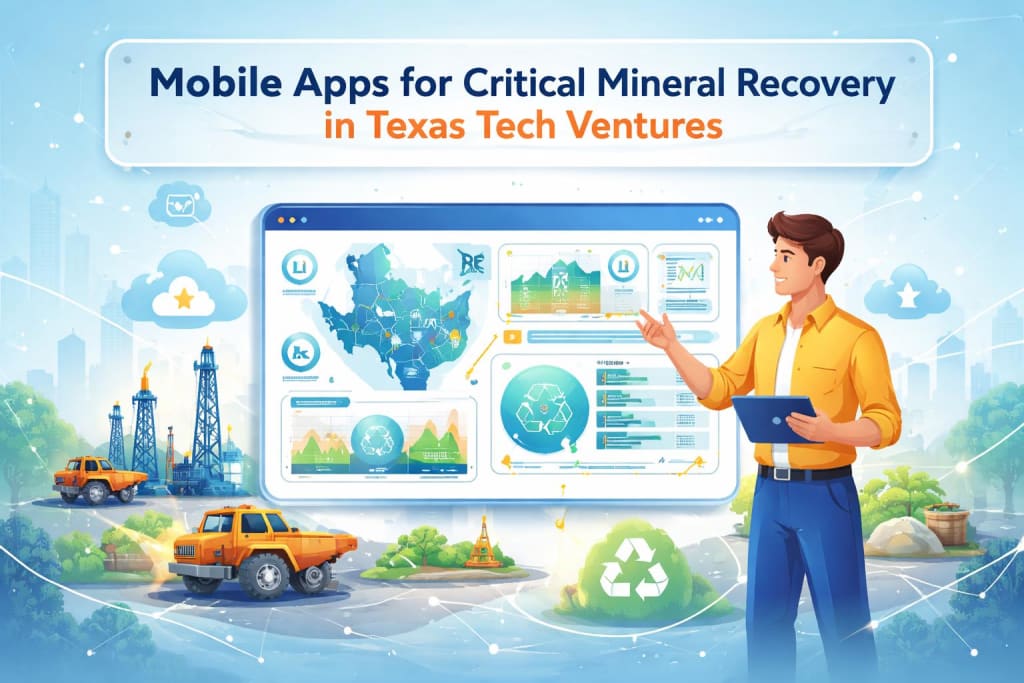
The race for critical minerals just got a Texas-sized upgrade, and mobile technology is driving the transformation.
While most folks worry about gas prices and grocery bills, a quiet revolution is happening in university labs across the Lone Star State. Texas Tech and the University of Texas are building the backbone of America's next industrial revolution.
Here's what nobody's talking about: your smartphone wouldn't exist without rare earth elements mined halfway around the world. Neither would your electric car, wind turbines, or modern technology. Right now, China controls about 90% of global rare earth processing. That's not just inconvenient—it's a national security nightmare.
Texas is fixing to change all that.
Texas Tech's $3.3 Million Game Changer
In February 2025, Texas Tech University's Department of Chemical Engineering landed a massive $3.3 million grant from the U.S. Department of Energy. Associate Professor Mahdi Malmali is leading a team focused on something most people flush down the drain without thinking twice: produced water from oil and gas operations.
The Permian Basin—that sprawling oil field stretching across West Texas—cranks out over 50% of America's oil and gas production. Every single day, this process generates more than 25 million barrels of produced water. That's the industry's largest waste product, and it's absolutely loaded with dissolved minerals like lithium and rare earth elements.
Malmali's team isn't just studying this stuff in a lab. They're building the tech to actually extract these critical minerals from water that would otherwise get pumped back underground or treated as waste.
"We have actively fostered strong partnerships with leaders in the oil and gas industry over the past five years," Malmali explained. These aren't just academic exercises—they're real-world collaborations with companies that move mountains of earth and process oceans of water every day.
The project aims to develop separation and purification technologies that could turn waste into wealth. We're talking about creating an entirely new revenue stream from what's currently considered garbage.
Where Mobile Tech Enters the Picture
Now, here's where it gets interesting for the mobile app crowd.
These aren't your grandpa's mining operations. Modern critical mineral recovery requires constant monitoring, real-time data analysis, and split-second decision-making. You can't do that with clipboards and weekly reports.
Digital platforms are absolutely essential for:
Real-Time Monitoring – Sensors track mineral concentrations, flow rates, temperatures, and chemical compositions 24/7. Mobile dashboards let operators check these metrics from anywhere—whether they're in the field, in an office, or grabbing breakfast tacos at 6 AM.
Predictive Analytics – AI algorithms running on mobile platforms can predict when extraction efficiency starts dropping, when equipment needs maintenance, or when mineral concentrations are optimal for processing.
Supply Chain Coordination – Once you extract these minerals, you need to route them to refineries, track purity levels, manage logistics, and coordinate with buyers. Mobile apps coordinate these complex networks in real-time.
Compliance and Reporting – Environmental regulations around produced water are strict. Mobile systems automatically generate compliance reports, track emissions, and alert managers when parameters drift outside permitted ranges.
The Texas Tech project specifically mentioned plans to develop a Technology Innovation Center and engage stakeholders through educational initiatives. Translation: they're building the infrastructure for startups and tech companies to commercialize these discoveries.
UT Austin's Supra: The "Chemical Sponge" That Changes Everything
While Texas Tech focuses on produced water, the University of Texas at Austin just launched something that sounds like science fiction.
In February 2026, UT Austin announced Supra Elemental Recovery Inc., a startup backed by $250,000 from the university's Discovery to Impact Seed Fund. The company commercializes technology that recovers high-purity critical minerals from mine tailings, industrial byproducts, and electronic waste.
The breakthrough? A 3D-printed filtration platform that acts like a molecular sponge.
Led by award-winning chemists Zachariah Page, Michael Cullinan, and Jonathan Sessler (who previously founded a company that sold for $21 billion), Supra's technology uses supramolecular receptors embedded in porous cartridges. Wastewater flows through these cartridges, and the receptors grab specific mineral ions like a baseball glove catching a fastball.
The process uses simple solvents like alcohol and water—no toxic chemicals, no massive machinery, no environmental devastation. And it's 100 times more selective and faster than current rare earth refining methods.
Mobile Control Systems for Modular Processing
Here's why this matters for mobile technology: Supra's systems are modular and portable. They can be deployed at different waste sites—a mine in Nevada today, an electronics recycling facility in California next month.
Managing distributed operations like this requires sophisticated mobile platforms. Operators need to:
- Monitor extraction efficiency across multiple sites
- Adjust parameters remotely based on feedstock composition
- Track mineral purity in real-time
- Coordinate logistics between collection points and processing facilities
- Manage inventory and optimize routing decisions
This isn't theoretical. Companies are already building these mobile management systems because centralized control rooms can't respond fast enough to changing conditions at distributed sites.
Katie Durham, Supra's CEO, emphasizes the technology's flexibility. "We're making it possible to capture billions of dollars' worth of critical minerals trapped in U.S. waste," she said.
Think about what that means: America generates mountains of electronic waste every year. Old smartphones, computers, solar panels—all packed with rare earth elements that currently get buried in landfills or shipped overseas. Supra's technology could turn landfills into mines.
The Bigger Texas Innovation Ecosystem
Texas isn't putting all its chips on one technology. The state's becoming a full-blown hub for critical minerals innovation.
TerraVolta received $225 million from the Department of Energy for a lithium refinery complex near Texarkana. The project got fast-tracked for permits and will extract lithium from underground brine deposits in the Smackover Formation.
Jamie Liang, TerraVolta's founder and former Wall Street banker, sees massive growth potential. "Texas—and specifically the Smackover Region—is quickly emerging as one of the central hubs for the U.S. lithium sector," he said. "In 10 years, we believe the Smackover Region will be the largest source of domestically produced lithium."
EnergyX, an Austin-based lithium startup backed by General Motors, announced a demonstration plant in Texarkana with plans for commercial-scale production by 2030. They're targeting 50,000 tons per year of lithium production.
Metallium is using flash heating technology developed at Rice University to extract critical minerals from discarded consumer electronics. They plan to start operations in 2026.
Maverick Metals, based in San Antonio, focuses on the "tremendous volumes of mineral-rich and toxic wastewater" from oil wells. Co-founder Jesse Evans put it bluntly: "We can basically turn an oil well into a mini-mine."
Every single one of these operations needs mobile technology to function efficiently.
Why Mobile Apps Are Critical Infrastructure
Let me be straight with you: mobile applications aren't just nice-to-have conveniences in this industry. They're mission-critical infrastructure.
Consider what operators in the field actually do:
Quality Testing – Portable spectrometers connected to mobile apps let technicians test mineral concentrations on-site. Results upload instantly to cloud databases where AI models flag anomalies or suggest process adjustments.
Equipment Diagnostics – Sensors on pumps, filters, and extraction equipment stream data to mobile maintenance apps. Technicians receive push notifications when vibration patterns indicate bearing wear or when pressure readings suggest filter clogging.
Safety Monitoring – Chemical processing involves hazardous materials. Mobile apps track exposure levels, monitor air quality, and ensure workers don't exceed safety thresholds. Emergency protocols trigger automatically when sensors detect dangerous conditions.
Production Optimization – Extraction efficiency varies based on feedstock composition, temperature, flow rates, and dozens of other variables. Mobile dashboards visualize these relationships and recommend optimal operating parameters.
Financial Tracking – At the end of the day, this is a business. Mobile apps track production volumes, purity levels, operating costs, and market prices to calculate real-time profitability.
The smart mining market hit $34.23 billion in 2025. That's not a typo. Companies are investing billions in digital transformation because traditional mining methods can't compete anymore.
According to CSG Talent's analysis, AI-driven exploration can reduce discovery time and costs by 30-40%. Mobile platforms make this AI accessible to field operators who actually make decisions.
The China Problem
We need to talk about the elephant in the room: China.
China accounts for 70% of rare earth element extraction globally, 90% of separation and processing, and 93% of magnet manufacturing. For critical minerals like gallium and magnesium, China controls 98% and 95% of production respectively.
"With China's strong control over rare earths and other key minerals, its export restrictions this year exposed the dependence of global automakers, electronics manufacturers and energy producers on Chinese capacity," says Gayathri Siripurapu, senior mining analyst at GlobalData.
China isn't shy about weaponizing this dominance. In December 2024, they introduced export controls on gallium, germanium, and antimony. They expanded restrictions in 2025 to tungsten, tellurium, and bismuth. In October 2025, China required foreign companies to obtain licenses to export parts containing Chinese-sourced rare earth elements.
This isn't just economic competition—it's strategic warfare.
Mobile supply chain monitoring apps now track material flows, inventory levels, and alternative sourcing options in real-time. Companies can't afford supply disruptions when a single missing component can halt entire production lines.
The University Research Advantage
Here's what makes the Texas approach different: universities are driving innovation instead of just studying it.
UT Austin hosted the inaugural North American Workshop on Critical Mineral Research in August 2025. The event brought together geologists, engineers, metallurgists, environmental scientists, and political scientists—groups that rarely talk to each other.
Doctoral student Shelby Clark, who co-organized the workshop, highlighted the unique value: "What's so unique about this workshop is that we have such a breadth of participants from all different kinds of sectors that would otherwise very rarely meet. Geologists go to geology conferences; engineers go to engineering conferences."
This cross-pollination is essential for mobile technology development. You need:
- Geologists to understand mineral deposits
- Chemical engineers to design extraction processes
- Software developers to build mobile platforms
- Data scientists to create AI models
- Business strategists to commercialize innovations
Universities can bridge these silos in ways that corporations struggle to replicate.
Texas Tech has built partnerships with oil and gas industry leaders over five years. These aren't one-off research projects—they're sustained collaborations that create pathways for technology transfer and commercialization.
The Texas Tech Accelerator program helps launch startup businesses based on university research. Students, faculty, alumni, and community members can access cutting-edge technologies developed in research labs, get mentorship from industry experts, and raise venture funding.
This is how research becomes real companies creating actual jobs.
Workforce and Future Growth
America needs 700,000 new workers in critical minerals extraction by 2030—an 88% increase from 2022 levels. The U.S. has only 14 mining schools and graduates far fewer specialists than China.
Mobile learning platforms fill this gap through virtual reality simulations and on-the-job training apps workers can access during downtime. Texas Tech's educational initiatives and UT Austin's workshop programs are creating the workforce pipeline through digital platforms that reach workers statewide.
Meanwhile, venture capitalists invested more than $628 million in U.S. critical minerals startups in 2025—a nearly 3,000% jump from 2024. Trump's Project Vault plans to invest $12 billion in a critical minerals stockpile.
"We expect every investor to be reaching out to understand what sales contracts we will have with the stockpile," said Nick Myers, CEO of Phoenix Tailings, a startup recycling mining byproducts into rare earth minerals.
This federal backing creates massive opportunities for mobile technology companies building tracking systems, quality verification platforms, and supply chain management tools.
The Bottom Line
Texas is building America's critical minerals future on three pillars: university research, startup innovation, and digital technology.
Mobile apps aren't peripheral to this transformation—they're central infrastructure that makes everything else possible. You can't coordinate distributed processing sites without mobile logistics platforms. You can't optimize extraction efficiency without mobile analytics dashboards. You can't ensure worker safety without mobile monitoring systems.
The $3.3 million Texas Tech grant and the Supra startup represent just the beginning. As federal funding accelerates and private investment floods in, the companies that build the best mobile platforms for this industry will capture enormous value.
More importantly, this isn't just about money. It's about national security, energy independence, and America's ability to manufacture advanced technology without depending on foreign suppliers who might cut us off at any moment.
Texas universities are proving that environmental responsibility and economic growth aren't contradictory goals. You can extract critical minerals without devastating landscapes if you're smart about it.
And you can coordinate complex industrial operations through mobile technology if you build the right tools.
The race for critical minerals is happening right now. Texas is in the lead. And mobile technology is writing the playbook.
About the Creator
Keep reading
More stories from Sherry Walker and writers in 01 and other communities.
The 2026 Enterprise App Blueprint: Inside INDI IT Solutions' Development Secret
In the hyper-competitive digital landscape of 2026, the gap between a "good" mobile app and a "high-performance" enterprise solution is no longer measured in seconds, but in milliseconds and micro-interactions. For Fortune 500 companies, an app isn’t just a mobile touchpoint; it is the central nervous system of their customer engagement and operational efficiency.
By Sherry Walkera day ago in 01
How Indi IT Solutions is Building the Next Digital Ecosystems in the USA
The American digital world has evolved fast. Standalone apps are being replaced by deeply connected ecosystems. In 2026, a digital ecosystem is not a trend. It is a survival requirement for modern enterprises.
By Devin Rosarioabout 13 hours ago in 01



Comments
There are no comments for this story
Be the first to respond and start the conversation.