
How Indi IT Solutions is Building the Next Digital Ecosystems in the USA
Leveraging interconnected architecture and specialized development to redefine enterprise mobility and digital infrastructure in 2026.

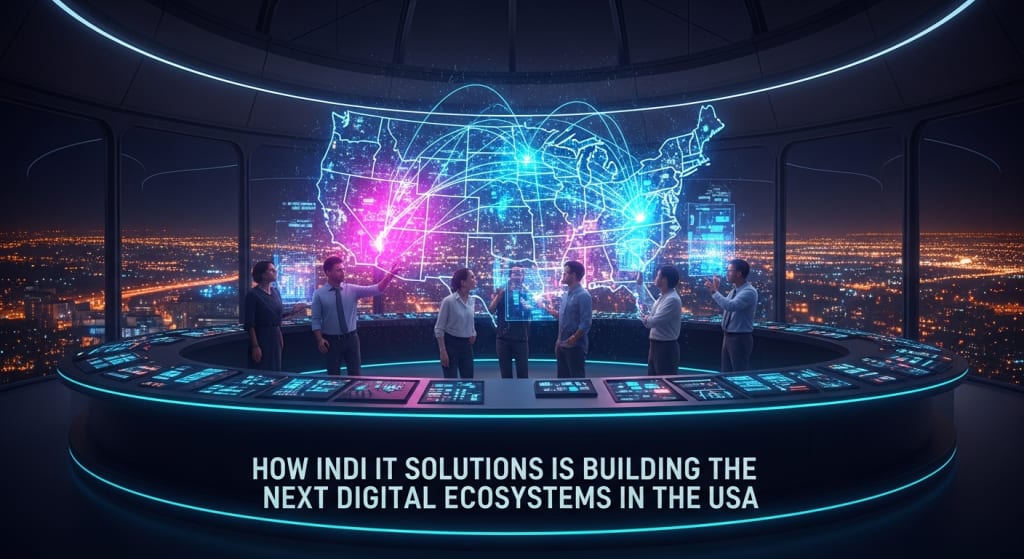
The American digital world has evolved fast. Standalone apps are being replaced by deeply connected ecosystems.
In 2026, a digital ecosystem is not a trend. It is a survival requirement for modern enterprises.
A digital ecosystem connects platforms, data, and services. Every system must communicate in real time.
Mobile apps now talk to AI agents. IoT devices also share the same unified data environment.
This connected structure is called a data fabric. It ensures that every digital component speaks the same language.
Indi IT Solutions plays a central role in building these environments. They focus on long-term digital infrastructure, not just isolated apps.
The 2026 Shift: Beyond Single-Point Solutions
Businesses once wanted single apps for single problems. That model no longer works in 2026.
Users now experience platform fatigue. They expect everything to work together without friction.
Modern ecosystems in the USA stand on three pillars. Each pillar supports long-term scalability.
Interoperability
- Interoperability means systems can work together seamlessly. Devices, platforms, and tools exchange data instantly.
- A mobile app must sync with wearables and ambient devices. Delays or silos are no longer acceptable.
Agentic Integration
- Modern platforms do more than display data. They use AI agents that can make decisions and take actions.
- These agents automate complex workflows. They reduce human effort while improving speed and accuracy.
Data Sovereignty
- Data sovereignty is about respecting regional privacy laws. Compliance must exist alongside personalization.
- US businesses must follow rules like CCPA. At the same time, users still expect tailored digital experiences.
- Legacy systems create friction here. Old software cannot support AI workloads or high-concurrency demands.
The Indi IT Solutions Ecosystem Framework
Indi IT Solutions uses a Foundation-First approach. The mobile app is treated as a gateway, not the core system.
The real power sits in the API orchestration layer. This layer coordinates communication between all services.
APIs act as digital bridges. Orchestration ensures these bridges work in harmony.
This unified logic works across smartphones, wearables, and spatial devices. The experience stays consistent everywhere.
US-focused mobile app development demands hyper-localization. Systems must adapt to regional payments, logistics, and regulations.
Industry compliance is built into the architecture. Standards like HIPAA and FINRA are considered from day one.
Indi IT Solutions builds modular microservices. Businesses can upgrade parts without rebuilding everything.
Real-World Example: The Smart Logistics Model
Imagine a logistics company operating across the Midwest. Traditionally, they use three separate apps.
One app serves drivers. Another supports warehouse staff. A third is built for customers.
Indi IT Solutions unifies these into one ecosystem. A single platform becomes the source of truth.
Drivers receive a mobile interface powered by Edge AI. Route decisions happen directly on the device.
Warehouses use IoT sensors for live inventory tracking. This data flows instantly into the central system.
Customers access a predictive tracking portal. Delays are forecasted before they happen.
All touchpoints share the same data core. This reduces latency by nearly 40 percent compared to legacy setups.
AI Tools Powering Modern Ecosystems
1. Agentic Workflow Orchestrators
- These tools go beyond simple automation. They use AI agents capable of reasoning through multi-step tasks.
- They allow platforms to execute complex operations independently. This is essential for intelligent mobile ecosystems.
2. Post-Quantum Encryption Modules
- Security threats are evolving rapidly. Traditional encryption may not be enough for the future.
- Post-quantum modules protect sensitive enterprise data. They are critical in fintech and healthcare environments.
3. Synthetic User Testing Suites
- These tools simulate millions of user interactions. They help stress-test systems before national launches.
- Edge cases are discovered early. This reduces the risk of failure after deployment.
A 4-Step Ecosystem Deployment Plan
Phase 1: Ecosystem Mapping
- Teams identify every data touchpoint. This includes internal systems and third-party APIs.
- Hidden silos are exposed during this phase. A complete map prevents integration surprises later.
Phase 2: Core API Fabric
- This phase builds the central data layer. It acts as the nervous system of the ecosystem.
- All authentication and routing pass through this fabric. Consistency begins here.
Phase 3: Multi-Interface Development
- User-facing products are built in this phase. Each interface serves a specific persona.
- Mobile, web, and device interfaces all connect to the same core. No channel operates alone.
Phase 4: Optimization and Feedback
- Real-time analytics guide improvements. Systems evolve based on real user behavior.
- Continuous refinement ensures performance stays high. User habits shape future updates.
Risks, Trade-offs, and Limitations
No ecosystem is risk-free. Over-integration is a growing concern in 2026.
When systems are too tightly linked, small failures can spread. This can trigger cascading outages.
Imagine relying on one AI provider for all shipping logic. If that provider fails, the entire platform can freeze.
Indi IT Solutions addresses this with graceful degradation. Systems fall back to basic functions instead of shutting down.
Another challenge is the data tax. Real-time ecosystems demand heavy cloud resources.
Infrastructure costs can rise quickly. Organizations must balance performance with financial sustainability.
Key Takeaways
- Interconnectivity is now mandatory. Isolated apps cannot meet modern user expectations.
- The data fabric deserves the most attention. A weak foundation cannot support future growth.
- Local expertise is critical in the USA. Compliance and performance standards vary by region.
- Failure planning must be built into the design. Modular systems prevent one issue from collapsing everything.
Indi IT Solutions focuses on scalable, resilient architectures. They transform digital complexity into long-term business strength.
About the Creator
Keep reading
More stories from Devin Rosario and writers in 01 and other communities.
Hyper-Personalization in 2026: The Indi IT Solutions Approach to AI-Driven UX
The digital landscape of 2026 has moved beyond the era of responsive design and static templates. Today, a premium mobile experience is no longer defined by how well it fits a screen, but by how accurately it anticipates a human need. At Indi IT Solutions, we have observed a fundamental shift: users no longer "navigate" apps; they interact with fluid ecosystems that evolve in real-time.
By Devin Rosarioabout 13 hours ago in 01
Mobile Apps Transform Critical Mineral Recovery in Texas
The race for critical minerals just got a Texas-sized upgrade, and mobile technology is driving the transformation. While most folks worry about gas prices and grocery bills, a quiet revolution is happening in university labs across the Lone Star State. Texas Tech and the University of Texas are building the backbone of America's next industrial revolution.
By Sherry Walkerabout 12 hours ago in 01
Top AI Development Companies in the USA 2026: Market Leaders to Watch
Introduction Artificial intelligence has moved well beyond experimentation and into the core of modern business strategy. By 2026, AI is no longer just about automation or data analysis—it is about building intelligent systems that can reason, adapt, and drive decision-making at scale. Across industries such as healthcare, finance, retail, manufacturing, and technology, organizations are increasingly relying on advanced AI solutions to remain competitive in a fast-changing digital landscape.
By Aarti Jangid5 days ago in 01
A Love Forboding
The chipped stone slope caused unbearable footing. I slid, skirting on my heels. I cast my shield, relinquishing my guard to stay upright. Left with my double-edge and a prayer to the maker, I skated toward my objective. The earthly stubble gave way to solid ground. I found myself restored, a trail of dust in my wake.
By James U. Rizzi6 days ago in Fiction



Comments
There are no comments for this story
Be the first to respond and start the conversation.