
LINQ: Your Tool for More Efficient C# Programming
LINQ: Your Tool for More Efficient C# Programming

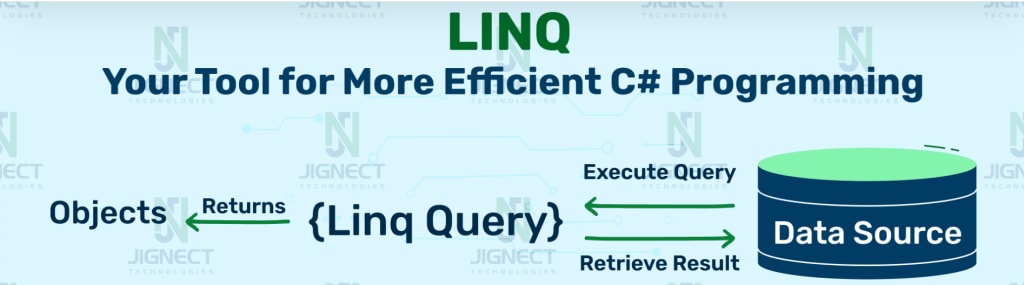
LINQ in C# is used to work with data access from sources such as objects, data sets, SQL Server, and XML. LINQ stands for Language Integrated Query.
To enhance your data manipulation capabilities, you can use LINQ (Language Integrated Query) in C#.
In general, these tools help you to perform various data operations, such as filtering, conditional data retrieval, and data type conversion.
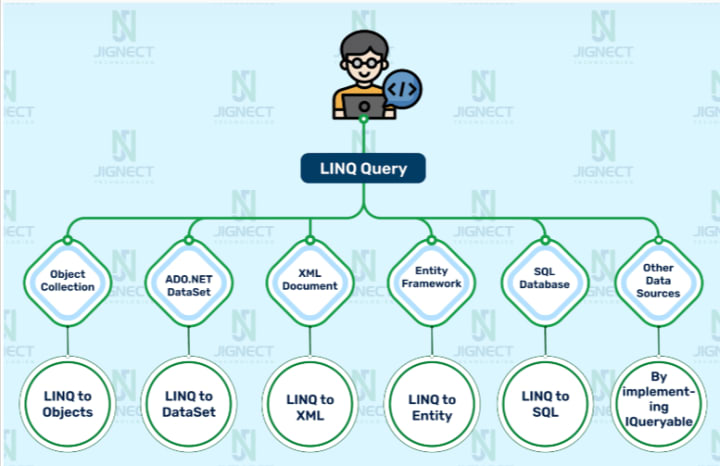
LINQ can be used with various data sources, including: Arrays, Lists, JSON, XML, docs, collections, ADO.Net DataSet, Web Service, MS SQL Server, and different database servers.
Let’s understand why LINQ was created and how we benefit from using it. These points will clarify its purpose.
- The main purpose behind creating LINQ is, before C# 3.0 we use for loop, foreach loop, or delegates traverse a collection to find a specific object, but the disadvantage of using these methods for finding an object is you need to write a large sum of code to find an object which is more time-consuming and makes your program less readable. So to overcome these problems LINQ introduced. Which performs the same operation in a few numbers of lines and makes your code more readable and also you can use the same code in other programs.
- It also provides full type checking at compile time, it helps us to detect the error at the runtime, so that we can easily remove them.
- LINQ is simple, well-ordered, and high-level language than SQL.
- You can also use LINQ with C# array and collections. It gives you a new direction to solve the old problems in an effective manner.
- With the help of LINQ you can easily work with any type of data source like XML, SQL, Entities, objects, etc. A single query can work with any type of database no need to learn different types of languages.
- LINQ supports query expression, Implicitly typed variables, Object and collection initializers, Anonymous types, Extension methods, and Lambda expressions.
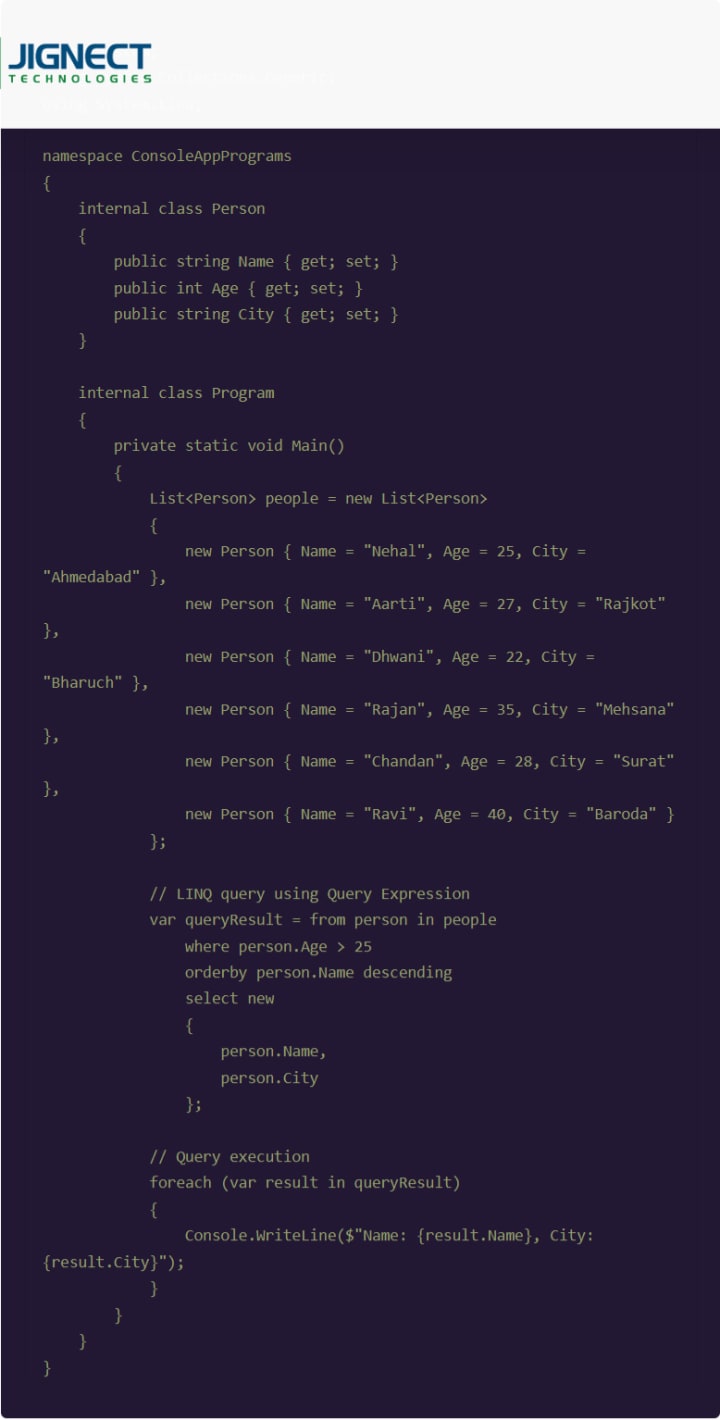
👉 Query Expressions
Query expressions are at the heart of LINQ. They allow you to express your queries in a way that closely resembles natural language. A query expression typically consists of the following parts:
From: Specifies the data source.
Where: Filters data based on a condition.
Select: Projects data into a new form.
Group By: Groups data based on a common attribute.
Order By: Sorts data in a specified order.
👉 Lambda Expressions
Lambda expressions are used in LINQ to define inline, anonymous functions. They are often employed with Where, Select, and other LINQ operators to express filtering and projection conditions succinctly.
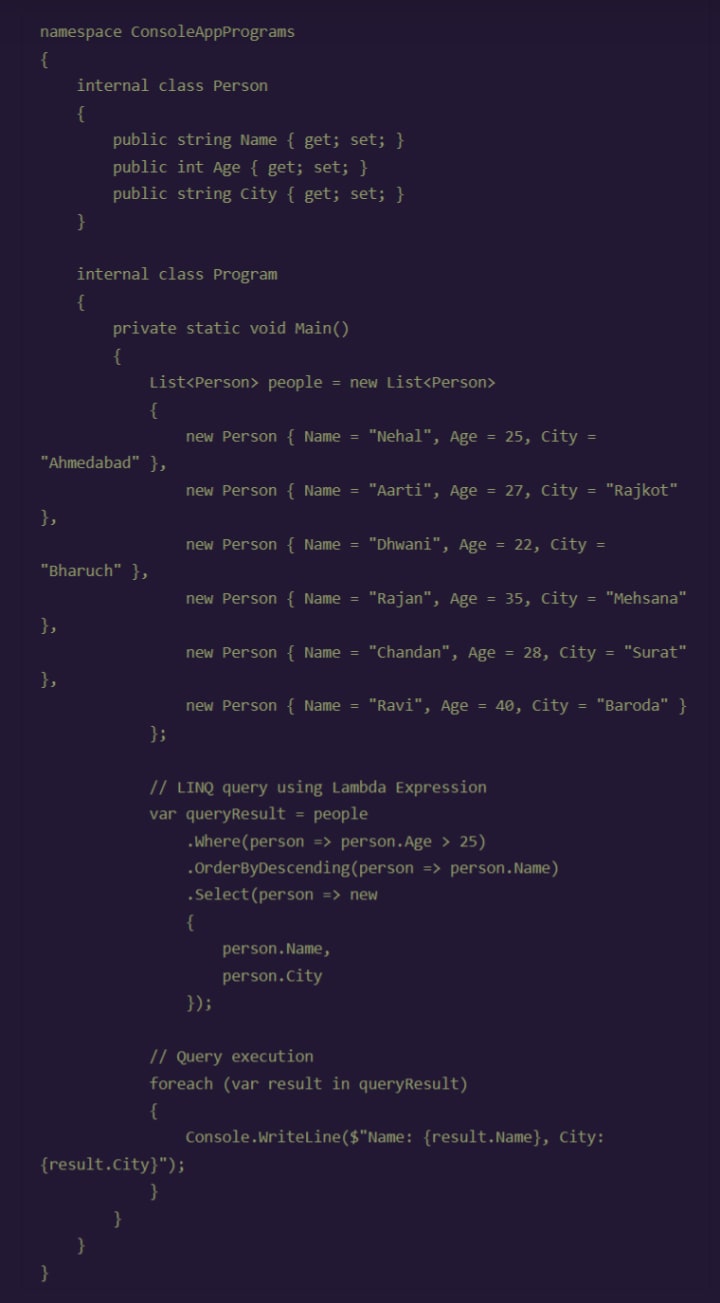
Certainly! This C# program uses LINQ to filter, order, and project data from a list of Person objects. It selects names and cities of people older than 25, orders them by name in descending order, and prints the results.
Witness how our meticulous approach and cutting-edge solutions elevated quality and performance to new heights. Begin your journey into the world of software testing excellence. To know more refer to Tools & Technologies & QA Services
If you would like to learn more about the awesome services we provide, be sure to reach out.
Happy Testing 🙂
About the Creator
Jignect Technologies
At JigNect Technologies, we believe that software testing is an art, a science, and a passion. Our team of experts combines years of experience, cutting-edge technology.
Keep reading
More stories from Jignect Technologies and writers in 01 and other communities.
Different Types of Software Testing
Software Testing & Types Software testing can be defined as one of several testing activities, along with test strategy, test deliverables, an established test aim, etc. Software testing is the process of running the software to look for vulnerabilities. Here are the two different types of software testing:
By Jignect Technologies2 years ago in 01
How to Choose a Mobile App Development Company 2026
The Google ecosystem has completed its transition from an index of pages to a comprehensive map of verified entities. This shift means the Trust Graph now dictates which development firms appear in AI Retrieval results.
By Del Rosario5 days ago in 01
Autonomy Is The Real Privilege
Good morning, freedom-seekers! Today we’re gonna be looking at autonomy. A strange word, I know; one many would probably look at blankly and run away from on sight. We’re gonna figure out what it actually means, consider how it’s achieved, and decipher just how deeply most of us are tangled up in dependence without realising it.
By That ‘Freedom’ Guy6 days ago in Humans




Comments
There are no comments for this story
Be the first to respond and start the conversation.