
Let It Snow...
But Not Before You Know These Chilling Facts!
Throwing a snowball to your friends, putting a carrot on the snow person of yours, skating, and many more, it's the snowy winter Spirit. Here's some facts about snow; surprisingly snow can come in different colors. Let's start with yellow snow. If it starts snowing when flowering trees are already in bloom, pollen is in the air too. Besides giving you allergies, it lands on snow covered surfaces.
In this scenario, snow blends with pollen which results in this suspiciously yellow shade. The snow clouds can carry sand particles too, yellowish tinged snow was seen in South Korea in March 2006.
The snow got the sand from the deserts of Northern China. Pollen is oftentimes harmless, but sand caused by yellow snow isn't that innocent, it's related to air pollution. When NASA's Aura satellite detected this phenomenon, weather officials warned the public about the potential risks of this golden snow. Sometimes the colour of the snow looks closer to Brown, not even yellow. Certain trees like Oaks carry a lot of tannins in the bark. These are organic compounds that protect the tree from harmful bacteria and funguses. These tannins can fall to the ground near the tree, for that to happen, it first needs to rain and then the rain should turn into snow. The moisture makes the tannins run down. Have you ever just laid on the fresh snow and opened your mouth to let those tiny flakes in, how safe is it to eat those flakes? Though in most cases it isn't, here's a pro tip for snow eaters; The safest way to consume snow is by choosing a clean and white layer. Get some from the freshly fallen, fluffiest part and now forget about it you never know what random show in the street may contain.
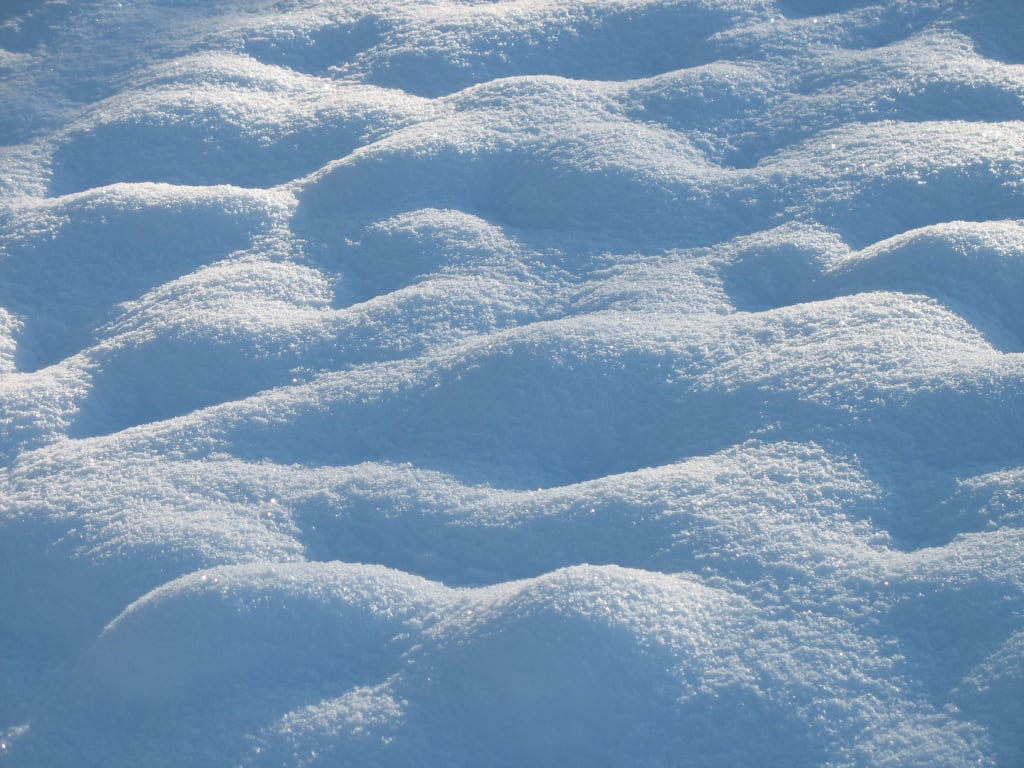
Blue tinted snow is the next one on the list. A cloudy day will create darker shadows of snow, absorbs all color wavelengths, well, almost all color wavelengths, it cannot completely absorb blue. The bottom line is that bluish snow forms due to the weather conditions. I mean the snowflakes are actually translucent since they're made up of ice crystals. These crystals reflect light, that's why in regular cases snow appears white to our eyes.
Grey and black snow also exist here. I'm not talking about melted snow mixed with dirt near the roads. The one I'm referring to is crew with a dust coming from the volcano, but it can be created with less exotic soot Ash or motor vehicle exhaust. This type of snow is dirty. It might have a dusty or oily scent if its colour comes from petrochemicals, then it's probably toxic.
The next one is watermelon snow. The name comes from the red and green color of the snow, unlike other color versions, this one has a sweet and fruity scent. Different kinds of algae and bacteria produce watermelon snow, you would be very lucky to see it because it's seen during summer in Alpine and Coastal polar regions.
The greenness comes from chlorophyll and the redness comes from aaz zanthin. This is sort of a pigment fun fact. Some animals such as flamingos, crabs and salmon also get their color from that pigment. This phenomenon is super important, ecologically when the snow melts, it mixes into the water and becomes a food source for organisms.
Snow can come in different colors but also different shapes too. An example would be snow rollers, to me it looks as if someone is dragging an ice cream scoop through the ground. They are rare phenomena because they need certain conditions to form. There should be wind but it shouldn't be too strong, typically 30 mph should do it, yet it depends on the snow too. It should be snowing and how powerful the snow falls is another issue.
Snow rollers occur in open prairies or Hills with no obstacles like boulders or trees. It's a combo of two separate layers of snow. The first layer is the pre-existing sheet that crashed on the ground. The second one is a fresh layer of fallen snow. Imagine snow running down from the top of an ice rink which doesn't hold on to what's under then the wind carries some snow that is sticky enough to hold on to the things on its way, as the roller moves, it continues growing if it's windy and there's an opportunity for rolling down a hill.
Now I want to move on to other cool facts about snow, for instance it's silence. Do you know how freshly fallen snow absorbs sound, especially if you live in a busy City? You realize it's the quieter Ambiance it literally absorbs sound waves. Think of it as a commercial sound, absorbing product things change when it melts and refreezes. Then the ice reflects sound waves, as a result, sound travels further plus it gets clearer. It's not just us enjoying the snow, apparently, some monkey species love it as much as we do. Japanese maacs or snow monkeys also make snowballs and play with them. Young maacs, especially, get attracted to snow. They steal one another's snowballs then fight to get them back. Snow blizzard, what else, I can count some words related to snow but the Inuit for example has dozens of words for snow and Scott has 421 terms related to the snow, for instance, skelf is a large Snowflake and unra means the beginning of a thaw. From one point of view, there's the cold and the risk of hypothermia. From the other point of view, animal burrows or human egloo. We associate snow with cold but it warms you up, since snow consists of above 90% trapped air it's a perfect insulator.
We talked about snow itself but what about snowflakes, the shape of a snowflake is bound to the air temperature around it. Researchers examined snowflakes and found out that long thin needle-like ice crystals form at around 28° fit. They also investigated other Ice Crystal samples taken from different temperatures. The flakes appear to be flat and platelike in lower temperatures such as 23° F.
The snowflake can also appear with six arms or a dendritic structure as ice crystals, and that again depends on the changes in the temperature surrounding each snowflake.
Maybe you heard the saying that no two snowflakes are identical. A catalogue of snowflakes supports this theory. One chemistry educator detected more than 30 different types of snowflakes. They are classified as column, plain rimmed irregular and so on the reason for all this variety is the path each snowflake makes to fall to the earth. Each one of them faces a tiny bit of different atmospheric conditions on its way to the ground. All of them have six sides that's for sure but, in 1988, a scientist found two identical snowflakes. Turns out they can be identical snow can be seen in deserts too. I know it sounds super contradictory, we're accustomed to thinking about smoking hot sand cactuses and nothingness from a desert. At first glance, in Death Valley or the Sahara Desert Snow is occasionally seen, in fact, in January 2022 some parts of the Sahara Desert got covered with a white blanket. It's not unlikely to happen all the time but it's not impossible at all. You see on some nights, the temperatures in the desert get low. Snow needs two things to form; cold temperatures and moist air. Sahara put a tick on both of these conditions.
Bonus fact, how long is the tallest snow figure? In 2008 Bethal Town residents in the US united their forces with the people of surrounding towns to break a world record. The snow person was 120 ft tall. It took them more than 1 month to finish creating the figure. The Statue of Liberty was only a few inches taller than this figure. When we see a strong snowstorm, we call it a blizzard that's not always so. You see a snowstorm should meet some qualifications to be classified as a blizzard, for instance, the wind should be at least 35 mph plus the snow must decrease the visibility to a certain mile for 3 hours at the least. Otherwise the snowfall can be named a snow squall or a snow burst.
About the Creator
Keep reading
More stories from writers in 01 and other communities.
How Chinese Crypto Marketing Agencies Drive Community Growth in 2026?
In 2026, Chinese crypto marketing agencies have become central architects of community growth across the global blockchain ecosystem. What was once a regional approach has evolved into a global strategy, with agencies in China blending deep cultural nuance with advanced technological engagement. These agencies are no longer just promoters they are builders of communities, designers of narratives, and orchestrators of long-term engagement strategies.
By Jack santoabout 14 hours ago in 01
How to Choose a Mobile App Development Company in 2026
The Google ecosystem is currently undergoing a structural realignment that fundamentally changes how mobile applications are discovered and validated. We are witnessing a tectonic movement away from traditional index-based search toward a unified Trust Graph where Entity Signals dictate market survival.
By Devin Rosario7 days ago in 01



Comments
There are no comments for this story
Be the first to respond and start the conversation.