
Key Java Concepts to Enhance Your Automation Testing Skills
Master Core Java for Reliable and Scalable Test Automation


Java is one of the most widely used programming languages, known for its versatility, platform independence, and robustness, it remains a favorite among all the developers globally. Whether you are new to programming or wishing to enhance your Java skills, then, it is imperative to understand the basic principles of Java in order to write code that is not only effective and efficient but also easy to maintain.
This blog post is intended to be your guide to learning Java. We will start with the basics of the language, and discuss data types, variables, methods, and constructors. We will then progress to the control flow constructs such as if-else statements, loops and switch cases to enable you develop the logic and the ability to repeat certain blocks of code. But we are not done yet! We will also look at some of the more advanced topics like OOP, collections, and exceptions, so you will have a full understanding of the Java development process.
By the time you finish this guide, you’ll possess a solid Java foundation and be prepared to confidently confront real-world programming obstacles. Let’s get started!
Understanding Datatypes and Variables
In Java, Data types are very important because they determine what kind of information can be stored and used. Primitive data types, such as integers, floating-point numbers, characters, and booleans, provide the foundation for representing simple values.
On the other hand, non-primitive data types, like arrays, classes, and interfaces, enable the creation of more complex structures and allow for the organisation and manipulation of larger sets of data.

A Variable is a container that holds data that can be changed during program execution.You will often define variables for WebDriver instances, element locators, or test data.
Let’s understand this with the Fibonacci series. It is a sequence of numbers where each term is the sum of the two preceding ones, beginning with 0 and 1. The pattern follows: 0, 1, 1, 2, 3, 5, 8, 13, 21, …
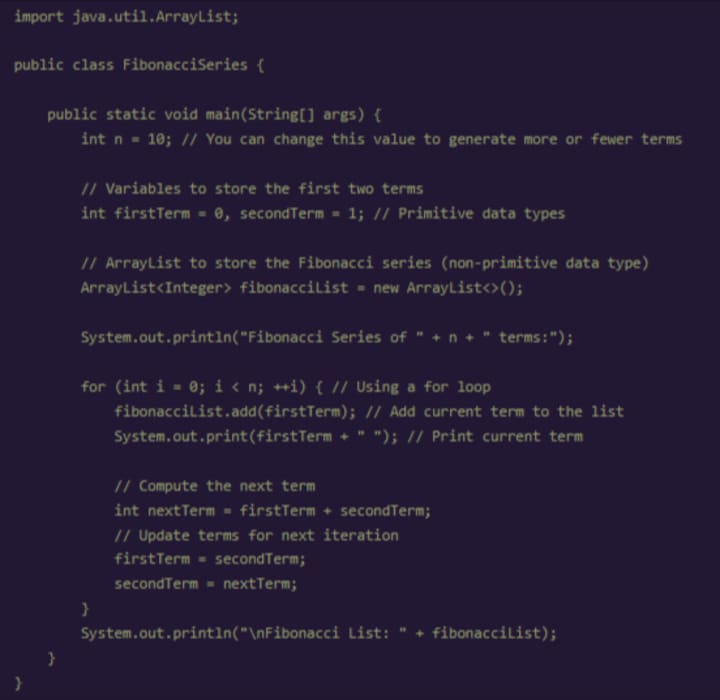
The provided Java program generates the Fibonacci series for a predefined number of terms, the variable n of int data type is set to 10 in this example. It utilizes primitive data types, specifically int, to store the first two terms of the series (0 and 1), while an ArrayList<Integer> serves as a The provided Java program generates the Fibonacci series for a predefined number of terms, the variable n of int data type is set to 10 in this example. It utilizes primitive data types, specifically int, to store the first two terms of the series (0 and 1), while an ArrayList<Integer> serves as a non-primitive data type to dynamically store the generated Fibonacci numbers.
An Overview of Methods and Constructors
Methods are essentially blocks of code that are designed to perform a specific task. A method is grouping of instructions that execute some operation and return the result. It allows us to reuse the code without writing it again.
Let’s consider the example of factorials of the number. to dynamically store the generated Fibonacci numbers.
The provided Java program generates the Fibonacci series for a predefined number of terms, the variable n of int data type is set to 10 in this example. It utilizes primitive data types, specifically int, to store the first two terms of the series (0 and 1), while an ArrayList<Integer> serves as a non-primitive data type to dynamically store the generated Fibonacci numbers.
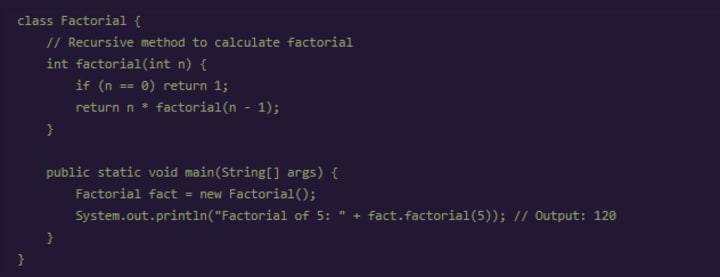
Here, a factorial method is created which returns the factorial of the given number.
This method is called from the main method of the class. Factorial method accepts integer value n and finds the factorial of n.
Constructor used to initialise the objects. Every class has at least one constructor, and if none is defined. Java compiler automatically provides a default constructor. Constructors share the same name as the class and do not have a return type.
Let’s consider an example of palindrome numbers. A palindrome number is a number that remains the same when reversed
(e.g., 121, 1331).
Read The Full Blog:-https://jignect.tech/key-java-concepts-to-enhance-your-automation-testing-skills/
About the Creator
Jignect Technologies
At JigNect Technologies, we believe that software testing is an art, a science, and a passion. Our team of experts combines years of experience, cutting-edge technology.
Keep reading
More stories from Jignect Technologies and writers in 01 and other communities.
Comprehensive Guide to Integrating Reporters in WebDriverIO
In test automation, effective reporting is as vital as the tests themselves. Without clear and actionable reports, analyzing test results and debugging issues becomes a time-consuming challenge. WebDriverIO, one of the most versatile testing frameworks, offers powerful integration options with various reporters, allowing teams to monitor, analyze, and share test execution outcomes efficiently. These reporters not only summarize test results but also provide detailed insights into failures, logs, and performance metrics, making them indispensable for modern test automation strategies.
By Jignect Technologies12 months ago in 01
Why Most Productivity Apps Fail to Improve Focus
Why Most Productivity Apps Fail to Improve Focus Productivity apps promise clarity. They offer systems, dashboards, timers, checklists, and endless customization. Yet despite their abundance, distraction remains the defining condition of modern work. This failure isn't accidental—it's a design problem rooted in many, though not all, productivity tools.
By LUCCIAN LAYTH7 days ago in 01


Comments (1)
Good to enhance my testing skills! Great work!