
Is Low-Code the Future? Get Ready with FutterFlow
Accelerate Your App Development Journey with FlutterFlow’s Low-Code Platform.

o stay ahead in business, it's important to quickly generate and develop new ideas. Low-code and no-code platforms are changing the game by making it easier for more people to create software. These platforms are growing fast and are expected to play a big role in the future of software development. Gartner predicts the low-code development platform market to reach a staggering $48.2 billion by 2025. That's explosive growth, reflecting the immense potential businesses see in low-code.
Our Co-Founder Yashesh Chauhan also added:-
“They simplify the process with low-code development, allows user to create applications with minimal coding, thus speeding up delivery and reducing costs. This popularity is growing by the need for businesses to rapidly adapt and innovate in the fast-pace and I think low-code development is a perfect technology in today fast moving world.”
The Stats Don't Lie: Low-Code is Booming
The industry is buzzing, and the numbers speak for themselves:
Business Adoption: A Kissflow study reveals that 70% of organizations are already using or plan to use low-code platforms. Companies are actively embracing this new paradigm, recognizing its value in accelerating innovation and digital transformation.
Development Speed: Low-code can cut development time by up to 10 times compared to traditional coding. This incredible speed allows businesses to bring ideas to life quicker, responding to market demands and opportunities faster.
Also read:- The Rise of Low-Code App Development in 2024
Low-code In The Current Phase
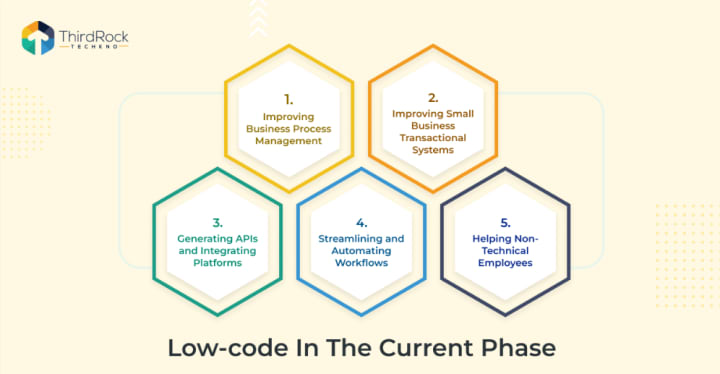
Low-code platforms are changing the way businesses operate by making software development more accessible and efficient. Here's a detailed look at how they are making an impact:
- Improving Business Process Management
Low-code platforms are transforming business process management by enabling companies to create custom applications quickly. These platforms provide tools and features that simplify the development process, allowing businesses to streamline their operations and make them more efficient. By using low-code platforms, companies can automate repetitive tasks, reduce manual errors, and improve overall productivity.
A real-world example of this is Captive Resources, one of America's largest alternative insurance firms. Using Pulpstream, they were able to transform key business processes digitally, eliminate data entry redundancies, reduce service delivery time, and build operational resilience to change — all in four months. Without a low-code platform like Pulpstream, this transformation may have taken years to achieve.
2. Improving Small Business Transactional Systems
For small businesses, low-code platforms offer a way to enhance their transactional systems without the need for extensive technical expertise. These platforms allow small businesses to easily build applications that manage sales, inventory, customer data, and other essential functions. As a result, small businesses can improve the accuracy of their transactions, gain better insights into their operations, and make more informed decisions.
A perfect example is Commerce Casino. After embedding Pulpstream's low-code automation solution, Commerce Casino saves its HR department two to three hours a day by automating digital processes so the HR team can focus on more critical tasks within the organization.
3. Generating APIs and Integrating Platforms
Low-code platforms enable businesses to generate APIs (Application Programming Interfaces) and integrate different software platforms. This integration capability allows for seamless data exchange between systems, enhancing the functionality of low-code applications.
Low-code automation tools make the work of IT and DevOps teams much lighter. These tools have visual environments and simple drag-and-drop interfaces that let regular employees, not just experts, create connections between different work applications. This helps create a smoother and more consistent workflow, making better use of the organization's resources like people, time, and money.
4. Streamlining and Automating Workflows
Low-code platforms are particularly effective in streamlining and automating workflows. By using these platforms, businesses can design workflows that automate various processes, from simple tasks like data entry to more complex operations like approvals and decision-making. This automation reduces the need for manual intervention, minimizes errors, and accelerates the completion of tasks.
For example, Robotic Process Automation (RPA) helps enterprise IT teams reach into multiple databases, information systems, and data sources to perform specific tasks on a schedule. Low-code tools, on the other hand, are simpler solutions that serve as connectors between two work applications or tasks.
Read The Full Blog:-https://www.thirdrocktechkno.com/blog/low-code-future/
About the Creator
Keep reading
More stories from thirdrocktechkno2024 and writers in 01 and other communities.
AI Strategy in 2025: 10 Ways to Implement in your Business
There is no doubt that AI will continue to be the most talked about technology in 2025. From the ed-tech to the healthcare industry, it’s only going to become more useful and integrated into our systems.
By thirdrocktechkno202411 months ago in 01
BigCommerce Theme Development: Key Features to Build a Better User Experience
Have you ever visited an online store that looked good but felt confusing to use? Pages took too long to load, navigation didn’t make sense, or the checkout felt frustrating. In most cases, the problem isn’t the product; it is the theme and how it’s built.
By Henry Davids4 days ago in 01
World War I: The War That Changed the World
The Spark That Ignited a Global Conflict World War I, also known as the Great War, began in 1914 after the assassination of Archduke Franz Ferdinand of Austria-Hungary in Sarajevo. This single event triggered a web of alliances, militarism, and nationalism that had been building across Europe for decades. What might have remained a regional conflict escalated into a global war involving more than 30 nations.
By Salaar Jamali7 days ago in 01




Comments
There are no comments for this story
Be the first to respond and start the conversation.