
Is AI Failing? A Deep Dive into the Current State of Artificial Intelligence
AI models are trained on historical data, which often reflects human biases.
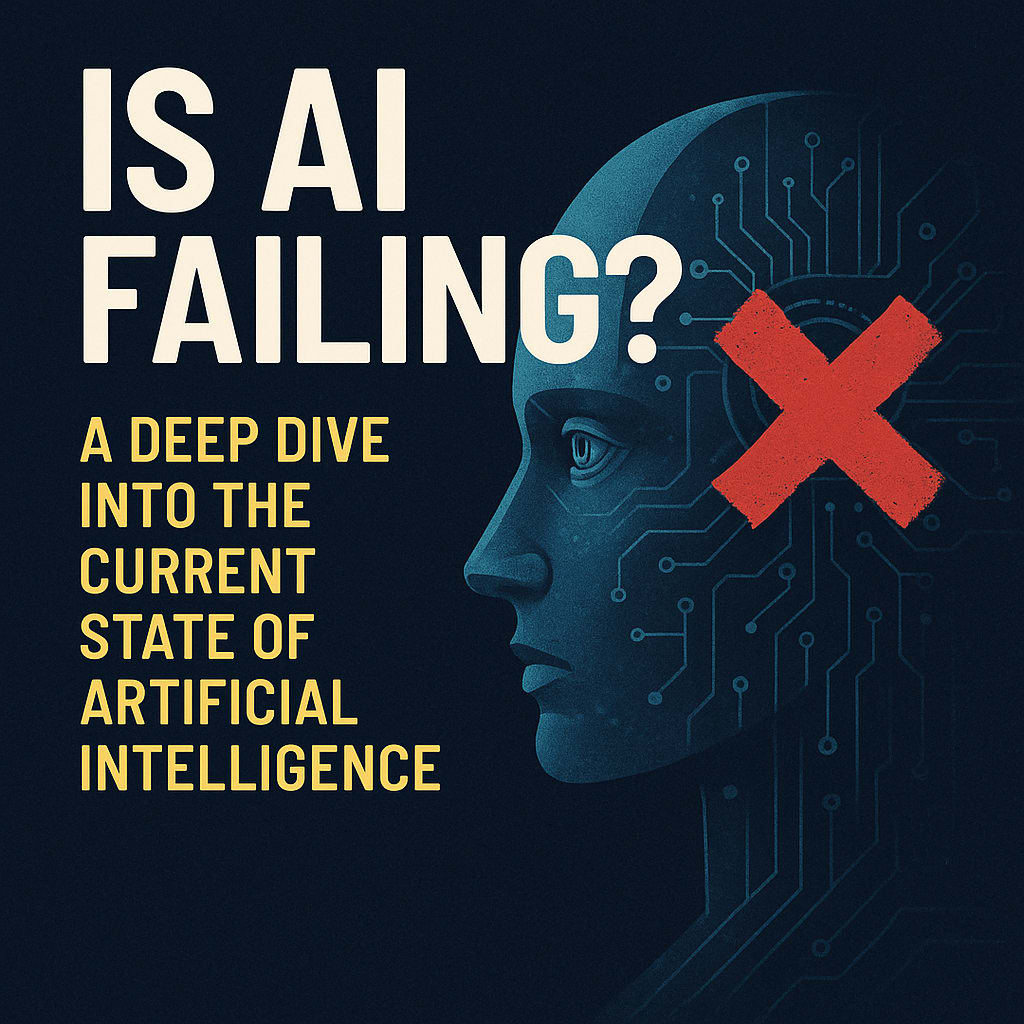
Artificial Intelligence (AI) has been hailed as one of the most revolutionary technological advancements of the 21st century. From automating mundane tasks to driving innovations in healthcare, finance, and logistics, AI is deeply embedded in modern life. But amid the excitement, a pressing question is beginning to surface more frequently: Is AI failing?
To answer this, we need to look beyond the hype and explore the current challenges, limitations, and the often-overlooked reality of AI’s development and deployment.
1. The Overpromise and Underdelivery Problem
One of the biggest issues plaguing AI today is the gap between public expectations and actual capabilities. Tech giants and media often portray AI as a near-magical solution capable of human-level reasoning, emotional understanding, and perfect accuracy. In reality, most AI models are narrow, fragile, and heavily reliant on data quantity and quality.
AI can win at chess or generate human-like text, but it still struggles with:
- Contextual understanding
- Common sense reasoning
- Emotional intelligence
- Bias and fairness in decision-making
When expectations are set too high, even modest failures seem catastrophic.
2. Bias and Ethical Failures
AI models are trained on historical data, which often reflects human biases. As a result, we’ve seen real-world examples of:
- Facial recognition systems misidentifying minorities
- Hiring algorithms discriminating against women
- Predictive policing tools unfairly targeting specific communities
These are not just technical failures—they're ethical and societal ones, eroding public trust and highlighting the urgent need for accountability and fairness.
3. Dependence on Data and Infrastructure
AI’s success hinges on massive datasets and powerful computational infrastructure. Small startups and developing nations struggle to keep up due to:
- Lack of access to quality training data
- High computing costs
- Limited access to AI research and open-source platforms
This technological divide raises the question: is AI really failing, or is it simply inaccessible to many?
4. General AI Is Still a Distant Dream
Much of the disappointment in AI comes from the confusion between narrow AI (task-specific intelligence) and general AI (human-level intelligence). Most real-world applications today fall into the narrow AI category. We’re still far from building machines that can:
- Learn new tasks as flexibly as humans
- Reason abstractly
- Exhibit true creativity or empathy
Thus, AI hasn’t failed—it’s simply not as far along as some narratives suggest.
5. Economic and Social Disruption
Another lens through which AI is seen as “failing” is its social impact. While AI promises productivity and efficiency, it also:
- Displaces jobs, especially in automation-heavy industries
- Fuels fears about surveillance and loss of privacy
- Exacerbates inequality due to uneven access and benefits
These aren't technical failures but systemic challenges that come with transformative technologies.
6. AI Isn't Failing — It’s Growing Up
Despite its flaws, AI is far from a failure. It's evolving. In many sectors, it’s already transforming processes:
- Healthcare: Detecting diseases early using image analysis
- Finance: Enhancing fraud detection and algorithmic trading
- Retail: Powering personalized recommendations and chatbots
- Agriculture: Optimizing crop yields through predictive analytics
These are tangible, real-world successes that demonstrate AI's potential when used responsibly.
7. The Road Ahead: Realignment and Responsibility
Rather than asking if AI is failing, perhaps we should ask:
- Are our expectations realistic?
- Are we aligning AI development with ethical standards?
- Are we educating users and policymakers on what AI can and cannot do?
The road to impactful, responsible AI lies not in abandoning it, but in refining it—with better governance, transparency, and collaborative development.
Final Thoughts
AI is not failing. It is misunderstood, overhyped, and at times misused. Like any powerful tool, it requires the right hands, thoughtful implementation, and constant refinement.
The journey of Artificial Intelligence is far from over. It’s not about replacing humans—it’s about augmenting human potential. Let’s judge it not by the myths we’ve built around it, but by the real value it can—and already does—deliver.
About the Creator
Why the United States Stepped Back from Confrontation with Iran: A 360° Geopolitical Analysis
Introduction In the long and turbulent history of US–Iran relations, moments of escalation have often brought the world to the brink of war. From the Iranian Revolution of 1979 to the sanctions era of the 2010s, and through the proxy conflicts simmering across Iraq, Syria, Lebanon, and Yemen, the tension between Washington and Tehran has become a defining feature of Middle Eastern geopolitics. Yet, despite decades of hostility, every cycle of confrontation has also produced unexpected decisions of restraint.
By Muhammad Islam khan swati6 days ago in 01


Comments
There are no comments for this story
Be the first to respond and start the conversation.