
Impact of Advanced Data Management Solutions on Drug Development Timelines
Impact of Advanced Data Management on Drug Development


The significant shift in drug discovery from a reductionist approach to a systemic view, has been largely driven by our ability to measure thousands, and even millions, of molecules across various modalities in biological samples. This evolution has been enabled by advancements in high-throughput technologies, such as next-generation sequencing and mass spectrometry. These advancements transformed experimental methods and transitioned from low-throughput, capturing just a few dozen data points, to large-scale, data-rich experiments conducted today.
Consequently, big data’s emergence ushered unprecedented research opportunities coupled with significant data management challenges.In response, public portals like GEO, PRIDE, and MetaboLights have offered essential platforms for researchers to deposit and share their datasets. This fosters a collaborative environment where data is accessible to all. For example, GEO guidelines like MIAME (Minimum Information About a Microarray Experiment) and MINSEQE (Minimum Information About a Next-generation Sequencing Experiment) promote data standardization and integrity, which supports the reusability of data. The research suggests that for every seventh dataset deposited in GEO, one is reused. Yet, as data volume continues to grow, there is an increasing need for data accessibility that adheres to the FAIR (Findable, Accessible, Interoperable, Reusable) principles, which ensures that data remains both easily accessible and compliant with regulatory standards.
A successful story of data management practices can be seen in The Cancer Genome Atlas (TCGA), a consortium that has generated over 2.5 petabytes of deep molecular profiling data and metadata from 11,000 patients. The management of data generated by TCGA is a public success story in molecular profiling data, advancing biological understanding and personalized medicine.
A key factor in TCGA’s success is its advanced data management infrastructure, including the Genomic Data Commons (GDC) and user-friendly portals like cBioPortal and XenaBrowser. These platforms not only provide secure data management and insightful analysis tools but also enforce controlled access. This protects patient privacy while allowing researchers to access essential information through secure applications. TCGA also exemplifies how data platforms should be organized to manage data effectively. Its approach, however, is an outlier rather than a norm. Infact, for many researchers, data still remains largely unstructured, with limited access, integration, and scalability, often equating to minimal or no formal data management at all.
Traditional model of data management poses many challenges and exhibits following common characteristics:
Data Silos: When data is scattered across separate computers or departments with no centralized access, researchers face delays and limited visibility across projects. These inevitably slow down discovery and decision-making.
Lack of Data Standardization: Inconsistent formats, units, and file structures make it nearly impossible to integrate and analyze data cohesively, often leading to time-consuming reformatting and potential misinterpretations.
Limited Scalability and Flexibility: Traditional systems struggle with large-scale data and lack adaptability. It creates issues of storage , slow processing, and acts as a barrier in adopting new technologies.
Time-Consuming Data Retrieval: Without intuitive search and retrieval options, researchers spend excessive time locating data, which reduces time available for analysis and innovation.
Poor Metadata and Documentation: Insufficient metadata limits data usability and reproducibility. In its absence, researchers face difficulties interpreting data and building upon previous work.
No Support for Advanced Analytics:.
Traditional model doesn’t support integration with AI or machine learning, which renders the application of advanced analytics difficult.
Version Control Issues: Without reliable version tracking, researchers risk using outdated or incomplete data. This is likely to cause inconsistencies and delays in collaborative projects.
Given the limitations inherent in traditional data management, it’s clear that biomedical research demands advanced solutions that go beyond traditional data handling. Data needs to be accessible, actionable and sufficient. Advanced data management solutions, therefore, are vital for growth and innovations in biomedical research. Understanding Advanced Data Management Solutions
As data grows in scale and complexity, advanced data management models offer the tools needed to make biomedical data accessible, actionable, and compliant. The solutions ensure:
User collaboration and accessibility of data and insights.
Strict data security and compliance regulations
Scalability of data, analytics and compute
Advanced analytics using standard statistical approaches and machine learning to enable deep insights and predictive modeling.
Data Integration across disparate datasets (e.g., genomics, proteomics, clinical data).
Automation for repetitive tasks (e.g., data preprocessing and analysis), It increases efficiency and reduces human error.
About the Creator
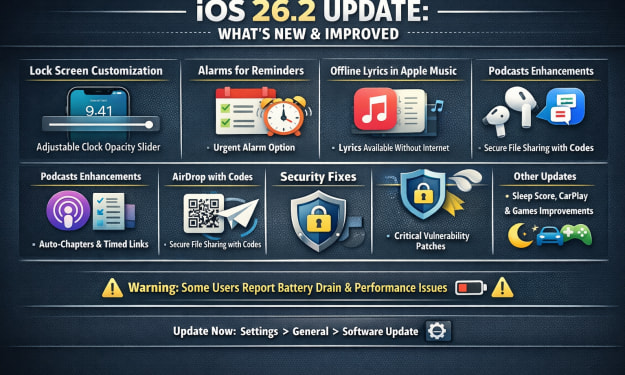
Apple iOS 26.2 Update
Apple officially released iOS 26.2 in December 2025 as a free over-the-air update for compatible iPhones (iPhone 11 and newer, plus second-generation iPhone SE). This second major point update for iOS 26 brings a mix of new features, system enhancements, customization options, security patches, and app upgrades aimed at refining the user experience following the launch of iOS 26 earlier in the year.
By USA daily update 4 days ago in 01
What Tampa Startups Learn After Shipping Their First App?
Ryan Matthews remembers the launch day clearly. The app went live. Friends shared the link. Early users signed up. A few congratulatory messages came in from investors and mentors. For a brief moment, it felt like the hardest part was over.
By Mary L. Rodriquez6 days ago in 01
One Unchecked Box
"Republished" because it was the only way to add the embed for the newly recorded audio version of this story due to the Top Story badge. Plus it serves as a nice, informal announcement of the podcast's revival for another season (go subscribe!):
By Stephen A. Roddewig5 days ago in Fiction



Comments
There are no comments for this story
Be the first to respond and start the conversation.