
How to Utilize River Stone for Sand Production: The Complete Workflow Explained
River Stone for Sand Production


The global construction industry is confronting a paradoxical crisis: a critical shortage of one of its most fundamental materials, natural sand. This scarcity, driven by over-exploitation and environmental regulations, has precipitated a search for viable, sustainable alternatives. River stone, a ubiquitous and often overlooked geological resource, presents a compelling solution. Its transformation into high-quality manufactured sand is not merely a technical process but a strategic imperative for the future of infrastructure development. The methodology for converting this robust, durable feedstock into a consistent and reliable construction aggregate involves a sophisticated, multi-stage workflow. Understanding this progression from raw cobble to refined, specification-grade sand is essential for any enterprise seeking to achieve operational independence, cost control, and environmental compliance in their material sourcing.
The Strategic Imperative of River Stone as a Raw Material
The depletion of natural sand pits and the severe ecological impact of river dredging have created an urgent need for manufactured alternatives. River stone emerges as a superior feedstock due to its inherent physical properties. Having been naturally tumbled and rounded by hydraulic action, it possesses a hard, dense structure and is typically composed of strong, silicate-based minerals like granite or basalt. These characteristics are the antithesis of the soft, weathered particles found in some desert sands, which are often unsuitable for high-strength concrete. Utilizing river stone bypasses the environmental degradation associated with traditional sand mining. More importantly, it provides a consistent, locally sourced raw material whose final quality can be precisely engineered, offering a level of control that is impossible with naturally harvested sand.
The Foundational Stage: Feedstock Preparation and Primary Crushing
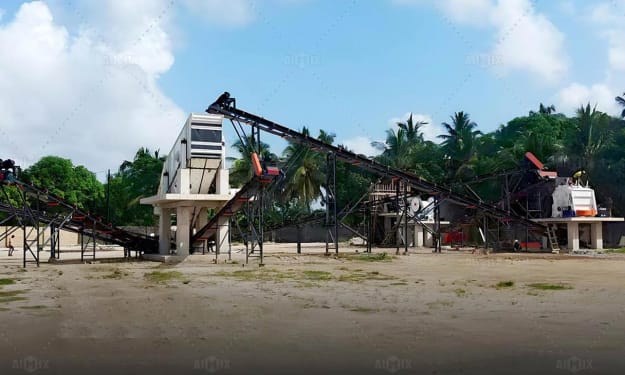
Before any size reduction can occur, the raw river stone must be meticulously prepared. This initial stage is often the most overlooked, yet it is paramount to the entire operation's success. The feedstock must be thoroughly washed to remove clay, silt, and organic contaminants that could compromise the adhesion properties of the final sand product. Following this, the larger cobbles are subjected to primary crushing, typically using a robust jaw crusher for sale. This machine acts as the workhorse of the plant, applying immense compressive force to break down the stones into a manageable, coarse aggregate, generally reducing them to a size of 150mm or less. The objective here is not to create sand, but to achieve a primary reduction that facilitates efficient processing in the subsequent stages.

The Core Transformation: Secondary Crushing and the Sand Making Process
The coarsely crushed material then enters the heart of the sand production plant: the secondary crushing circuit. Here, a cone crusher is often employed to further refine the aggregate, producing a uniformly sized feed of 40mm or smaller for the final and most critical machine. This is where the actual transformation into sand occurs, within the chamber of a Vertical Shaft Impactor (VSI) crusher - sand making machine. The VSI operates on the principle of high-velocity rock-on-rock impact. It hurls the feedstock against a cascade of other stones within a contained rotor, fracturing the particles along their natural cleavage lines. This action is instrumental in shaping the final product, as it produces the highly prized cubical grain structure that is essential for workable and high-strength concrete, as opposed to the flaky and elongated particles created by some compression-based crushers.
Refinement and Classification: Achieving Precise Sand Specifications
The output from the VSI crusher is a mixture of sand particles of various sizes, which must be meticulously refined to meet industry standards. This is accomplished through a closed-circuit system involving vibrating screens and a sand washer. The screens segregate the material by particle size, routing oversize grains back to the stone crusher machine for further processing—a feedback loop essential for efficiency. The correctly sized sand is then sent to a sand washer, which uses hydraulic action to scrub the grains and, crucially, to remove excess fines (particles smaller than 75 microns). While a certain fines content is necessary for concrete workability, an excess is detrimental to its strength and durability. This stage of gradation control is what separates a basic aggregate from a premium, specification-grade manufactured sand suitable for the most demanding construction applications.
The Operational and Economic Rationale
The decision to invest in a river stone-to-sand production workflow is justified by a powerful economic and operational rationale. While the capital expenditure for the plant is significant, it must be weighed against the escalating and volatile costs of procuring natural sand, along with the associated transportation expenses. By establishing an on-site or local production facility, operators gain unprecedented control over their supply chain, insulating themselves from market shortages and price fluctuations. The ability to consistently produce sand with optimal particle shape and controlled gradation leads to higher-quality concrete, which can reduce cement consumption and improve the durability of structures. This practice represents a forward-thinking, sustainable, and economically sound approach to securing one of the construction industry's most vital resources, transforming a common river stone into the foundation of modern infrastructure.
About the Creator
consrtuctionmachines
AIMIX is a customer-center-oriented heavy equipment manufacturer and supplier, devoted to production, innovation, combination, one-stop solution, etc.
https://aimixgroup.com/
Keep reading
More stories from consrtuctionmachines and writers in 01 and other communities.
How to Scale Your Crushing Business While Managing Stone Crusher Plant Costs
Scaling a crushing business is a complex endeavor that requires a delicate balance between ambitious growth and meticulous financial discipline. The aspiration to take on larger projects and increase market share is often tempered by the significant capital and operational expenditures associated with stone crusher plant. Success in this competitive field hinges not on simply working harder, but on working smarter, implementing strategies that enhance output and operational agility while simultaneously exercising rigorous control over costs. This involves a holistic approach, considering everything from the initial machinery investment to the nuanced management of daily operations, all with the goal of building a resilient and profitable enterprise poised for sustainable expansion.
By consrtuctionmachines4 months ago in 01
A Planetary Alignment will coincide with Mercury Retrograde
Double phenomena in the heavens Some people say in jest that the planets have aligned in their favor when life works the way they desire. Were you aware that there are seasons when things do line up in the heavens? There will be a planetary alignment AKA a planet parade, on February 28, 2026.
By Cheryl E Preston5 days ago in FYI



Comments