
How are industrial robotic arm controlled ?
industrial robot arm - Borunte

How are robotic arms are controlled? Do they need a separate CNC control? Are PLCs used to control robotic arms at all? Is the industry moving to an embedded control system at all?
how are industrial robotic arm controlled !
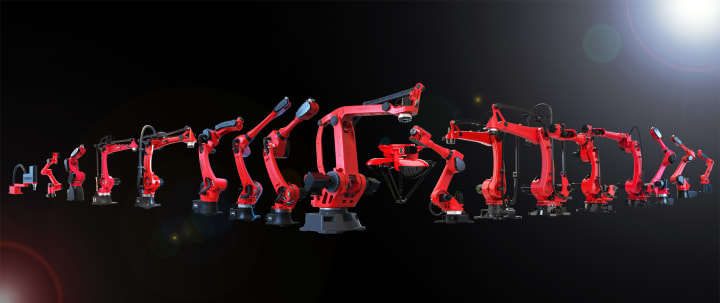
Industrial robotic arms are typically controlled using a combination of hardware and software components. The control system for industrial robotic arms consists of the following key elements:
Robot Controller: The robot controller is the central component of the control system. It is a dedicated computer or embedded system that manages the overall operation of the robotic arm. The controller is responsible for receiving commands, processing them, and generating control signals for the arm’s actuators.
Programming and Command Input: To control the robotic arm, it needs to be programmed with specific instructions. This can be done through various methods, including:
Offline Programming: Robotic arm movements and tasks are programmed using specialized software on a computer. The program is then transferred to the robot controller.
Teach Pendant Programming: Operators manually move the robotic arm through the desired motions using a teach pendant or handheld device. The positions and actions are recorded and saved as a program.
Integrated Programming: Some robotic arms offer integrated programming interfaces, allowing operators to program the arm’s movements directly through intuitive user interfaces or by physically guiding the arm through the desired path.
Sensors and Feedback: Industrial robotic arms are equipped with various sensors to provide feedback and enable precise control. These sensors include:
Encoders: Measure the position and velocity of the arm’s joints, providing feedback on their actual positions.
Force/Torque Sensors: Measure forces and torques applied by the arm’s end effector, enabling it to react to external forces or maintain a specific force during tasks.
Vision Systems: Cameras and vision sensors allow the robotic arm to perceive and interact with its environment, detect objects, and perform tasks based on visual information.
Actuators and Motors: The robotic arm’s joints are actuated using motors, such as electric servo motors or hydraulic/pneumatic actuators. The control signals generated by the robot controller are sent to these actuators, enabling precise control of the arm’s movement and positioning.
Safety Systems: Industrial robotic arms are equipped with safety systems to ensure safe operation in collaboration with human operators. These may include emergency stop buttons, safety interlocks, proximity sensors, and software features that monitor and respond to potential collisions or hazardous situations.
Communication and Integration: Industrial robotic arms often need to communicate with other systems and devices in the manufacturing environment. This can involve integration with supervisory control systems, programmable logic controllers (PLCs), human-machine interfaces (HMIs), and other automation equipment to coordinate tasks and exchange data.
By combining these elements, the control system of an industrial robotic arm enables precise and efficient operation, executing programmed tasks with speed, accuracy, and safety.
About us:

GUANGDONG BORUNTE TECHNOLOGY CO.,LTD., is the distribution and wholesale of BORUNTE industrial robots, injection molding machine robots, die-casting robots and peripheral automation equipment with professional marketing, technology and after-sales automation. At present, the company has established long-term and stable cooperative relations with many terminals and agents at home and abroad. At the same time, we are sincerely welcome you join us who would like to be our agent around the world.
About the Creator
BorunteRobots
Its main business is the distribution and wholesale of BORUNTE industrial robots, injection molding machine robots. https://industrialrobotarm.com/
Keep reading
More stories from writers in 01 and other communities.
Top 20 OnlyFans Ideas for Content, Niche, Username, and Bio
Are you looking for the best ideas for creating engaging OnlyFans content, or do you want to know the platform's top content categories? Maybe you are struggling with your OnlyFans bio and username and need some tips? No matter what the case, we are here to rescue you.
By Intelligent Creator2 days ago in 01
How Shadow APIs Are Putting Public Sector Data at Risk
Introduction – The Rise of Shadow APIs in Government Systems Government digital services increasingly rely on APIs to power citizen portals, data exchanges, mobile apps, and inter-agency integrations. While this API-driven architecture improves efficiency and accessibility, it has also introduced a silent and growing risk: shadow APIs.
By Sam Bishopa day ago in 01



Comments
There are no comments for this story
Be the first to respond and start the conversation.